


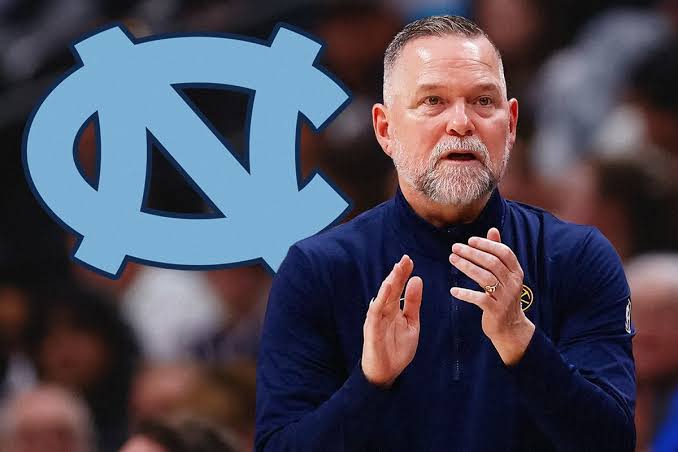
When a program as iconic as North Carolina Tar Heels men’s basketball makes a significant shift in leadership, it doesn’t just signal a change in strategy—it signals a change in identity. That’s exactly what’s unfolding in Chapel Hill as Michael Malone steps into the spotlight, bringing with him a philosophy that is already stirring excitement, curiosity, and a fair amount of debate across the college basketball world.
This isn’t just about a new coach. This is about a new tone, a new edge, and perhaps most importantly, a new standard.
And it all starts with one powerful word: toughness.
A Moment That Defined Everything
Sometimes, the essence of a new era can be captured in a single moment.
For Malone, that moment came when he shared an interaction with Tyler Hansbrough, one of the most revered figures in North Carolina history. Hansbrough, whose No. 50 jersey hangs proudly in the rafters of the Dean Smith Center, didn’t need a long speech to make his point.
He simply grabbed Malone and said:
“I know we’re gonna play hard and we’re gonna be tough.”
That statement wasn’t just a compliment—it was an expectation. A challenge. A passing of the torch.
And Malone embraced it.
Toughness as the Foundation, Not the Feature
In today’s era of highlight-driven basketball, where offensive fireworks often dominate headlines, Malone is doubling down on something that never goes out of style: physicality and grit.
But make no mistake—this isn’t just about playing hard. It’s about building a culture where toughness is non-negotiable.
Under Malone, toughness will show up in:
Every defensive possession
Every loose ball
Every rebound battle
Every moment of adversity
Players won’t just be encouraged to compete—they’ll be expected to outwork, outfight, and outlast their opponents.
For a North Carolina program known for its elegance and offensive brilliance, this represents a fascinating evolution.
Defense First: The Heart of Malone’s System
If there is one area where Malone’s influence will be immediately felt, it’s on the defensive end.
Defense, in his system, isn’t just a phase of the game—it’s the identity of the team.
Relentless On-Ball Pressure
Expect North Carolina guards to become far more aggressive at the point of attack. Ball handlers won’t be allowed to operate comfortably. Every dribble will be contested. Every move will be challenged.
This pressure forces mistakes—and mistakes lead to opportunities.
Team Defense Over Individual Talent
Malone’s philosophy emphasizes collective responsibility. It doesn’t matter how talented a player is offensively—if they can’t defend within the system, they won’t see the floor.
This means:
Crisp rotations
Constant communication
Trust in teammates
Defense becomes a shared mission, not an individual task.
Rebounding as a Statement
Rebounding under Malone isn’t just about securing the ball—it’s about sending a message.
Winning the glass means:
Limiting second-chance opportunities
Controlling tempo
Imposing physical dominance
For UNC, a program already proud of its rebounding tradition, this could become a defining strength.
Offensive Identity: Controlled, Calculated, and Dangerous
While Malone’s defensive philosophy is strict, his offensive approach is far more nuanced.
He isn’t here to strip away North Carolina’s offensive identity—he’s here to refine it.
Ball Movement and Efficiency
Isolation-heavy play will take a backseat to:
Quick, decisive passing
Smart spacing
High-percentage shot selection
The goal isn’t just to score—it’s to score efficiently.
Adapting to Personnel
One of Malone’s greatest strengths is his ability to adjust his system based on his roster.
Strong post players? Expect inside-out offense.
Elite guards? Expect pick-and-roll dominance.
Shooters? Expect spacing and perimeter emphasis.
This flexibility ensures that players are put in positions to succeed.
Transition with Discipline
North Carolina’s fast-break tradition isn’t going anywhere—but it will evolve.
Under Malone:
Fast breaks will be purposeful, not reckless
Decision-making will be prioritized
Turnovers will be minimized
The result? A transition game that is just as exciting—but far more efficient.
A Culture of Accountability
Perhaps the most significant change Malone brings isn’t tactical—it’s cultural.
At North Carolina, talent has never been the issue. But Malone’s system demands something deeper:
Accountability.
Players will be held to high standards in:
Effort
Execution
Consistency
There will be no shortcuts.
Minutes will be earned, not given. Roles will be defined by performance, not reputation.
And in that environment, only the most committed players will thrive.
The Emotional Edge: Playing With Purpose
What separates good teams from great ones isn’t just skill—it’s emotion.
Malone understands this.
His teams don’t just play—they compete with intensity, passion, and purpose.
That emotional edge shows up in:
Defensive stops that energize the team
Hustle plays that shift momentum
Resilience in close games
For UNC fans, this could bring a new level of connection to the team—a sense that every player is fully invested in every moment.
Honoring Tradition While Building Something New
North Carolina basketball isn’t just a program—it’s a legacy.
From championship banners to legendary players, the expectations are clear: win, and win the right way.
Malone isn’t here to erase that history.
He’s here to build on it.
The fast pace remains
The emphasis on fundamentals stays
The pride of wearing Carolina blue continues
But now, it’s paired with:
Defensive intensity
Physical toughness
Relentless effort
It’s not a departure—it’s an evolution.
The Tyler Hansbrough Standard
The connection to Tyler Hansbrough is more than symbolic—it’s foundational.
Hansbrough represents everything Malone wants his team to embody:
Grit
Determination
Fearlessness
Relentless energy
By aligning himself with that legacy, Malone is setting a clear expectation:
This is what it means to play for North Carolina.
Early Challenges and Long-Term Vision
No transformation happens overnight.
There will be challenges:
Players adjusting to new expectations
Learning a more demanding defensive system
Building chemistry within a new structure
But the long-term vision is undeniable.
Malone isn’t just building a team—he’s building an identity.
One that can sustain success year after year.
What This Means for the ACC and Beyond
The ripple effects of Malone’s arrival won’t be limited to Chapel Hill.
The entire ACC will feel it.
Opponents will have to prepare for:
More physical matchups
Smarter defensive schemes
A team that refuses to back down
And nationally, UNC could quickly become one of the most difficult teams to play against.
Not just because of talent—but because of mentality.
Why Fans Are So Intrigued
There’s a reason this transition has captured so much attention.
It’s not just about change—it’s about contrast.
North Carolina has long been associated with fluid offense and finesse.
Malone brings:
Structure
Discipline
Toughness
That combination creates intrigue.
Because if it works, it could elevate the program to an entirely new level.
Final Thoughts: A New Identity Is Taking Shape
As Michael Malone begins his journey with the North Carolina Tar Heels men’s basketball, one thing is already clear:
This team is going to look different.
Not just in how they play—but in how they think, compete, and respond to adversity.
The message has been set.
The standard has been defined.
And the foundation has been laid.
Play hard.
Play tough.
Earn everything.
If Malone succeeds in instilling those principles, North Carolina won’t just remain relevant.
It will become dangerous.
And maybe—just maybe—it will redefine what Tar Heel basketball looks like for a new generation.




