


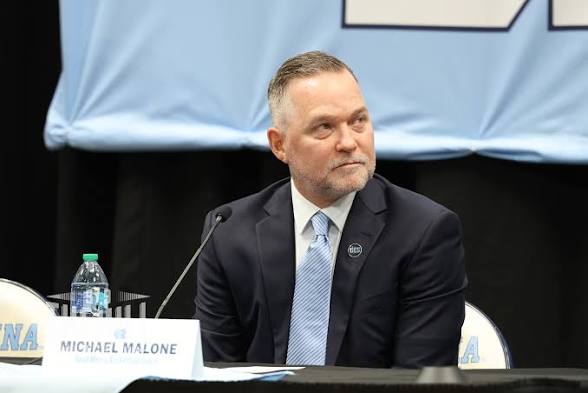
Michael Malone spent 25 years immersed in the NBA, including the final 12 as a head coach, where the game was built around established professionals, sophisticated front offices, free agency, trades and players who had already spent years developing their basketball skills.
Now, after making the jump to college basketball and taking over as the head coach at North Carolina, Malone is discovering that the job comes with a completely different set of challenges.
And there is one particular part of the college game that appears to have caught him off guard.
The rules.
According to Malone, the constant changes surrounding college athletics, particularly the transfer portal, recruiting and the evolving rules connected to the modern college basketball landscape, have made the transition considerably more complicated than he anticipated.
“What is strange about college athletics is that it seems like the rules change every day, like literally every day,” Malone said, per the Charlotte Observer.
“And so that is the hardest part. The transfer portal, recruiting, all those things, I had a good idea what that was going to entail, having been in college before going to the NBA 25 years ago. But the fact that there are rules that change every single day I think I’m speaking just for myself, for all coaches, that makes it kind of hard.”
That admission provides a fascinating look into just how dramatically college basketball has changed.
For Malone, this isn’t simply a coach learning a new system.
It is a coach returning to a level of basketball that he experienced 25 years ago and discovering that the college game he remembers bears little resemblance to the one he is now entering.
The transfer portal has transformed roster construction.
NIL and revenue-sharing developments have changed the financial landscape.
Recruiting has become a year-round operation.
And the rules governing all of it continue to evolve.
That creates a learning curve even for someone with Malone’s extensive basketball background.
The irony is that Malone arrived at North Carolina with something very few college coaches possess: decades of experience evaluating and developing professional basketball players.
He has coached some of the best players in the world.
He has competed at the highest level.
He has spent years preparing NBA players for the demands of professional basketball.
Yet now, instead of evaluating established NBA players, Malone has to retrain his eyes to evaluate teenagers who are still developing.
That may be one of the biggest adjustments of all.
“You’ve got to remember, I was in the NBA for 25 years and was a head coach for the last 12,” Malone said. “…. So, training my eyes and realizing these (possible recruiting targets) are 16-17 years old. They’re not 25-year-old NBA players with years of experience.”
That distinction is enormous.
An NBA player has already gone through years of organized basketball, strength training, professional coaching and competition against elite athletes.
A high school recruit is still a work in progress.
A player who looks dominant against high school competition may need significant development before becoming a major college contributor.
Another player might not immediately stand out physically but could possess the basketball intelligence, work ethic and developmental potential that eventually make him an elite player.
For Malone, learning to distinguish between those players requires a different evaluation process.
And that is where his NBA background becomes both an advantage and a challenge.
There is no question that North Carolina has access to some of the most talented players available.
The Tar Heels remain one of the biggest names in college basketball, and Malone is now responsible for recruiting players through multiple pathways.
That includes high school recruiting, the transfer portal and the complicated process of maintaining a roster in an era where player movement has become a central part of college basketball.
But the evaluation process cannot simply be based on what a player looks like today.
Malone has to think about what that player could become.
That requires patience.
It requires projection.
And it requires understanding that a 16- or 17-year-old prospect is nowhere near the finished product that Malone became accustomed to evaluating in the NBA.
Imagine spending years watching players like Nikola Jokic up close.
Malone coached Jokic during his time with the Denver Nuggets and experienced firsthand what it looks like when an extraordinary professional talent develops at the highest level.
That kind of experience changes the way a coach sees basketball.
But it can also make the transition to recruiting young players particularly interesting.
NBA coaches are often evaluating what a player can contribute immediately.
College coaches have to think several steps ahead.
They need to ask whether a young player can physically handle the college game.
They need to determine how quickly he can adjust.
They need to understand his personality.
They need to evaluate his ability to learn.
And they need to project how he might develop over several years.
That is a very different exercise.
And Malone appears to understand that.
The most intriguing part of his comments, however, may be his discussion of the rules.
College basketball is currently navigating one of the most significant periods of change in its history.
The transfer portal has become an essential part of roster management.
NIL has changed how players and programs approach the financial side of college athletics.
Revenue sharing is adding another major component.
And the NCAA landscape continues to evolve as administrators, coaches, athletes and schools adjust to new policies.
For a coach who spent 25 years in the NBA, that environment is naturally unfamiliar.
The NBA certainly has complicated rules.
There are salary-cap restrictions, free-agency rules, trade regulations, draft procedures and collective bargaining agreements.
But Malone knows that system.
He spent decades working within it.
College basketball is different because the rules and structures surrounding player movement and compensation have been undergoing rapid changes.
That means Malone cannot simply rely on everything he learned during his NBA career.
He has to learn again.
And perhaps that is the most fascinating part of his transition to Chapel Hill.
Malone is not pretending that his NBA experience automatically makes him an expert in every aspect of college basketball.
Instead, he is openly acknowledging that there is a learning process.
That could ultimately become one of the defining aspects of his first season at North Carolina.
The Tar Heels aren’t simply getting an NBA coach.
They are getting an NBA coach who is learning how to become a college coach in real time.
And Malone appears determined to embrace that challenge.
His basketball knowledge is unquestioned, but college basketball demands much more than X’s and O’s these days.
Recruiting relationships matter.
Roster management matters.
Player development matters.
NIL strategy matters.
Transfer-portal evaluation matters.
And understanding the ever-changing rules matters.
All of those responsibilities now fall on Malone’s shoulders.
For North Carolina fans, that makes the coming months particularly fascinating.
Malone has already demonstrated that he understands the biggest difference between his old world and his new one.
He cannot evaluate every player as if he were looking at a finished NBA product.
He has to see the teenager behind the prospect.
He has to identify potential.
He has to understand development.
And perhaps most importantly, he has to adapt to a college basketball environment that can look completely different from one year to the next.
That may be the real challenge waiting for Malone at North Carolina.
Not coaching basketball.
Not understanding the game.
Not preparing players.
But learning an ecosystem that is changing almost as quickly as the players themselves.
After 25 years in the NBA, Michael Malone has seen almost everything professional basketball can throw at a coach.
Now he has entered a college basketball world where the rules can change, the roster can change and the recruiting landscape can change seemingly overnight.
And if his first comments are any indication, even a coach with decades of NBA experience knows that Chapel Hill is going to be a very different challenge.
For North Carolina, that could make Malone’s first recruiting classes among the most fascinating storylines of his tenure.
Because now, the man who spent years evaluating professional stars has to learn how to identify the next ones before they become stars.




