


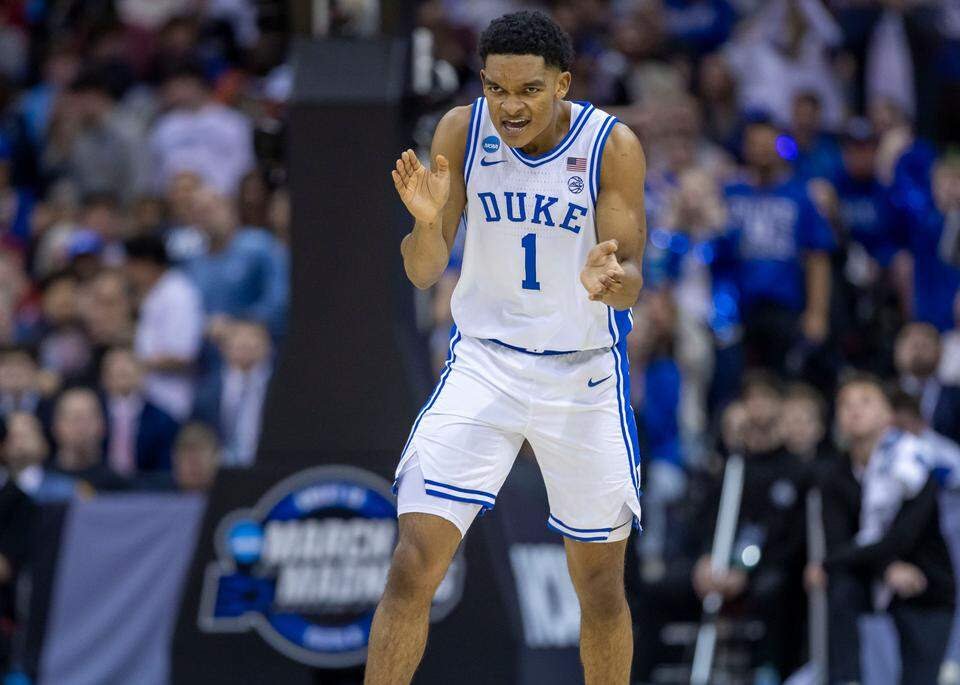
When others took the easy road, Caleb Foster chose the hard one. In an era when college basketball players jump ship at the first sign of struggle, the Duke guard stood his ground. He didn’t chase headlines or greener pastures — he chased purpose. Through injury, doubt, and frustration, Foster stayed faithful to the program he grew up admiring. Now, as he enters his junior season in Durham, his story isn’t about what went wrong — it’s about what’s finally going right.
Caleb Foster could have gone anywhere, and no one would have blinked. He grew up a Duke fan outside Charlotte, but after two topsy-turvy years at Duke, if he’d wanted a change, a fresh start, he could have had one.
As a one-time top-25 prospect with Duke pedigree, he could have called his shot in the transfer portal. There was an easy way out. He chose the harder path.
Foster is back at Duke for his junior year, competing for playing time at point guard with freshman Cayden Boozer. After two frustrating seasons — one cut short by injury, the other beset with inconsistency — Foster committed himself to changing the narrative of his career, and finishing what he started at
“We just looked at the problem,” Foster said. “Why wasn’t I playing? I mean, it’s a lot of self-reflection, a lot of self-accountability. I think there are a lot of things I have to be better at, a lot of things I control. And ultimately, I want to be here at Duke.”
In some ways, in the college basketball world of 2025, he is an anomaly. Players have never had more freedom to transfer, to change schools as they see fit. Some transfer solely for money, to be sure, but many are fleeing bad situations or looking for better ones, no longer yoked to their original program by the restrictions the NCAA refused to change until lawsuits changed them for the NCAA.
There have, obviously, been positives and negatives to that. Fans complain about the de facto free agency that this freedom of movement has created, and it’s hard to progress toward a degree at your third school in three years, but the pendulum is swinging back from another extreme, and players should long ago have had more rights than they did.
A player like Foster fit the profile of both the old-time and new-school transfer: His career at Duke had not gone as planned or expected, he was still a player of high potential, and there were certainly questions from the outside about how well his skills fit the way Duke played last season, especially once Sion James became an unexpected point guard by default.
All of that meant his decision to stay or go was never an easy one. As a freshman, he had just re-established himself in the starting lineup when a stress fracture in his right ankle gave way in February, eventually requiring surgery. He started the first seven games of his sophomore year before beginning a long, slow slide down the bench and into irrelevance.
His role and minutes declined until a home blowout of Wake Forest late last season, when he was the only Duke player who didn’t get off the bench. He had fallen out of the rotation, and Duke didn’t want to embarrass him by sending him out with the walk-ons. Players have transferred for less.
But five days later, he played a key role both defensively and as a ballhandler in Duke’s win at North Carolina, and continued to emerge throughout the ACC and NCAA tournament as an unexpected situational role player, scoring 12 points in the ACC title game win over Louisville and contributing to NCAA tournament wins over Baylor and Alabama.
If he’d been on the court at the end against Houston, after playing 13 turnover-free minutes and making a surprising impact as a rebounder … who knows what might have happened?
In the wake of all that, with a five-player freshman class coming in highlighted by the Boozer twins, Foster had a difficult decision to make. A year earlier, he watched as Duke cleaned house in the offseason, with Mark Mitchell, TJ Power and Sean Stewart all transferring elsewhere. But he chose Duke for a reason. And like another Duke player from Charlotte who chose to return, freshman Isaiah Evans, he wasn’t done yet.
“His freshman year was really good until he got injured, and now you come back as a sophomore and you think you’re going to have a breakthrough and you don’t,” Duke assistant coach Chris Carrawell said. “It’s easy now. They make it easy for you to run away, just go to the next place. Caleb Foster from Duke, he’d be a hot commodity, even after an up-and-down year.
“To his credit, he said, ‘I want to win a national championship here.’ He stated that in his recruitment and for him to stick through it says a lot about his character. He’s an old-school guy who takes the old-school approach. He doesn’t just run.”
So now Foster enters his junior season in a point-guard time-share with Boozer, the most experienced player on the team, relied upon not only for ball-handling but leadership, an opportunity he had to earn even after he decided to return.
Fully healthy this offseason, he was able to fully commit to his fitness and training, with visible results — “He looks phenomenal, man, like a gladiator,” Carrawell said, “muscles popping out his neck and everything” — while also embracing the leadership role that fell to him somewhat by default.
It may be the first thing that has gone as planned for Foster at Duke, still chasing the 18-point explosion he had to beat Michigan State at Chicago’s United Center in the third game of his career, but also making the decision to come back and chase it.
“The best thing you can ask for as a coach is knowing what you’re going to get from a guy every single day, and after what Caleb went through his first two seasons, I think the recipe is very clear to him,” Duke coach Jon Scheyer said. “It’s just a matter of going out there and doing it.”




