


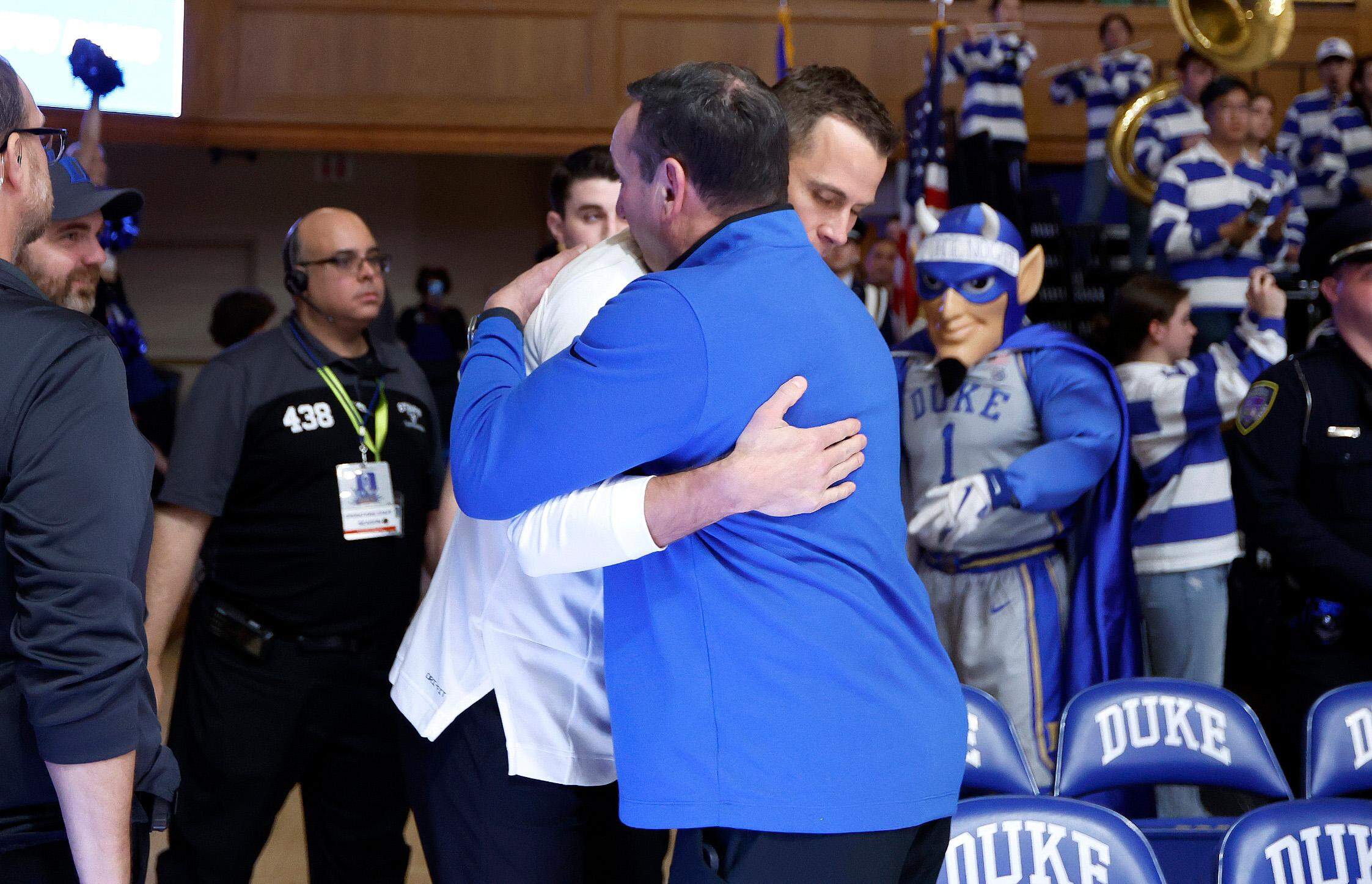
It’s not just another game on the schedule. When Duke basketball steps onto the floor at West Point this Veterans Day, it’s stepping into the heart of its own origin story — the place where discipline met destiny, and a young cadet named Mike Krzyzewski learned how to lead men long before he led Blue Devils to banners.
For nearly half a century, Duke and West Point have been linked by something deeper than a coach’s résumé — a shared spirit of structure, sacrifice, and relentless pursuit of excellence. And now, as the Blue Devils return to the very ground where their basketball philosophy was born, it feels less like a visit and more like a pilgrimage.
WHERE IT ALL BEGAN
Forty-five years ago, Mike Krzyzewski walked away from West Point as a coach for the final time. But in truth, he never left. The lessons, the values, the grit — they traveled with him to Durham, where he built one of the most disciplined and dominant programs in college basketball history.
Krzyzewski’s journey began long before Cameron Indoor roared his name. As a cadet, he learned about leadership, accountability, and loyalty — the kind of lessons that don’t fade with time. Those same traits became the foundation of Duke basketball, shaping every player who walked through its doors and every championship that followed.
So when Duke returns to West Point this week, it’s not just honoring the man who changed college basketball. It’s honoring the military code that quietly became the program’s backbone.
THE WEST POINT SPIRIT STILL LIVES IN DURHAM
Chris Spatola, ESPN broadcaster, West Point graduate, and Krzyzewski’s son-in-law, understands that bond better than most.
“Obviously, it’s sort of what birthed Coach K,” Spatola said. “The values that he conducted not just his life with, but his program, were built out of that. The tone, the way he communicated, evolved. But the values? Those never changed.”
The same spirit that drives cadets at West Point — precision, integrity, selflessness — still pulses through Duke’s locker room. Every season, Duke players make a pledge to one another: We look each other in the eye. We tell the truth. We show up on time. No excuses.
It’s a code straight out of the military handbook — and one that has turned raw talent into unified teams, time and time again.
Jon Scheyer, Krzyzewski’s successor, played under those values. Now, he coaches by them. Even without military experience, Scheyer absorbed that ethos by osmosis — learning to lead with discipline, clarity, and trust.
“Coach K taught us so much about what he learned at West Point,” Scheyer said. “Our program represents that discipline. That definitely comes from his background.”
A LEGACY OF LEADERSHIP
Army head coach Kevin Kuwik sees the same thread tying the two programs together. A former Army Reserve officer who earned a Bronze Star during his service in Iraq, Kuwik knows exactly what it means to blend basketball with military values.
“One of the things I love that Coach K says is, ‘I don’t look at myself as a coach. I look at myself as a leader,’” Kuwik said. “That’s what West Point is about — developing leaders for life, no matter what path they take. That’s why his impact resonates here so deeply.”
That leadership style, born in military halls and refined on hardwood courts, turned Duke into more than a basketball team. It became a leadership academy disguised as a sports program.
Krzyzewski’s emphasis on trust and unity mirrored the same foundation that keeps soldiers together in combat. Former Joint Chiefs of Staff Chairman Gen. Martin Dempsey put it best:
“When you’ve really distilled down what Coach K has done both at Duke and with USA Basketball, he developed an uncommon degree of trust among the athletes themselves and between the athletes and him,” Dempsey said. “That’s very much what our military is built upon. You’d never leave a base without trusting the person next to you — and he built that same trust on the court.”
That’s the military mindset, transferred seamlessly into sports — and it’s what made Duke unstoppable for decades.
SCHEYER: THE SOLDIER WHO NEVER WORE A UNIFORM
What’s most fascinating about Duke’s story is how seamlessly that military DNA transferred to Jon Scheyer — a man who never served but embodies every bit of that discipline.
Spatola once said, “There was not a player more reflective of a cadet than Jon.”
As a player, Scheyer was methodical, responsible, and always composed — qualities that made him the heart of Duke’s 2010 national championship run. When he transitioned from sharpshooter to point guard, he didn’t flinch. He adapted. He led. He inspired.
“There was a way about him that was very cadet-like,” Spatola recalled. “He followed orders. He wanted to be the translator between leadership and the team. During our championship run, I remember him saying, ‘We got this. You don’t have to lecture us today.’ That kind of accountability is rare. It’s leadership. It’s Army stuff.”
That’s exactly why the transition from Krzyzewski to Scheyer felt less like a coaching change and more like a military handover — a change of command.
Krzyzewski, the five-star general of college basketball, didn’t just retire. He passed the torch, just as a commander would to his most trusted officer. And true to form, Duke didn’t crumble after the change — it reloaded.
COMING FULL CIRCLE
Now, decades after Krzyzewski left West Point, the circle completes itself. Duke’s visit to Army this week isn’t just about honoring a legend. It’s about recognizing the shared DNA between two institutions that turned young men into leaders.
There’s already an athletic leadership award named after Krzyzewski, given annually to a coach and cadet who embody the same traits he carried from West Point to Durham — discipline, courage, and integrity. But this trip feels different. It’s emotional. It’s symbolic.
As Krzyzewski returns to where it all began, surrounded by his former players and peers, it’s impossible not to feel the magnitude. The cadet who once marched these halls went on to become the most successful college basketball coach in history — and he did it using the very principles he learned right here.
“The way I look at it,” Kuwik said, “he’s kind of the premier alum of Army basketball. We’ve had generals and great leaders, but when you talk about what he’s done for West Point — this brings his story full circle.”
THE CODE THAT NEVER FADES
Krzyzewski didn’t need to wear a uniform anymore to carry his Army lessons with him. Every practice, every speech, every timeout at Duke echoed with the discipline of a cadet and the conviction of a commander.
Even now, after his retirement, Duke basketball still breathes that same air — the spirit of West Point. The uniforms may be blue instead of camouflage, but the message remains identical:
Be accountable. Be selfless. Be strong for the person next to you.
That’s what West Point taught him. That’s what Duke still teaches today.
And as the Blue Devils step onto the hardwood at Christl Arena, they’re not just playing a basketball game. They’re honoring the code that built a dynasty — the Army inside Duke’s heart.




