


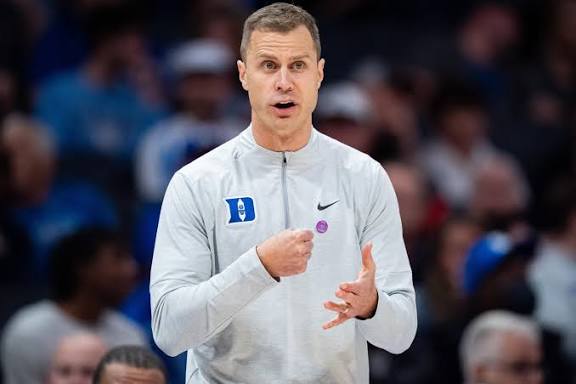
When Duke head coach Jon Scheyer sat down with reporters to discuss the upcoming 2025-26 season, few expected him to drop a piece of news that would instantly ignite debates among fans and analysts alike. Yet, amid talk of leadership, development, and team chemistry, Scheyer made a revelation that sent ripples through Blue Devil Nation — freshman Sebastian Wilkins will redshirt this season.
At first glance, it may seem like a quiet, routine roster move. But make no mistake — this decision might prove to be one of Scheyer’s smartest long-term plays since taking over the legendary program built by Mike Krzyzewski. Behind this redshirt choice lies a deeper strategy: one that could shape the future of Duke basketball far beyond the next few months.
A Bold Call from a Young Coach
Jon Scheyer is not afraid to think differently. Since inheriting the head coaching role from Coach K, he’s faced the impossible task of maintaining Duke’s elite status while building his own identity as a leader. The 2025-26 roster is stacked with talent — headline stars like Caleb Foster, Cooper Flagg, and Khaman Maluach have already captured national attention. But within that mix, Scheyer saw something special in Sebastian Wilkins — and something worth waiting for.
During a recent media availability, Scheyer explained the reasoning behind the redshirt:
“Sebastian and I have had great conversations. We’re planning on redshirting him. We really believe in his development, and saving that year of eligibility is the right thing for him.”
It wasn’t a flashy announcement. But for a freshman who came to Durham full of energy and expectations, it represents a major turning point — both for his own journey and for the way Duke continues to manage elite-level depth.
Who Is Sebastian Wilkins — and Why Does He Matter?
For fans who may not know him yet, Sebastian Wilkins is a name to remember. The 6-foot-8 forward from Georgia impressed scouts with his length, defensive instincts, and ability to finish through contact. Coming out of high school, Wilkins wasn’t as hyped as Cooper Flagg or Patrick Ngongba, but insiders around the Duke program have long praised his work ethic and upside.
Scheyer and his staff saw a player with all the tools — just not the immediate opportunity. Duke’s current frontcourt is loaded, featuring the returning experience of Mark Mitchell, the athleticism of Maluach, and the versatility of Sean Stewart. Minutes will be scarce, and the competition fierce. In such an environment, even a talented freshman could struggle to carve out meaningful playing time.
By redshirting Wilkins, Scheyer gives him the chance to develop in the shadows — to train, grow stronger, study the system, and adapt to college basketball’s physical demands without the pressure of game-day performance. It’s a move that could pay massive dividends later, especially as Duke prepares for roster turnover after inevitable NBA departures.
A Strategic Move in the Era of One-and-Done
In today’s college basketball landscape, patience is rare. The transfer portal spins faster than ever, and players often leave after a single season — whether for professional opportunities or new schools promising bigger roles. But Scheyer’s decision suggests a shift in Duke’s philosophy: a return to building multi-year contributors.
By encouraging Wilkins to redshirt, Scheyer effectively invests in the future. The freshman will keep four full years of eligibility, meaning that by the 2026-27 season, he could step in as a battle-tested sophomore ready to lead a younger class.
It’s a long play — and one that reflects Scheyer’s growing confidence as a program builder. He isn’t just managing stars; he’s constructing a system where every player fits into a long-term vision. It’s the kind of forward thinking that sustained Duke’s dominance for decades — and now, it’s being rewritten under Scheyer’s leadership.
Inside the Redshirt Year: What It Really Means
A redshirt season isn’t a sabbatical. In fact, for many players, it’s one of the most transformative years of their college careers.
For Wilkins, this means a daily grind behind the scenes — early-morning workouts, strength and conditioning sessions, defensive drills, film study, and mentorship under the coaching staff. He’ll be learning from some of the best in the country, without the burden of having to perform immediately.
Scheyer’s staff is known for its development-first mindset, and Wilkins fits perfectly into that framework. Assistant coaches Chris Caro and Amile Jefferson have built reputations for molding players from raw talent into polished, confident contributors. Their fingerprints can already be seen in the growth of players like Tyrese Proctor and Caleb Foster.
This year, those same developmental eyes will be locked on Wilkins — not for highlights, but for habits. And when he finally debuts, Duke fans may see not just another player, but the product of an elite, patient program.
Fan Reaction: Surprise, Curiosity, and Excitement
The moment the news broke, Duke’s fanbase was buzzing. Social media filled with mixed reactions — some surprised, others supportive, but nearly all intrigued. Many pointed out that redshirting is rare for Duke freshmen, who often either play immediately or transfer elsewhere if they’re buried on the bench.
But the underlying sentiment was largely positive. Fans recognize the potential for long-term success. One post read, “Smart move by Scheyer — we’ll get an older, stronger, more experienced Wilkins when we really need him.” Another added, “He’s got too much upside to waste a year sitting behind three NBA-bound forwards. Let him grow.”
The curiosity isn’t just about Wilkins himself — it’s about what this says about the program’s direction. Is Duke pivoting toward sustainable depth and multi-year stability rather than chasing one-year glory? If so, this could mark the start of a new identity for the Blue Devils.
The Bigger Picture: Scheyer’s Vision for a Dynasty
Jon Scheyer has made it clear: he wants Duke to remain not just relevant, but dominant — year after year. And that requires more than recruiting top-10 prospects. It requires balance, foresight, and a willingness to delay gratification for greater rewards.
By redshirting Wilkins, Scheyer demonstrates a leadership style that values growth over instant payoff. He’s building a culture where development is just as celebrated as draft stock — and where players can thrive over multiple seasons instead of being pressured into early exits.
In that sense, Wilkins’ redshirt season isn’t a detour. It’s a cornerstone — one that could help stabilize Duke’s future as it transitions into the next era of college basketball.
Looking Ahead: What to Expect from Wilkins’ Return
When Wilkins finally takes the court — whether that’s next season or beyond — he’ll bring with him a full year of behind-the-scenes preparation. Expect a stronger frame, sharper instincts, and an understanding of Duke’s schemes that most true freshmen can’t match.
By that time, the Blue Devils may look entirely different. Some current stars could be in the NBA, others in the portal — but Wilkins will be ready to step into a leadership role from day one. That’s the payoff Scheyer is counting on: a player who’s been molded, mentored, and motivated the Duke way.
And if the gamble pays off? This move could be remembered as the moment Scheyer quietly laid the foundation for his own dynasty.
Final Take: A Quiet Decision with Loud Potential
Jon Scheyer’s decision to redshirt Sebastian Wilkins isn’t about the 2025-26 season — it’s about every season after that. It’s about patience in a sport that rarely rewards it, and about vision in a landscape obsessed with immediacy.
So while Duke fans won’t see Wilkins in uniform this winter, they should take comfort in this: Scheyer isn’t just coaching for today. He’s planning for tomorrow — and the day after that.
And if history tells us anything about Duke basketball, the quietest moves often lead to the loudest triumphs.




