


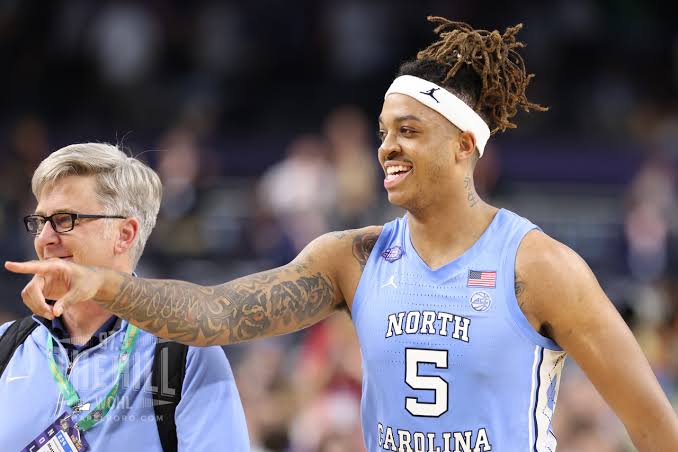
When Armando Bacot walked off the court after North Carolina’s convincing win over Michigan State, he expected his phone to buzz with the usual messages — celebrations, congratulations, and maybe a few jokes from friends. Instead, he opened his DMs to a flood of over a hundred angry strangers demanding answers, criticizing his performance, and lashing out over something that had nothing to do with the Tar Heels’ victory. Their frustration wasn’t about the scoreboard or the team’s strategy — it was about money they lost on prop bets. And suddenly, a college basketball star found himself at the center of a growing national crisis in sports.
Armando Bacot has been in the spotlight for years — a double-double machine, a veteran leader, a beloved Tar Heel whose name resonates across Chapel Hill and beyond. But even as one of the most respected players in college basketball, Bacot says nothing prepared him for the wave of anger that hit his phone after UNC’s NCAA Tournament win over Michigan State.
Speaking to reporters earlier this week, the fifth-year senior revealed that he received over 100 direct messages — not from fans celebrating the Tar Heels’ victory, but from bettors furious that he failed to hit their predicted rebound totals.
“It’s terrible,” Bacot said, according to the Tar Hill Tribune. “I guess I didn’t get enough rebounds or something. I thought I played pretty good last game, but I looked at my DMs, and I got, like, over 100 messages from people telling me I sucked and stuff like that because I didn’t get enough rebounds.”
The honesty in his voice struck a chord across the college basketball world. What was supposed to be a joyful moment of advancement in the NCAA Tournament became overshadowed by harassment, insults, and a public reminder of how deeply sports betting has penetrated the college game — for better or worse.
A Victory Overshadowed by Vitriol
UNC’s 85–69 win over No. 9 Michigan State wasn’t a nail-biter. The Tar Heels dominated the Spartans with a balanced attack, physical defense, and veteran composure that has defined their postseason identity. Bacot finished with 17 points, seven rebounds, and hit an unexpected five three-pointers — a performance most would describe as outstanding.
But not everyone viewed it that way.
In the age of legalized sports gambling, where every rebound, assist, foul, and turnover can instantly make or break a parlay, some fans have grown to see athletes through the lens of cash rather than competition. And when a player misses their prop line by one stat — even if their team won by double digits — the anger gets personal.
That’s exactly what happened to Bacot.
“I think it’s definitely a little out of hand,” he admitted. “But at the same time, too, I get the point of it too. Like, if you bet a lot of money on something, and you’re, like, one pick away and somebody messes it up, I understand the part of fans being mad. But it’s annoying, too, at times.”
“Annoying” might be an understatement. For a student-athlete balancing academics, practice schedules, national expectations, and personal pressure, the last thing anyone should have to handle is a barrage of hate from anonymous gamblers.
Yet Bacot is far from the only college athlete facing it.
The NCAA’s Growing Concern — and a Possible Solution
The college sports landscape has transformed dramatically since the U.S. Supreme Court legalized sports betting in 2018. Once taboo, gambling has become a normalized part of the viewing experience, with commercials, odds, and parlay promotions appearing everywhere — during broadcasts, on social media, and even inside arenas.
But now, the NCAA says it’s fighting back.
On Wednesday, NCAA President Charlie Baker released a strong statement condemning the rise of prop bets in college athletics, calling them a threat to competition, athlete mental health, and the integrity of the sport.
“Sports betting issues are on the rise across the country with prop bets continuing to threaten the integrity of competition and leading to student-athletes getting harassed,” Baker wrote. “The NCAA has been working with states to deal with these threats, and many are responding by banning college prop bets.”
This marks one of the NCAA’s clearest and most forceful stances on gambling to date.
Why prop bets specifically?
Because unlike traditional wagers — like moneylines or point spreads — prop bets are entirely focused on an individual athlete’s performance.
How many rebounds will Armando Bacot get?
How many threes will a player hit?
Will someone reach 20 points?
When numbers don’t add up, bettors blame players directly. And when those players are college students, many of whom are 18–22 years old, the consequences can be severe.
Multiple states — including Ohio, Vermont, and Louisiana — have already banned college player prop betting. More may follow as stories like Bacot’s become increasingly common.
A Crossroads for College Sports
What makes Bacot’s situation so striking is that he’s one of the most accomplished and well-respected players in the nation. A veteran presence, a team-first leader, and someone who has given everything to UNC basketball.
If someone like him is facing harassment, what does that mean for freshmen, role players, or athletes at smaller schools?
The NCAA is worried — and with good reason.
1. Player safety and mental health
College athletes already deal with academic stress, pressure to perform, and the challenges of living under national scrutiny. Adding gambling-driven harassment only compounds that.
2. Fear of match-fixing pressures
If bettors start contacting players directly, what stops someone from applying pressure to influence outcomes? Even subtle suggestions can be dangerous.
3. The culture shift around college sports
Where fans once rooted for teams, many now root for numbers.
Where athletes were once beloved and protected, some are now treated like tools for profit.
It’s a radical shift that college sports is trying to manage in real time — with no roadmap.
Bacot Balances Empathy With Frustration
One of the most fascinating parts of Bacot’s comments was his surprising empathy for bettors. Even after receiving over 100 insulting messages, he acknowledged that he understands why people get upset.
“If you bet a lot of money on something… I get it,” he said.
“But it’s annoying.”
In those few words, Bacot illustrates the complicated reality athletes live in:
They understand fans want entertainment.
They understand people put money on the game.
They understand they are part of a larger sports economy.
But they also know that they are human — not robots programmed to meet statistical goals.
The empathy is admirable. The mental toughness is impressive. But it shouldn’t be necessary.
The Larger Trend: When Sports Betting Becomes Too Personal
Bacot’s experience isn’t isolated. Across the country, athletes in basketball, football, baseball, and even women’s sports have reported harassment tied to prop bets.
Some players receive threats.
Some get racial slurs.
Some are pressured to “play better next time” for bettors.
Some are accused of losing games on purpose.
And in an era where athletes are more accessible than ever through social media, the direct line between fan and player has never been easier to cross.
The NBA Example
The NCAA isn’t the only league dealing with this issue.
The NBA confirmed to ESPN this week that it is investigating prop bets involving Toronto Raptors player Jontay Porter, raising further alarm about the potential for manipulation.
When pro leagues with million-dollar contracts and advanced integrity systems are struggling to manage betting, what chance do college programs have?
UNC’s Calm Amid Chaos
Despite the storm outside, the Tar Heels remain focused on their NCAA Tournament run. They prepare to face Alabama at Crypto.com Arena in Los Angeles — a matchup loaded with intrigue, pace, and star power.
For Bacot, the mission is singular: win games.
He’s a senior.
He’s a leader.
He’s chasing a national championship.
His story — as stressful as it is — should serve as a wake-up call, not a distraction.
A Crisis That Exposes the Price of Modern Sports
Sports wagering is here to stay. That much is clear.
But Bacot’s experience highlights a harsh truth:
The same innovation that brought excitement, money, and attention to college sports has also introduced a wave of toxicity that athletes never asked for.
Student-athletes are not betting machines.
They are not parlay pieces.
They are not responsible for someone’s $20 flutter or $500 wager.
But because prop betting turns individuals into commodities, players like Bacot are becoming targets — not of rivalry, but of rage.
The Path Forward
The NCAA’s push to ban prop bets on college athletes is gaining momentum.
And based on stories like Bacot’s, it’s not hard to see why.
Possible solutions include:
Statewide bans on college player prop betting
Enhanced integrity monitoring and social media protection for athletes
Educational programs for fans and gamblers
Stronger punishment for harassing or contacting student-athletes
Mental health support systems within athletic departments
But the reality is this: the culture around sports betting must shift. Fans need to remember the line between fandom and fixation — between entertainment and entitlement.
Armando Bacot’s Voice Matters
For years, Bacot has been a cornerstone of UNC basketball.
Now, he has unexpectedly become a voice for a national discussion.
His willingness to speak out — not in anger, but with honesty and clarity — may influence how fans, leagues, and lawmakers address the issue.
“I thought I played pretty good,” Bacot said with a shrug.
He did.
The problem isn’t his performance.
It’s the expectations placed on his shoulders by people whose only connection to him is a lost bet.
Conclusion: The Line Has Been Crossed — Now It Must Be Redrawn
Armando Bacot didn’t ask to become the face of this issue.
He didn’t ask for the spotlight or the backlash.
He certainly didn’t ask to open Instagram and find strangers telling him he “sucked” because he grabbed seven rebounds instead of nine.
But his experience has done something important:
It exposed the reality that college sports and sports betting are colliding in ways that harm the athletes at the center of it all.
As UNC continues its postseason journey, Bacot’s message lingers:
Sports betting may be part of the game now — but harassment should never be.




