


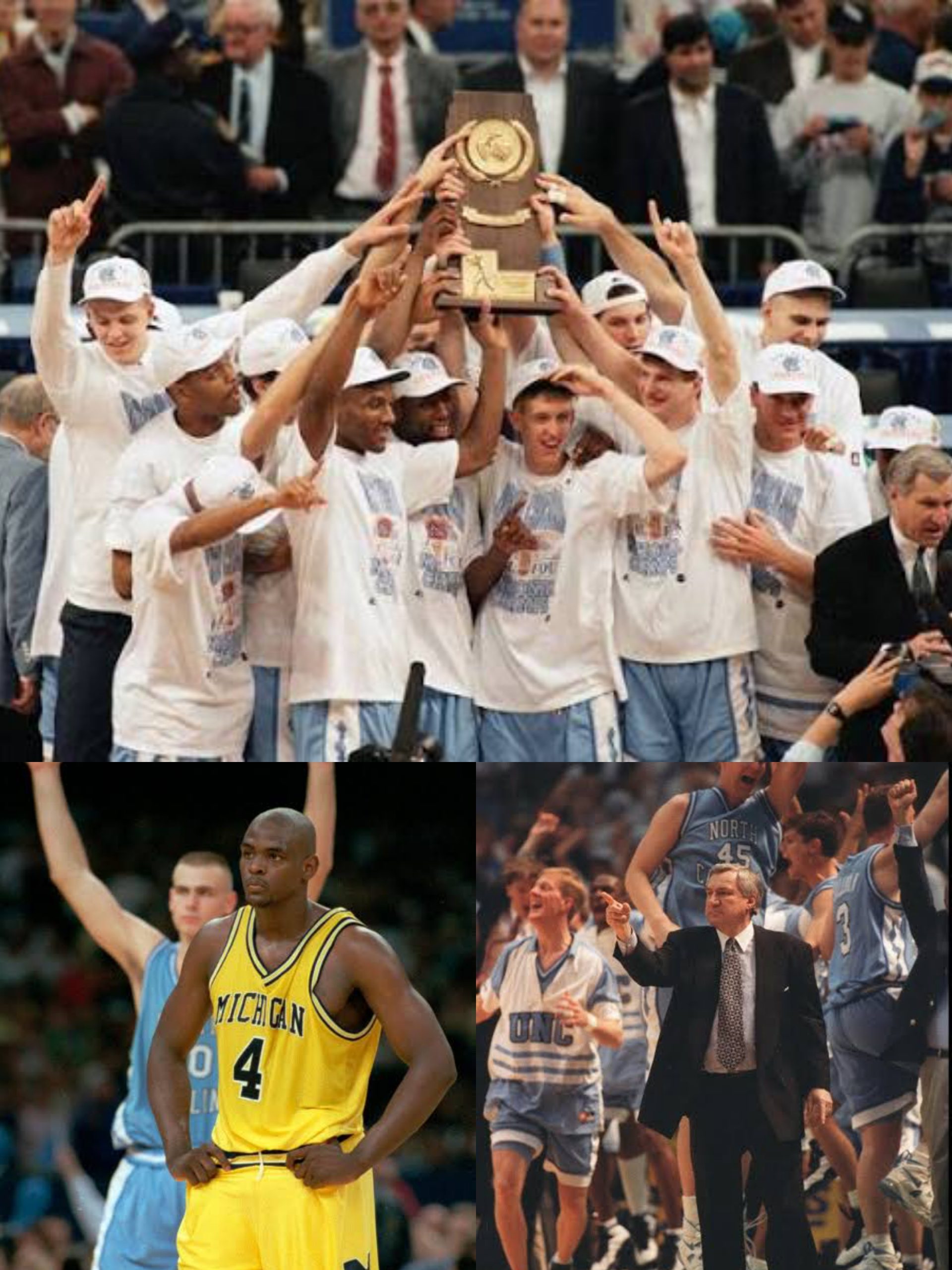
THE UNTHINKABLE GIFT: The Play Everyone Thinks They Remember—But Got Wrong: Why the Ending of UNC vs. Michigan in 1993 Is Back Under the Microscope. North Carolina Was 11 Seconds From Overtime Until One Star’s Unspoken Mistake Handed Dean Smith The Most… Was It Panic… Or Something Else? A New Look at the Blunder That Changed College Basketball Forever
NEW ORLEANS — For more than 30 years, the story has been repeated so often that it hardened into myth: North Carolina defeated Michigan in the 1993 National Championship because Chris Webber called for a timeout he didn’t have. The images are iconic. The soundbites are eternal. And the words “Webber called the timeout” have become one of the most replayed sentences in March Madness history.
But what if everyone has remembered it wrong?
What if the play that won Dean Smith his second national title didn’t begin with Webber’s fatal gesture…
but with something far more subtle—and far more overlooked?
A small, unspoken mistake that set off a chain reaction.
A decision made three seconds too late.
A missed opportunity that could have sent the game to overtime instead of ending it.
Now, as the 1993 title game resurfaces in documentaries and new interviews, the final 11 seconds are being re-examined with sharper detail than ever before. Historians, former players, and coaches are piecing together a final sequence that may not match the version of events fans have carried for decades.
And the conclusion is startling:
UNC was seconds from losing control of the game—until Michigan gave them the very gift they needed.
Not because of panic alone…
but because of something much deeper.
THE FINAL SEQUENCE: WHAT REALLY HAPPENED BEFORE THE TIMEOUT
The widely accepted memory goes like this:
Chris Webber grabbed the rebound, dribbled up the floor, got trapped, panicked, called timeout, Michigan didn’t have one, UNC got a technical, game over.
It’s clean. It’s simple. It’s cinematic.
It’s also incomplete.
When analysts revisited the full possession this year, frame-by-frame, they uncovered a key moment that almost no one ever talks about:
Michigan had a chance to reset. Chris Webber didn’t take it.
After securing the rebound off a missed UNC free throw, Webber clearly traveled. Officials missed it—one of the great “what ifs” in championship history. But what followed is even more fascinating: Webber looked toward the Michigan bench, where several coaches frantically attempted to signal instructions.
He didn’t see them.
Or he saw them too late.
Instead of handing the ball to a guard or slowing the possession, Webber took off down the sideline. A 6’10” power forward leading a full-speed transition in the national title game with 11 seconds remaining was not the design. Not by the coaches. Not by the players. Not by anyone.
Michigan’s backcourt shouted for the ball.
Webber kept dribbling.
By the time he crossed half court, UNC defenders saw the mismatch instantly. They trapped him—with the sideline acting as a third defender.
This trap is where most memories begin.
But the real story begins with that missed reset.
“If he stops, we run a play. We get a shot,” one former Michigan player said in a new interview.
Instead, the trap led to the moment that made basketball history.
THE UNSPOKEN MISTAKE — AND WHY IT MATTERS
Why didn’t Webber slow the possession down?
Why didn’t he pass?
Revisiting the footage and interviews paints a clearer picture:
1. He didn’t know how many timeouts Michigan had left.
Teammates have admitted the confusion lingered from earlier in the half.
2. The crowd noise at the Superdome was deafening.
Bench instructions were nearly impossible to hear.
3. His adrenaline spiked after escaping a non-called travel.
Players have said this moment changed the rhythm of the possession.
4. And perhaps most importantly—Webber was not the primary ball-handler.
This was not his responsibility. Not his comfort zone.
Because of these factors, the final seconds were not merely panic.
They were a collapse of communication in the most chaotic environment imaginable.
UNC’S ROLE: THE TRAP THAT BROKE THE GAME
Lost in the legend is what UNC actually did.
Dean Smith’s defense recognized the mistake instantly.
They didn’t just trap Webber—they weaponized the sideline, forcing him into the one corner where his only options were:
• turn the ball over,
• step out of bounds, or
• call a timeout.
They pushed him toward the inevitable.
“We knew they didn’t have one,” a UNC player said years later.
Think about that.
UNC’s defenders had more clarity about Michigan’s timeout situation than Michigan’s own star did.
What looks, in hindsight, like a single catastrophic decision was really the final snap in a defensive trap that worked exactly as Smith designed.
THE MOMENT EVERYONE REMEMBERS — BUT NO ONE TRULY UNDERSTANDS
At 11 seconds remaining, Webber raised his hands and shouted the word that would haunt him for decades:
“Timeout!”
A referee blew the whistle.
Michigan’s bench froze.
UNC’s bench exploded.
Technical foul.
Two UNC free throws.
Possession.
Championship.
But here is the twist:
UNC was not leading comfortably.
They were up two when everything began.
A clean Michigan possession likely sends the game to overtime—or wins it outright.
This was not a foregone conclusion.
This was a razor’s-edge contest.
And the timeout wasn’t the beginning of the collapse.
It was the end of it.
THE AFTERMATH: A MOMENT THAT NEVER STOPPED FOLLOWING WEBBER
For years, Webber avoided interviews about the game.
It wasn’t the loss—it was the narrative.
The narrative that he “panicked.”
The narrative that he “lost track of the moment.”
The narrative that the play was his fault alone.
But the re-examination suggests otherwise:
Michigan’s bench confusion.
The missed travel.
The decision to push in transition.
The UNC trap.
The sideline angle.
The deafening arena.
The mismatch in ball-handling.
All of these factors collided in a perfect storm that remains one of the most analyzed endings in tournament history.
WHY THE PLAY IS BACK IN THE SPOTLIGHT NOW
What sparked the renewed attention?
A new documentary featuring previously unreleased audio from Michigan’s bench.
New interviews with UNC players who detail the trap’s design.
And fresh analysis revealing five small mistakes—not one—that shaped the final sequence.
This was not panic.
It was pressure, physics, coaching, environment, and miscommunication colliding all at once.
And now, experts agree:
The ending of the 1993 title game wasn’t the biggest blunder in March Madness history…
It was the most misunderstood.
THE REAL GIFT: HOW UNC BENEFITED
Dean Smith received his second national title not because Michigan collapsed, but because his players recognized a moment of chaos and seized it.
The trap was perfect.
The awareness was perfect.
The timing was perfect.
A “gift” that UNC created—not one that simply fell into Smith’s hands.
The game was heading toward overtime.
Instead, it ended with a whistle that will echo forever.




