


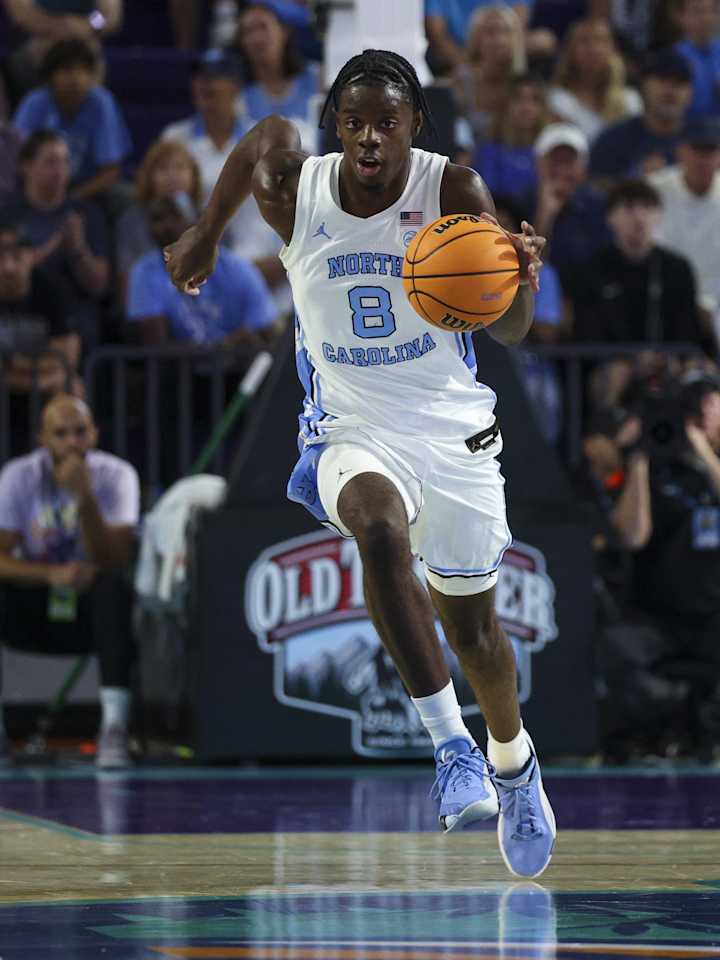
When North Carolina head coach Hubert Davis speaks publicly about one of his players, people listen. When he singles out a freshman—especially one carrying the weight of Chapel Hill’s expectations—people start asking deeper questions. And when that freshman is Caleb Wilson, a 6-foot-9, 216-pound revelation who has quickly become one of the most productive newcomers in college basketball, curiosity naturally skyrockets.
This week, Davis’ comments about Wilson in his Monday press conference ignited exactly that type of reaction. Not panic. Not hype. Something deeper. Something that made Tar Heel fans tilt their heads and wonder:
What exactly did Hubert Davis see in this young star that has him speaking with this level of conviction?
Because the tone wasn’t casual. It wasn’t simply a coach praising a player who scored a lot of points. Davis sounded like a coach who sees something unfolding—something bigger than the box score, bigger than the highlights, bigger even than Wilson’s already impressive freshman-year stat line.
Wilson currently leads the Tar Heels in both scoring (19.9 points per game) and rebounding (9.9 per game). He’s efficient, he’s aggressive, and he has shown a complete understanding of how to impact a game in ways numbers don’t always capture. But for Davis, the real story isn’t simply how good Wilson is. It’s how quickly he’s adapting to pressure he has never seen before.
And the head coach made that clear immediately.
A Freshman Learning the Hard Stuff Faster Than Expected
When asked about how opponents have been defending his star freshman, Davis didn’t hesitate.
“It’s definitely changed throughout each game,” he said. “The first time that he was doubled was against St. Bonaventure. And then obviously Michigan State was loaded towards him when he was trying to attack the basket. He was still able to get there pretty much as well.”
Most freshmen hit a wall when the scouting report changes. They get flustered when double-teams arrive earlier. They rush. They force shots. They start pressing because the game suddenly feels harder than it looked on film.
But Wilson? Davis made it clear he was different.
The coach praised not just Wilson’s ability to score through defensive pressure, but how he has learned to manipulate defenses—a trait normally reserved for polished upperclassmen or future pros.
“Caleb adjusting to that and understanding opportunities for him to score, but also to get two on the ball and be able to facilitate and hit open teammates,” Davis continued. “The great thing about Caleb is, yeah, he can score, but he’s also a gifted passer and a willing passer as well. So that’s good for us.”
That statement might have sounded simple. But in Chapel Hill, it carried weight.
Because Hubert Davis wasn’t just saying Caleb Wilson is a talented scorer. He was saying Wilson is already learning how to bend defenses to his will. That is the difference between a good college player and a future NBA star. And Davis knows exactly what that looks like—he’s coached plenty of elite talents.
Is Wilson Feeling the Pressure? Davis Answers Quickly
One of the few concerns surrounding Wilson this season has been the potential for him to feel too much responsibility. UNC’s offense has sputtered at stretches this year, making it tempting for a player of Wilson’s caliber to try to do everything—sometimes to the team’s detriment.
So Davis was asked a natural question:
Is Wilson pressing? Is he forcing too much?
The head coach didn’t need time to think.
He didn’t soften his words.
He didn’t navigate around the question.
He shut it down immediately.
“No, I don’t think so. Caleb, he’s a competitor. He wants to win. He wants his team to be successful. And on both ends of the floor, he’ll do whatever he needs to do to put us in a position to be successful. That word is nowhere near Caleb in any form or fashion.”
That word—selfish.
Davis didn’t even want it in the same sentence as Wilson’s name.
This is the same player who could take 25 shots per game if he wanted to. The same freshman who is simultaneously the most talented scorer, the best rebounder, and arguably the most naturally gifted player on the roster.
And yet, what Davis sees most is not Wilson’s production.
It’s his intent.
Wilson is not obsessed with stats. Not chasing scoring titles. Not fixated on draft boards. Not trying to be the next UNC superstar who treats Chapel Hill like a one-year rental.
He wants to win.
This is the type of mindset that turns talented freshmen into unforgettable legends.
A Player with More Than Talent — He Has the Rare Intangibles
There are players every season who put up big numbers. There are freshmen who look advanced for their age. But the ones who elevate a program—who reset expectations, who shift the energy inside the locker room, who make coaches talk differently—are the ones who understand the game beyond highlights.
Davis believes Wilson belongs in that category.
“He contributes on both ends of the floor,” Davis emphasized, “which shows his understanding and intellect of the game.”
That type of praise is not normal for a coach who prides himself on discipline and structure. It wasn’t just about execution—it was about Wilson’s mind.
And the truth is, Wilson’s basketball IQ has shown itself repeatedly:
His timing on cuts.
His patience against double-teams.
His willingness to pass out of pressure.
His recognition of mismatches.
His instinct to rotate defensively instead of ball-watching.
His ability to rebound outside of his zone.
These traits aren’t taught in a month. Many players never develop them at all. The fact that Wilson is already showing them—and showing them consistently—is the biggest reason Davis’ praise resonated so strongly with UNC fans.
Talent gets you drafted.
Intelligence and maturity get you to March.
And Davis made it clear that Wilson has both.
The Maturity That Separates Future Pros from Good College Players
While Davis didn’t say it outright, his comments framed Wilson as the type of player who is already playing with senior-level poise.
This is where curiosity from fans exploded.
Because when a head coach starts talking about a freshman’s maturity, something important is happening.
Maturity isn’t just about attitude.
It’s about being able to slow down the game in real time.
It’s about making decisions that help the team even when they don’t help your stats.
It’s about embracing responsibility instead of trying to avoid it.
That is textbook leadership.
And Davis sees it in Wilson at 18 years old.
The idea of pairing elite talent with elite maturity is the kind of combination that wins championships. It’s the same formula behind past UNC greats who made deep tournament runs.
No wonder Tar Heel fans raised their eyebrows.
A Freshman Who Could Become the X-Factor in March
UNC’s season has had highs, lows, and moments of uncertainty. But the one constant, the one stabilizing force, has been Wilson.
He plays with a fearlessness that energizes the team.
He rebounds like someone who has played college ball for three years.
He handles pressure like someone who has already seen the NCAA tournament.
And perhaps more importantly:
He wants the challenge.
That last part is why Hubert Davis’ comments struck such a chord this week. Davis was not just talking about Wilson’s value today. He was talking about what Wilson could become.
If the Tar Heels make a deep NCAA Tournament run—and the potential is absolutely there—Caleb Wilson might be the central reason.
Not because he is UNC’s leading scorer.
Not because he’s their most gifted freshman.
Not because he’s their go-to option late in games.
But because he plays like someone who understands the moment.
Because he plays like someone who knows how to elevate those around him.
Because he plays like someone who is not intimidated by expectations.
Hubert Davis sees that.
And now, UNC fans are starting to see it too.
The Bottom Line: Something Is Brewing in Chapel Hill
Coaches don’t praise lightly during stressful stretches of a season. They praise when they see something that steadies the program. Something they trust. Something they can build around.
Caleb Wilson has become that “something.”
If he continues on this path—growing, adapting, learning, leading—the Tar Heels may find themselves in position to not only rewrite their narrative this season, but possibly exceed expectations entirely.
And maybe that’s why Davis spoke the way he did.
Maybe that’s why fans reacted the way they did.
Maybe that’s why this story feels bigger than a freshman playing well.
Because everyone in Chapel Hill can sense it:
Caleb Wilson isn’t just having a strong freshman season.
He’s becoming the player who might define UNC’s future.
And that is the type of realization that always starts with one question—
What did Hubert Davis see?
The answer now seems clearer than ever:
A star who’s not shining too early…
…but right on time.




