


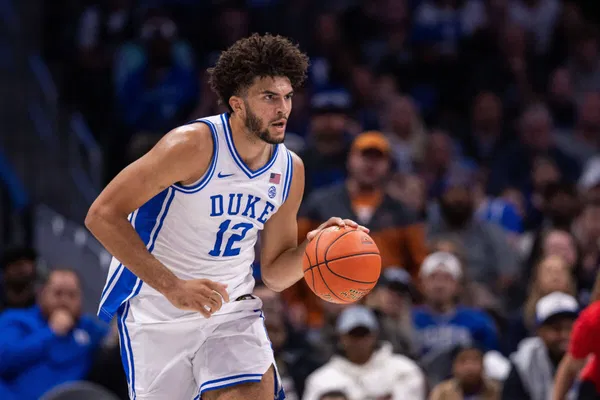
If there’s one thing Duke basketball refuses to tolerate, it’s a lazy narrative built on outdated scouting bias — especially when it targets the face of their program. So when an unnamed NBA executive tried to diminish Cameron Boozer’s dominance with a comment many around college basketball found laughable, the Blue Devils didn’t ignore it. They pushed back. Hard. And the response didn’t just defend Boozer — it spotlighted exactly why the freshman phenom is rapidly becoming one of the most unstoppable forces in the sport.
A Critique That Sparked a Firestorm
Freshman sensation Cameron Boozer has been nothing short of a revelation for Duke basketball. Through the first stretch of the season, he’s averaging 22.9 points, 9.8 rebounds, shooting 56.2% from the field, 37.5% from three, and 77.3% at the line — numbers that place him not just among the best freshmen in America, but among the most productive players in the entire country.
And yet, somehow, that wasn’t enough for one anonymous NBA executive.
In a recent comment, the executive claimed:
“Every time he’s played against like-sized bigs, he can’t finish. He dominates lesser competition.”
In one sentence, Boozer’s production was dismissed, his competition belittled, and his NBA potential questioned.
For many college basketball fans, the take was simply wrong.
For Duke?
It was personal.
Duke’s Response: “Absolutely Hilarious”
Duke Nation wasted no time firing back. Social media erupted, Blue Devil fans swarmed the comment sections, and analysts aligned themselves with the numbers rather than the narrative.
Duke’s official community voice summed up the program’s feelings perfectly:
“Absolutely hilarious. He just scored 29 on the best frontcourt in the country.”
That wasn’t an exaggeration.
Just days before the executive’s comments surfaced, Boozer unleashed one of his best performances of the season against the Florida Gators, widely considered to have the best frontcourt in college basketball.
And he dominated.
The Florida Game That Destroyed the Narrative
Against Todd Golden’s physically imposing, experienced Florida bigs — a group praised for their strength, length, and rim protection — Boozer responded with:
29 points
6 rebounds
2 assists
10-of-21 shooting
Total control of the pace, paint, and physicality.
This wasn’t a case of him bullying smaller defenders. It wasn’t a case of out-athleting weaker competition. It was the game of a skilled, polished, mentally tough forward imposing his will on one of the nation’s elite interior defenses.
If that is what “struggling against like-sized bigs” looks like, scouts may want to adjust their definitions.
Why Boozer’s Dominance Shouldn’t Surprise Anyone
To understand why Duke reacted so strongly, you have to understand the player Boozer already is — and the expectations he arrived with.
1. A Fully Formed Offensive Weapon
Boozer isn’t just a power finisher. He’s a three-level scorer with the finesse of a wing and the physique of a forward.
He punishes mismatches in the post.
He hits threes at nearly 38%.
He finishes through contact with either hand.
He can pass, initiate offense, and read double teams.
That combination is uncommon in a freshman. The last Duke rookie to show this kind of versatility?
Cooper Flagg.
2. Elite Against High-Level Competition
At the high school level, Boozer repeatedly dominated top-ranked players. The idea that he only flourishes against “inferior competition” simply doesn’t match the film.
3. He doesn’t avoid physicality — he invites it.
His strength and balance are already NBA-ready. You don’t average nearly 10 rebounds per game without having elite instincts, motor, and physical toughness.
The Bigger Issue: NBA Scouting Narratives
Let’s be honest: scouts and executives sometimes fall into patterns. When a player’s style doesn’t perfectly fit into a traditional mold, critics lean on what they expect his weaknesses to be, not what they actually are.
For Boozer, this outdated narrative sounds familiar:
“He’s undersized for a modern 4.”
“He lacks elite explosiveness.”
“He won’t be able to bully NBA bigs.”
Those are concerns about archetype, not performance.
And Duke’s reaction made it clear — they’re tired of seeing Boozer placed into a predetermined box instead of being judged by what he’s actually doing on the court.
The Numbers That Prove the Executive Wrong
Look deeper into Boozer’s production:
• Against Top-25 opponents:
He averages more points, more rebounds, and shoots a higher percentage.
• Against elite frontcourts:
He consistently posts 20+ points.
• In high-pressure situations:
He plays his best basketball.
He is not inflating his stats against cupcakes.
He is elevating his play when the lights get brightest.
Why This Narrative Matters for Duke
This isn’t just about pride. It’s about respect — for Boozer, for the program, and for what Duke basketball represents.
Duke has produced:
Multiple No. 1 picks
Multiple Rookie of the Year winners
Generational freshman talents
So when an NBA executive tries to reduce a player like Boozer to a “bullies smaller players” stereotype, it’s not just inaccurate — it’s lazy.
And Duke refuses to let laziness shape their players’ reputation.
Boozer’s Mentality: Calm, Confident, Unbothered
What’s striking is how little the noise affects Boozer himself.
People around the program describe him as:
Mature
Focused
Film-obsessed
Calm in pressure
Driven by team success
He’s the opposite of the diva superstar archetype. And that level-headedness is part of what makes Duke so protective.
The Florida Game: A Blueprint for His NBA Translation
If scouts wanted to know how Boozer projects at the next level, the Florida game gave them a blueprint.
He didn’t need elite explosiveness.
His footwork created space.
He didn’t need to be taller or longer.
His strength shielded defenders.
He didn’t need an offense built around him.
He found opportunities within the flow of the game.
He didn’t shrink in physical matchups.
He embraced them.
That’s why Duke reacted with sarcasm instead of outrage — the numbers speak louder than the criticism.
So Why the Disrespect? A Possible Explanation
Some scouts fall into a trap: comparing every power forward prospect to the last unicorn they saw.
If you’re not Giannis, you’re not athletic enough.
If you’re not Durant, your shot isn’t elite enough.
If you’re not Zion, your frame isn’t special enough.
But Boozer doesn’t fit any of those categories.
He’s something else:
A fundamentally dominant, physically advanced, technically polished forward whose game translates because it’s built on skill, not gimmicks.
That kind of player usually thrives in the NBA.
Why Duke Will Continue to Stand Up for Him
Duke didn’t push back because they’re sensitive.
They pushed back because:
Boozer is producing at an elite level.
His film contradicts the criticism.
He’s beating top-level competition.
His maturity sets him apart.
His work ethic is praised internally.
And most importantly —
he represents the program the right way.
Duke protects players who protect the culture.
What Comes Next for Boozer
With Michigan State, ACC play, and more ranked opponents ahead, Boozer will only have more opportunities to silence critics.
But ironically?
He doesn’t need to silence anyone. His game already did.
The executive’s comment didn’t expose a flaw in Boozer’s game — it exposed a flaw in outdated scouting.
And Duke wasn’t about to let that slide.
Final Thoughts
Cameron Boozer is not dominating because the competition is weak.
He’s dominating because:
He’s skilled.
He’s poised.
He’s physical.
He’s productive.
He rises to the challenge.
He’s built for the moment.
Duke stood up because Boozer earned that respect.
And as the season continues, the critics will vanish — but the numbers won’t.




