


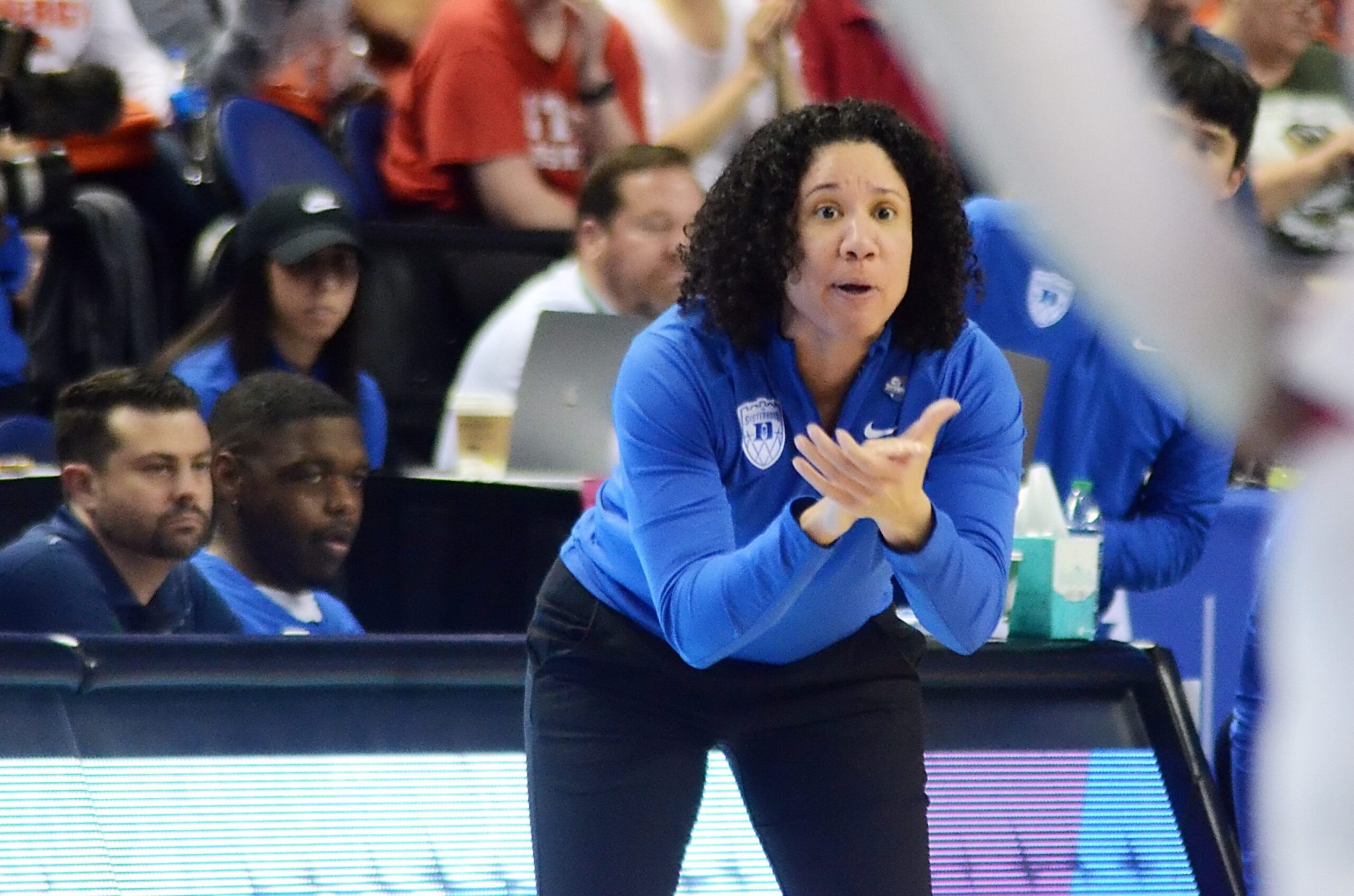
Duke entered the season with expectations higher than they had been in years. A preseason No. 7 ranking, a stable roster with only one graduated starter, and a growing reputation under head coach Kara Lawson all suggested that this would be the year the Blue Devils broke through as true national contenders. Instead, the season has unraveled far more quickly than anyone expected — and the problems have been both glaring and layered.
The Blue Devils opened the year with a deflating loss to No. 14 Baylor, followed by wins against Norfolk State and Holy Cross that briefly steadied the ship. But everything changed after one of the most shocking upsets in recent memory: a stunning loss to West Virginia, a team that had six of its 11 available players ejected following a first-half altercation. Duke couldn’t take advantage of a roster decimated mid-game — a red flag that has since proven to be the beginning of a downward slide.
What followed was a win over Liberty and then four consecutive defeats, including losses to three of the top five teams in the nation. Since Nov. 20, Duke has fallen to South Florida, No. 3 South Carolina, No. 4 UCLA, and No. 5 LSU. The competition has unquestionably been elite, but the margins of defeat — especially 89–59 to UCLA — made it clear that Duke wasn’t simply being outclassed; it was being exposed.
Lawson pointed to the difficulty of the schedule, emphasizing that facing three top-five teams in eight days across multiple cities was “a challenge” but also an opportunity to identify their deficiencies. Yet the issues go deeper than fatigue or travel. Duke’s identity — once built on lockdown defense and steady guard play — has cracked in several places.
BACKCOURT DEPTH THAT VANISHED OVERNIGHT
While Duke did not suffer numerous offseason departures, the ones it did have were deeply impactful. Nearly every exit came from the guard room: Reigan Richardson graduated, while Oluchi Okananwa, Vanessa de Jesus, and Louann Battiston transferred to Maryland, Notre Dame, and Rice. Those losses, particularly Richardson and Okananwa, have proven far more costly than expected.
Richardson provided scoring bursts and veteran steadiness, including a 35-point performance last season. Okananwa was the quintessential energy player — an elite rebounder at 5’10”, ACC Sixth Player of the Year, and the 2025 ACC Tournament MVP. Replacing that production, grit, and versatility has been nearly impossible.
Compounding matters, Duke’s remaining guards are injured or overworked. Ashlon Jackson and Taina Mair have been forced into near-iron-woman roles, each logging over 32 minutes per game across the last six contests and playing 38 minutes apiece against LSU. Meanwhile, Emma Koabel is out for the season with an ACL tear, and top-five recruit Emilee Skinner has been limited by a lingering leg injury. Despite dressing and warming up, Skinner has barely played — leaving Duke perilously thin.
Lawson admitted the reality plainly: “We just don’t have a lot of guards that are healthy.” And without that backcourt depth, Duke’s defense has struggled to contain top guards, while the offense has lacked the ball-handling stability and perimeter threat it once relied on.
RETURNERS STRUGGLING TO GROW INTO NEW ROLES
While sophomore standout Toby Fournier has been excellent — averaging 15.6 points and shooting an impressive 44% from three — others expected to elevate their performance have stumbled. The biggest surprise has been the quiet start from junior Jadyn Donovan. A two-year starter known for slashing, rebounding, and defensive versatility, Donovan has averaged just two points per game, shooting a career-low 34.8% from the field.
Transitioning into a more guard-oriented role has limited her ability to cut, crash the boards, and score in the paint. Her lack of three-point shooting has also invited defenses to sag off her, which in turn has made life harder for Fournier inside. Donovan went scoreless without attempting a shot in consecutive games — a sign of her discomfort in the new system.
The frontcourt overall has struggled with rebounding and physicality. Against South Carolina, Duke lost the rebounding battle 43–35. Against a UCLA team missing star center Lauren Betts, the margin was still 43–33. Without a traditional dominant post player — as freshman Arianna Roberson is still developing — Duke has been overwhelmed in the paint, surrendering 52 points inside to LSU.
BRIGHT SPOTS AND LONG-TERM HOPE
There are signs of life. Maryland transfer Riley Nelson has begun to settle into Duke’s system, scoring in double figures against both LSU and South Carolina. Her shooting ability, once fully integrated, could help relieve pressure on the overworked backcourt. Roberson, though still raw, has shown flashes of potential that suggest she could grow into the role Duke desperately needs filled.
Lawson remains confident: “That’s the development, that’s the growth… It happens as you’re playing and getting reps.” Her message is clear — these struggles are part of the journey, not the destination.
And perhaps the biggest wildcard remains Emilee Skinner. Lawson has hinted repeatedly that the five-star recruit could become a difference-maker once fully healthy: “You’ll remember her when she starts playing.” If she returns at full strength, Duke’s guard issues could look very different within weeks.
SO WHAT REALLY HAPPENED?
Duke’s disappointing start isn’t the result of one failing — it’s the accumulation of several:
A depleted guard rotation that left the backcourt overextended
Key returners struggling to adjust to unfamiliar roles
A frontcourt lacking a true physical anchor
Early-season injuries robbing the roster of needed depth
And a brutal schedule magnifying every weakness
The talent is still there. The coaching is still there. But the chemistry, health, and role clarity simply haven’t aligned.
If Duke can get healthy, grow its young players, and regain its defensive identity, the season can still be salvaged. But the margin for error is gone — and the climb back up will be steep.




