


The Kentucky Wildcats — one of college basketball’s proudest, most tradition-rich programs — found themselves at the center of a storm Friday night. And that storm came in the form of a brutally honest message from one of their own: former Kentucky superstar and NBA veteran DeMarcus Cousins.
Following No. 18 Kentucky’s stunning 94–59 loss to No. 11 Gonzaga, Cousins held nothing back. Watching the Wildcats stumble through one of their worst performances in recent memory was simply too much for the former All-American. His reaction spread quickly through social media, resonating with fans who have been desperately trying to make sense of the team’s sudden collapse.
“Can’t lie… this UK team has no heart! This is hard to watch,” Cousins posted — a sentence that summed up the feelings of an entire fanbase in one emotional burst.
But to understand why Cousins’ words hit so deeply, you have to look at what unfolded on the court in Nashville. Kentucky didn’t just lose — they unraveled. The Wildcats missed their first 10 shots from the field and opened 0-for-7 from three-point range, immediately digging themselves into a hole that only got deeper. The frustration inside the arena was almost palpable. By halftime, boos rained down as Kentucky walked toward the locker room trailing 43–20, shooting a disastrous 16-for-60 overall by game’s end.
Gonzaga dominated the interior with a staggering 46–18 advantage in paint scoring, while Kentucky once again struggled from beyond the arc, following up a dreadful 1-for-13 outing in their loss to North Carolina earlier in the week.
The Wildcats, once considered one of the most promising young teams in the country, have now dropped three of their last five and appear to be slipping further away from their early-season identity. Energy is down. Confidence is shaken. And execution — especially offensively — has vanished at crucial moments.
But inside all of this frustration came something unexpected: accountability.
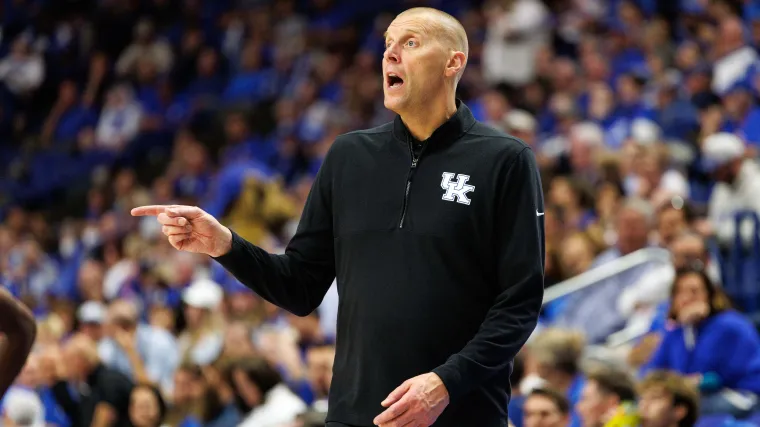
Head coach Mark Pope, in his first season at the helm of college basketball’s most scrutinized program, didn’t bristle at Cousins’ criticism. He didn’t dismiss it, ignore it, or fire back. Instead, he embraced it.
“As a former player, I’m pissed at the coach, too, and that’s all deserved,” Pope admitted. “There’s nothing inappropriate about what he said.”
It was a striking moment — a coach publicly accepting criticism from a former star, acknowledging that the frustration was valid, and even agreeing with it. Pope didn’t hide behind excuses about youth, early-season inconsistency, or the team’s chemistry still developing. Instead, he owned the moment, something that may ultimately become a turning point for the program.
He also gave a blunt assessment of where things stand:
“We’re in a bad spot, and we’ve got to dig out of it.”
That honesty from both Cousins and Pope has already sparked conversation across Big Blue Nation. This wasn’t simply a bad night — it was a wake-up call. A demand to rediscover the toughness, identity, and pride that has long defined Kentucky basketball.
For players, that means taking a hard look in the mirror. Kentucky has talent — that much is undeniable. But talent alone isn’t enough in a sport built on urgency, grit, and discipline. A poor shooting night is one thing. A lack of energy, physicality, and fight is something entirely different, and that’s exactly what Cousins was calling out.
Yet in his criticism, there was something more powerful at play — something motivational. DeMarcus Cousins loves Kentucky. He’s one of the fiercest competitors the program has ever produced. His frustration came from passion, not hostility. His words were not an attack; they were a challenge.
And challenges like that have the power to transform teams.
Pope’s players now have a choice. They can let this moment define them, or they can use it as the spark that rekindles the fire that once made them one of the most exciting teams in the NCAA earlier this season. Great Kentucky teams of the past were not great because they were perfect; they were great because they responded when adversity hit.
This is that moment for the 2024–25 Wildcats.
They must rediscover their identity on defense — something that can steady a team even when shots aren’t falling. They must return to playing fast, confident, aggressive basketball. And above all, they must reclaim the heart and hunger that made the Kentucky uniform mean something.
If they do that, this Gonzaga loss may one day be remembered not as a disaster, but as a turning point. A breaking point that became a breakthrough.
For now, the pressure is high, the spotlight is hotter than ever, and the noise around the program is growing louder. But pressure is not the enemy — it is the catalyst that has forged many great Kentucky teams before.
As the Wildcats attempt to dig out of this slump, they are armed with something invaluable: accountability from their coach, honesty from one of their legends, and the opportunity to rewrite their season starting today.
The question now is simple — and season-defining:
Will Kentucky respond?
Because if they do, this low point may be the start of something far more powerful: a resurgence forged in criticism, driven by passion, and built on the determination that has always defined Kentucky basketball.




