


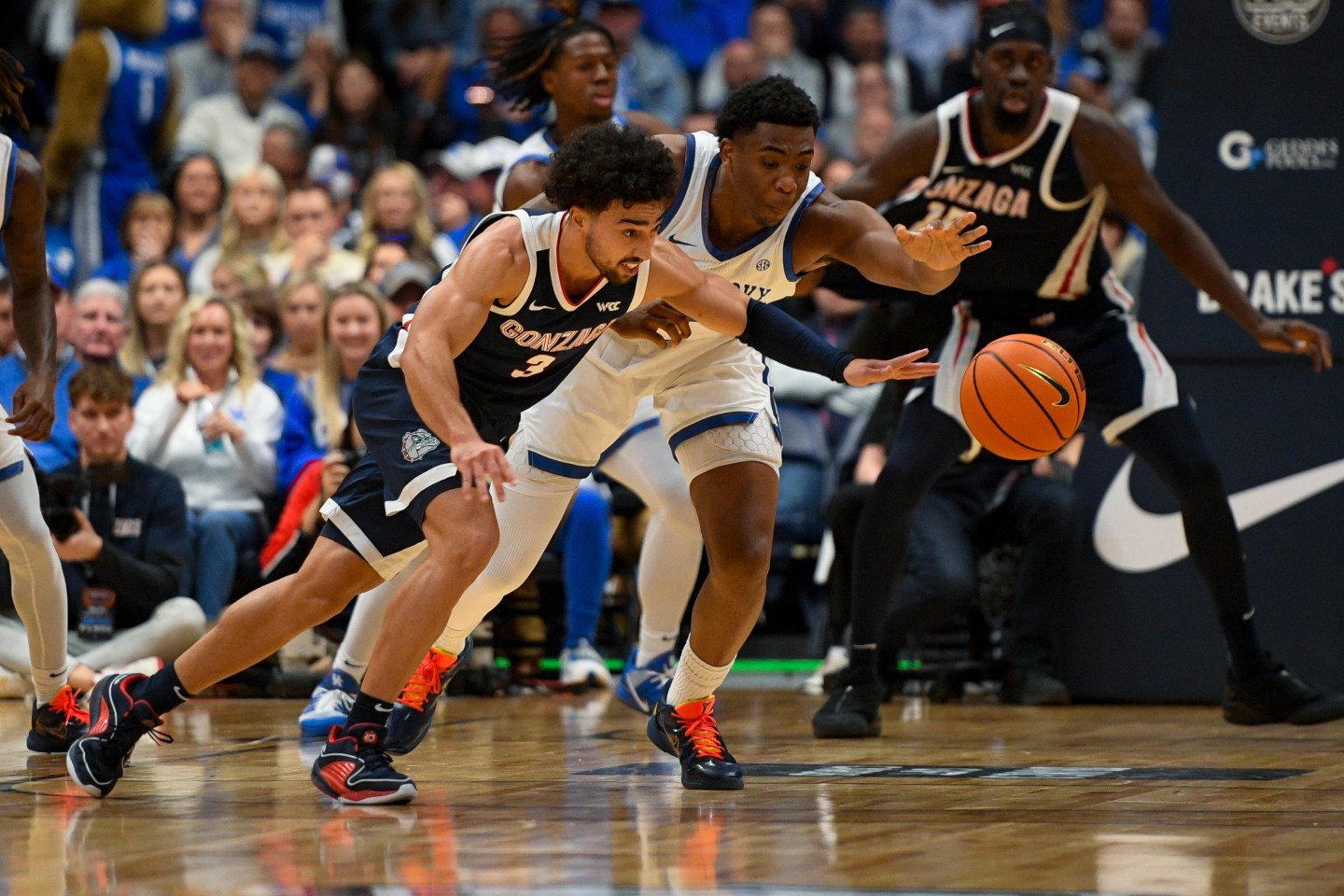
A night that was expected to test Kentucky became something far more sobering: a complete unraveling on both ends of the floor. Gonzaga didn’t just beat Kentucky — the Bulldogs dismantled the Wildcats 94–59 in a performance that left fans stunned, frustrated, and searching for answers.
This wasn’t a loss that came down to a few missed shots or a cold stretch. This was a comprehensive collapse, a game where Kentucky looked out of rhythm, outmatched, and at times, overwhelmed. The Wildcats now sit at 5–4, and with each passing game, the concern grows louder: What is this team’s identity, and where is it headed?
This moment is undeniably painful, but it also forces clarity. The flaws are visible, the issues are urgent, and the response must be decisive. As the program tries to regain its footing, here are five major takeaways — and a realistic look at what must change.
1. ANOTHER DEVASTATING START SET THE TONE
Kentucky didn’t just start slow — it started flat, unfocused, and unable to generate even basic offensive rhythm. The Wildcats missed their first 10 shots, failing to get on the scoreboard in any meaningful way while Gonzaga sprinted ahead on a 21–5 run.
By the under-12 media timeout, Kentucky had two points and four turnovers, a stat line that summed up the disastrous opening minutes. Missed jumpers, forced shots, and sloppy execution created a hole the Wildcats never clawed out of.
This isn’t a one-off problem. Slow starts have plagued Kentucky multiple times this season, but this one was the most damaging. A team without early energy or offensive flow can’t dictate pace, can’t control matchups, and certainly can’t compete with a disciplined, experienced program like Gonzaga.
If Kentucky wants to rediscover its footing, fixing the opening stretches of games must be the top priority.
2. SHOOTING WOES CONTINUE TO CRIPPLE THE OFFENSE
There is no sugar-coating it: Kentucky shot the ball terribly. Again.
The Wildcats finished the night shooting 26% from the field and 21% from three, but even those numbers feel generous given how difficult it was for Kentucky to string together made baskets.
The offense was stuck in the mud, relying on contested threes, rushed jumpers, and low-percentage looks that never had a chance. Even open shots — when they appeared — weren’t falling.
This isn’t simply a shooting slump anymore. It’s a trend, and it paints a harsh truth: this team is not built to win games from the perimeter right now. Without more consistent ball movement, better spacing, and a commitment to attacking the paint, the offense will continue to sputter.
Kentucky must find a way to generate easier looks. Whether that means lineup changes, new offensive sets, or simplifying the approach, adjustments are necessary.
—
3. GRAHAM IKE REMAINS UNSOLVED — AND DOMINANT
Gonzaga’s Graham Ike has tormented Kentucky in their last two meetings, dropping 23 and 28 points, and once again he proved unstoppable.
At halftime, Ike already had 17 points, scoring with ease in the post while Kentucky struggled to contain him physically and tactically. At one point in the second half, Ike had 24 points while Kentucky had just 26 as a team, a stat that underscores how dominant he was.
He finished with 28 points, a season high, controlling the game with footwork, strength, and a scoring versatility that Kentucky had no answer for.
If Kentucky wants to compete with elite frontcourts, its interior defense must improve dramatically — both in individual matchups and help-side structure.
—
4. JALAND LOWE RETURNS — BUT HAS A QUIET NIGHT
Fans eager to see freshman guard Jaland Lowe back on the floor finally got their wish, but the young guard is clearly still shaking off rust.
In his return, Lowe finished with 1 point, going 0–5 from the field, adding only one rebound, one assist, and one turnover. It wasn’t the comeback performance many hoped for, but it’s important to recognize the challenge he’s facing: recovering from a lingering shoulder injury that disrupted his rhythm and limited his early-season development.
Lowe has the talent to contribute meaningful minutes once he regains his feel for the game. His growth and confidence will be essential for Kentucky as the season progresses.
—
5. NASHVILLE CROWD BOOS SPEAK TO GROWING FRUSTRATION
Kentucky fans are famously passionate, loyal, and demanding — and on this night, they made their feelings unmistakably clear.
As the Wildcats headed to halftime, a wave of boos cascaded through Bridgestone Arena. By the end of the game, it was even louder. This is not something that happens often, and when it does, it signals something deeper: concern, disappointment, and fear that the team is drifting in the wrong direction.
The Big Blue Nation showed up, but the performance did not meet the moment.
—
WHERE DOES KENTUCKY GO FROM HERE?
This loss hurts. There’s no denying it. But sometimes, a breakdown forces a breakthrough.
Kentucky must choose how it responds:
Will the team find its energy and identity?
Can the offense be simplified and stabilized?
Will someone emerge as a consistent scoring presence?
Can the defense become disciplined enough to stop elite talent?
These questions don’t have easy answers, but the path forward isn’t hopeless. There is time, there are pieces, and there is an opportunity for growth — if Kentucky embraces it with urgency.
The season is far from over. But the wake-up call has officially arrived.




