


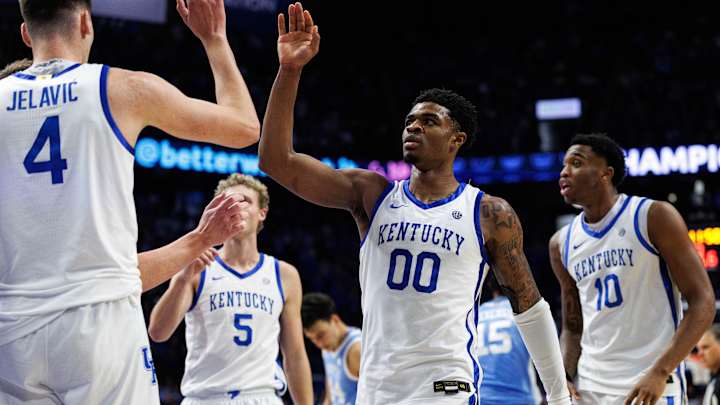
There are moments in a season when a coach says something that makes the entire fanbase stop, blink twice, and suddenly realize: Wait… there’s more going on here than we thought. Mark Pope delivered one of those moments recently when he admitted that Kentucky’s players are “wearing themselves out,” not because of the physical grind of the schedule or some brutal stretch of matchups, but because of something deeper happening behind the scenes. And suddenly, Big Blue Nation wants answers. What exactly is draining these players? Why is this becoming a pattern? And most importantly — what does this say about the direction of Pope’s new era? That is where this conversation truly begins, and where every Kentucky fan should lean in.
When Pope said his players were wearing themselves out, it didn’t sound like a casual remark or a coach trying to excuse a tough performance. It sounded like a carefully chosen message, something meant to be understood but not fully spelled out. Coaches don’t often reveal emotional or internal team dynamics unless they want the public — and their own locker room — to absorb the weight of those words. So when Pope opened the door to fatigue, he wasn’t saying, “We’re tired from playing hard.” He was saying something closer to, “Something is draining us, and you need to understand this isn’t normal.” And that’s where the mystery begins. How can a roster built on athleticism, elite facilities, modern strategy, and a coaching staff obsessed with pace and precision be wearing itself down?
To understand that, we have to look beyond the stat sheet and into the emotional and psychological reality of a program undergoing a full identity shift. When a new coach takes over at Kentucky — especially after a Hall of Fame era — the expectations are immediate and intense. Pope is not simply coaching a team; he is carrying the weight of a fanbase that demands dominance and tradition. His players feel that pressure as much as he does. Some handle it quietly. Some internalize it. Some push too hard trying to meet it. Emotion, expectation, and the burden of representing a historic program can drain players far more deeply than any press defense ever could.
This pressure shows itself in different ways. One major source of exhaustion is overthinking. Pope’s system is fast, creative, heavily based on spacing, ball movement, and quick decisions. That style demands constant mental engagement, and players unfamiliar with it often hesitate, overanalyze, or doubt their instincts. This leads to mental fatigue, slower reactions, and a drop in natural confidence. Another factor is the effort to impress. At Kentucky, every possession feels like an audition. Some players dive, sprint, and push not purely out of competitiveness, but out of fear of making mistakes. That type of effort isn’t sustainable — fear-based energy empties the tank twice as fast.
Add to this the emotional weight of Big Blue Nation. Kentucky fans are passionate, loyal, and vocal. That passion can energize players, but it can also overwhelm them. Being praised one week and heavily criticized the next is tough for a young team still forming its identity. A roster can be physically fresh yet emotionally exhausted, and Pope speaking about fatigue publicly suggests that something real is happening beyond the floor.
It’s important to understand that effort itself is not the issue. It’s the type of effort. Smart effort is structured, efficient, and strategic. Desperate effort is chaotic, frantic, and unbalanced. Kentucky has shown brilliant moments where the system looks fluid and modern. But they’ve also had stretches where the game becomes rushed — unnecessary fouls, early-clock threes, miscommunication on switches, overhelping on drives, and players trying to individually solve problems instead of trusting the system. These moments aren’t signs of laziness; they’re signs of a team pushing too hard in the wrong manner. And that is exactly what Pope was pointing toward: misplaced energy.
Behind closed doors, practice is another element wearing players down. Pope’s practices demand constant motion, rapid adjustments, switching, precise passing, and three-point shooting under fatigue. This is dramatically different from the slower, isolation-heavy style many of these players grew up playing or experienced under previous staff. They are learning not just plays, but a new identity. Some players adjust quickly. Others struggle. And some push themselves so hard trying to impress their coaches that they burn out before the season reaches its midpoint. Pope’s comment suggests that he sees that trend clearly.
Another underlying issue is leadership — or the lack of a clear emotional anchor. Every great Kentucky team has had a heartbeat: Anthony Davis, Tyler Ulis, John Wall, Oscar Tshiebwe. This year’s roster has talent, shooting, length, and athleticism, but it does not yet have one undeniable leader who controls the emotional temperature. When that role is vacant, every player feels pressure to step up, which leads to uneven energy, inconsistent focus, and emotional exhaustion. Pope is describing a team that cares too much, not too little.
Kentucky players have always battled the temptation to do too much. This is the cost of playing for the biggest brand in college basketball. When things go wrong, the natural instinct is to force the issue, to make the hero play, to take over instead of trusting the system. Pope’s comment reflects that familiar tradition: he sees a team whose hearts are in the right place but whose rhythm is off. This wasn’t criticism, and it wasn’t blame. It was a message — one meant for fans, media, and especially the players.
Behind the scenes, Pope is building more than a team. He is establishing a culture. His words indicate that the culture is still forming, roles are still stabilizing, emotional standards are still rising, and trust is still developing. None of these are weaknesses. They are natural signs of a program in transition. Every rebuild goes through this stage. The only difference is that at Kentucky, the world watches it unfold in real time.
Pope likely chose to go public for several reasons. He wants his players to hear the message through the media — sometimes athletes listen differently when something is said publicly. He also wants fans to understand the process so that criticism does not overshadow growth. He is setting the foundation for accountability while simultaneously protecting his team. And he is subtly challenging the roster to respond, to grow, and to develop the maturity required to handle Kentucky’s expectations.
The path forward is clear. Kentucky needs clarity of roles so players stop overexerting themselves trying to be everything at once. The offense must become instinctive rather than forced, something achieved only through repetition and trust. And most importantly, the team must find its vocal, emotional leader — someone who sets the tone, absorbs pressure, and stabilizes the locker room. When those things happen, the emotional fatigue will disappear, because the body tires — but it is the mind and heart that collapse first.
In the end, Pope’s comment was not a warning, an excuse, or a complaint. It was a diagnosis. He sees a team that cares deeply, fights hard, and gives everything it has. He also sees a team whose intensity is driven by pressure rather than confidence. Kentucky is not broken. Kentucky is not unraveling. Kentucky is not lacking passion. This is simply a group learning how to be Kentucky again. And sometimes, the biggest growth doesn’t happen on the court — it happens behind closed doors.
If you want, I can:




