


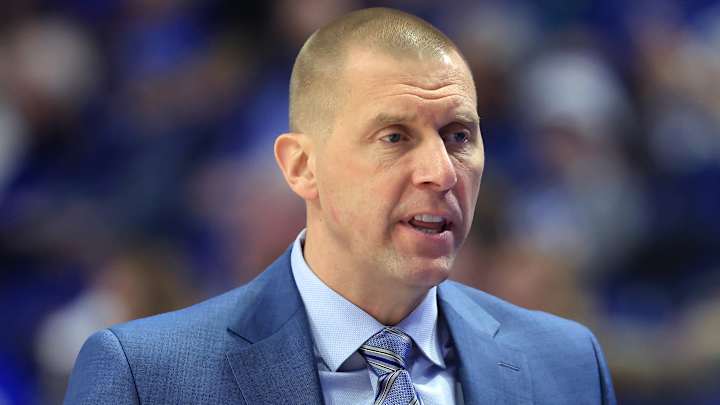
Mark Pope says other athletic directors are calling to copy something BBN hates. On the surface, it sounds almost unbelievable. Inside Big Blue Nation, the dominant emotion surrounding Kentucky basketball right now is anxiety, not confidence. Fans worry about NIL. They worry about recruiting momentum. They worry about whether Kentucky is adapting fast enough in a landscape that feels more like the Wild West every month. And yet, from inside the Joe Craft Center, Mark Pope is telling a very different story.
According to Pope, Kentucky is not behind. In fact, he believes Kentucky is ahead. So far ahead, he says, that athletic directors from other major universities are reaching out, asking how the Wildcats have structured their NIL operation and whether they can replicate it on their own campuses.
For a fanbase that sees empty recruiting boards and missed targets, that claim lands somewhere between confusing and infuriating.
If you spend any time around Kentucky fans, you hear the same concern repeated again and again. Is Kentucky doing enough in NIL to compete with the new powers of college basketball? Is the program too cautious while others push the boundaries? Has Kentucky’s traditional advantage eroded while rivals weaponize collectives, inducements, and aggressive recruiting tactics?
Mark Pope hears that noise. He feels it. But he also insists that the internal reality looks nothing like the external panic.
“I’m telling you… someone needs to do like a super in-depth New Yorker magazine 30-page article on Mitch Barnhart,” Pope said ahead of the Indiana game. “His leadership in this space has been incredible.”
That statement alone is enough to spark debate. Mitch Barnhart is one of the most polarizing figures in Kentucky athletics. To his supporters, he is a steady, principled administrator who protects the long-term health of the program. To his critics, he is overly cautious, slow to adapt, and resistant to the aggressive tactics that now define elite recruiting in the NIL era.
Pope made it clear which side he is on.
He went further, claiming that Kentucky’s NIL structure, built around a partnership with JMI Sports and UK Athletics, is not only functional but envied.
“I have ADs from other major universities reaching out and trying to figure out how are you doing this and like how did you move ahead this way,” Pope said. “This partnership with JMI… Paul Archey is incredible and Kim Shelton, who we work with day to day, is incredible.”
That quote cuts straight to the heart of the disconnect between perception and reality. Inside the building, Pope sees an organized, compliant, and forward-thinking system. Outside the building, fans see missed commitments, shrinking recruiting lists, and rivals landing players Kentucky once would have locked down with ease.
Both things can be true at the same time.
Understanding why requires understanding what Kentucky is actually trying to do in NIL, and why that approach is so different from what fans see elsewhere.
Unlike some programs that rely heavily on loosely structured collectives operating in legal gray areas, Kentucky has leaned into a centralized, partnership-based model. JMI Sports, which already handles Kentucky’s multimedia rights, plays a major role in organizing NIL opportunities, sponsorships, and partnerships for athletes. The goal is control, transparency, and compliance.
That model comes with benefits. It reduces risk. It provides stability. It ensures deals are structured in ways that are more likely to survive future NCAA enforcement or federal regulation. It also aligns NIL more closely with institutional branding and long-term athlete development.
But it also comes with limitations. It is slower. It is more cautious. And in a recruiting world driven by speed, perception, and promises, slow and cautious often look like losing.
Pope acknowledged how chaotic the process has been behind the scenes.
“When we get to write the book, there’s been a lot of late nights, tight deadlines, trying to get to winning spots,” he said. “We have an incredible team in the dynamic times.”
That line matters. It reveals something fans rarely see. Kentucky’s staff is not sitting still. They are reacting daily to rule changes, interpretations, and shifting enforcement priorities. NIL is not governed by a clean, universally accepted rulebook. It is a patchwork of state laws, NCAA guidance, court rulings, and institutional policies that sometimes contradict each other.
“One of the complicated things right now is that there’s not a clear interpretation of exactly what the rules are,” Pope said. “Literally it’s a dynamic process every single day and we’ll make sure that we always err on the side of doing this legal, which is a guessing game because nobody knows exactly what’s legal right now.”
That phrase, “err on the side of doing this legal,” is the philosophical core of Kentucky’s approach. It is also the source of much of the frustration from fans.
In the short term, playing it safe can cost you players. Other programs are willing to push into gray areas, offer more aggressive upfront packages, and promise things that may or may not hold up long term. Kentucky, under Barnhart, is not interested in winning those races if it means risking sanctions, lawsuits, or structural collapse down the road.
That caution is intentional. Barnhart has always prioritized institutional protection over short-term gain. In the NIL era, that instinct has only intensified.
For Pope, that approach creates trust. He believes the stability and support he receives from the administration gives him a foundation others lack.
“In the dynamic times, landing on exactly the right spot is ultimately my job to guess the right spot,” Pope said. “But the support that we’re getting is ridiculous from Mitch and the administration, from JMI.”
That confidence, however, runs headlong into the current reality of recruiting. As of now, Kentucky basketball has zero commitments in the 2026 class. According to multiple reports, they are no longer leading for several top targets they once felt good about. Rivals are filling boards. Kentucky is waiting.
That gap between words and results is impossible to ignore.
It raises an uncomfortable question. Are Pope’s comments an honest reflection of a long-term vision, or are they an attempt to publicly reinforce a model that is under growing pressure?
Some fans wonder whether these statements sound more like Mitch Barnhart talking through his head coach than a coach speaking freely. Barnhart has faced criticism for the JMI partnership, particularly because no other major college basketball power has structured NIL in quite the same way. If that model fails to deliver elite recruiting results, the scrutiny will only intensify.
At the same time, it is also possible that Pope genuinely believes in what Kentucky is building and is willing to endure short-term pain for long-term stability.
Pope also made a point to refocus the conversation on the athletes themselves.
“These student athletes still matter, right? They still matter,” he said. “Like that’s still the most important thing that’s going on. And so honoring that’s really, really important.”
That sentiment resonates philosophically, but it can feel hollow to fans watching rivals stack talent. In an era where NIL has effectively professionalized college sports, idealism often loses to results.
The reality is that NIL is no longer just about branding opportunities and endorsements. It is about roster construction. It is about retention. It is about closing deals quickly and convincingly. Programs that fail to do that fall behind, regardless of how ethical or compliant their systems may be.
Pope insists Kentucky is not failing. He insists they are building something others want to copy.
If that is true, it suggests a longer timeline. It suggests that Kentucky is positioning itself for a future where NIL becomes more regulated, more centralized, and less chaotic. If and when that happens, programs that built clean, compliant systems early may suddenly gain a massive advantage.
But that future is not guaranteed. And even if it arrives, it may come too late to satisfy a fanbase accustomed to immediate results.
Kentucky basketball is not judged on process. It is judged on banners, Final Fours, and NBA draft picks. Recruiting rankings matter. Momentum matters. Silence on commitment days matters.
Right now, Kentucky is asking its fans to trust a system they do not like, built by an administrator many already distrust, during a period where visible results are lacking.
That is a hard sell.
The irony is that Pope may be telling the truth. Other athletic directors may genuinely be calling. They may see value in Kentucky’s structure. They may be trying to learn how to protect their own programs from future chaos. But fans do not care who is calling behind the scenes. They care who is signing on the dotted line.
Until Kentucky starts landing recruits at a level that matches its history and expectations, skepticism will remain.
The NIL era has changed the rules, but it has not changed the standard. Kentucky is still expected to be elite. Playing the long game only works if you survive the short one.
Mark Pope has tied his credibility to Mitch Barnhart and the JMI model. He has publicly endorsed it, praised it, and defended it. That makes the coming years critical. If the system works, Pope will look like a visionary who ignored the noise and trusted the process. If it fails, these quotes will be replayed endlessly as evidence of denial.
For now, Kentucky sits in an uncomfortable in-between space. According to its head coach, it is ahead of the curve. According to its fans, it is falling behind. The truth likely sits somewhere in the middle, shaped by a sport still figuring out what it wants to be.
One thing is certain. Words are no longer enough. In modern college basketball, the only thing that quiets doubt is results. And until those results arrive on the recruiting trail, Big Blue Nation will continue to question a system that other athletic directors may admire, but that Kentucky fans desperately want to see prove itself.




