


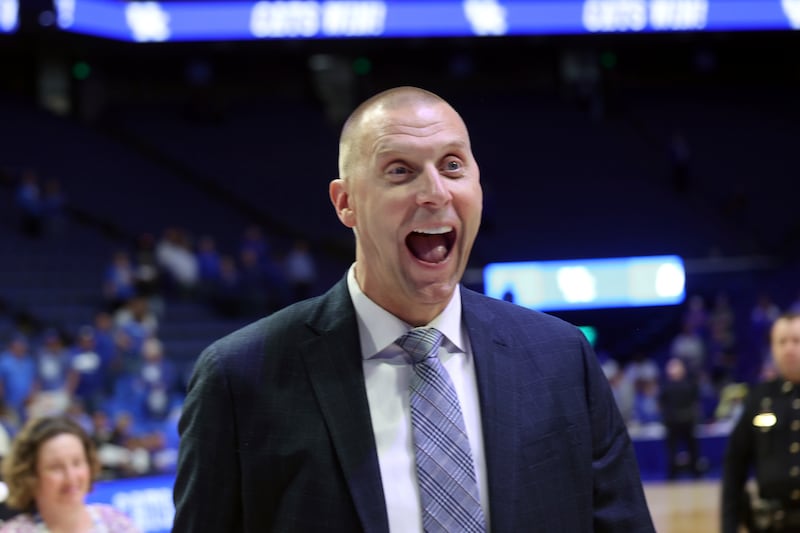
Mark Pope shortened his rotation against Indiana, and while it may have started as a game-by-game adjustment, it has quickly become one of the most important conversations surrounding Kentucky basketball moving forward. Pope has been consistent all season in his belief that depth is a strength and that using a wide rotation would eventually pay off. But Saturday night at Rupp Arena showed a different version of Kentucky — one that leaned on fewer players, clearer roles, and longer stretches of continuity. The result was not subtle. Kentucky erased a halftime deficit, dominated the second half, and closed out a 72-60 win that felt far more controlled than many of its recent performances.
The question now is unavoidable: was this simply a situational response to Indiana, or did Mark Pope stumble upon something that could reshape Kentucky’s approach for the rest of the season?
For much of the year, Pope has defended the idea of playing deep into his bench. The reasoning has been logical. Kentucky has numbers. It has athleticism. It has versatility. In theory, rotating players keeps legs fresh, allows different combinations to flourish, and creates internal competition. But in practice, the constant shuffling has often disrupted rhythm, stalled offensive flow, and made it difficult for players to play through mistakes.
Against Indiana, that changed — especially after halftime.
Kentucky still used 10 players in the first half, which aligned with Pope’s usual approach. Nine of those players logged at least seven minutes. The idea was familiar: let everyone get a feel for the game, see who responds, and gather information. But the second half told a different story. Pope tightened the rotation, trusted what was working, and resisted the urge to cycle endlessly through lineups.
Only nine Wildcats played in the second half, and just six of them logged double-digit minutes. Otega Oweh never left the floor, playing all 20 minutes after halftime and finishing with 33 minutes total, tying his season-high. That alone was a notable departure from Pope’s usual minute distribution.
Kam Williams, Jaland Lowe, Brandon Garrison, Mo Dioubate, and Denzel Aberdeen all received extended runs as well, giving Kentucky something it has often lacked this season: sustained continuity.
Perhaps the most telling statistic from the game came from the lineup data. The five-man unit of Lowe, Oweh, Williams, Dioubate, and Garrison played nine minutes together and posted a +11. In a game Kentucky won by 12, that stretch mattered. Pope saw it, trusted it, and stuck with it.
That trust also meant difficult decisions.
Collin Chandler and Trent Noah both started the game, but neither finished it. Chandler played just 16 minutes, Noah only 11. Jasper Johnson saw a season-low three minutes. Andrija Jelavic, who had been a regular part of the rotation all season, did not play a single second for the first time.
Those are not insignificant choices, especially for a coach who has emphasized opportunity and patience.
After the game, Pope was candid about how fluid the decision-making process was.
“I actually had no idea where the rotation would go today,” he said. “I didn’t know how Kam was going to feel on the court today, I had no idea how Mo was going to feel on the court today. I did feel like there was space for Jela to be really effective in this game. I actually felt like it made some sense, he’s our most effective post player, especially at the 4, and this mucked-up game kind of felt that way.”
That quote is revealing. Pope went into the game expecting Jelavic to matter, yet the flow of the game dictated otherwise. Indiana’s style, the pace, and the physicality forced Pope to adapt on the fly. Instead of sticking rigidly to a pregame plan, he let performance dictate minutes.
“And that’s the nature of the game and what the game was calling for tonight,” Pope added. “If we can embrace that, we can win a lot of different ways.”
That last sentence may be the most important of all.
Winning different ways does not necessarily mean playing everyone. It means being flexible, recognizing what a specific game demands, and having the willingness to shorten the leash when necessary.
This is where the rotation conversation becomes bigger than one game.
Earlier this season, Kentucky’s depth was supposed to be an advantage. In reality, that depth has not consistently played to its talent level. Bench units have struggled to score. Defensive communication has broken down. Energy has fluctuated. Asking players to find rhythm in five- or six-minute bursts has proven difficult, especially for younger or still-developing pieces.
By shortening the rotation against Indiana, Pope simplified the game for his team. Roles became clearer. Defensive assignments were cleaner. Offensive decision-making improved because players were not constantly looking over their shoulders.
The second-half numbers back that up. Kentucky outscored Indiana 40-21. That is not a coincidence. It is the product of stability, trust, and sustained pressure.
Oweh’s extended minutes were especially impactful. His ability to stay on the floor allowed him to settle into the game defensively, attack with confidence, and become a steady presence rather than a sporadic spark. Players often talk about how difficult it is to play aggressively when they fear quick substitutions. Longer runs change that mindset.
The same can be said for Kam Williams and Mo Dioubate. Both benefited from extended minutes that allowed them to play through mistakes rather than being pulled after one missed shot or defensive lapse. That freedom showed up in effort and engagement.
None of this means Kentucky should abandon depth entirely. Pope has been clear that he values having options, and there will be games where matchup considerations demand a wider rotation. Foul trouble, injuries, and specific opponent tendencies will always factor in.
But Indiana highlighted something Kentucky has been missing: a reliable core.
At this stage of the season, teams often benefit from identifying their top seven or eight players and letting them carry the bulk of the load. Chemistry grows faster. Defensive communication sharpens. Late-game execution improves.
Kentucky may be arriving at that point.
It is also important to consider context. This was not just another game. This was a rivalry game. It was a must-win situation for momentum. The crowd was engaged. The pressure was real. In those moments, coaches often default to trust rather than experimentation.
Pope acknowledged before the Indiana game that while he hoped to continue using an extended rotation, it might not always be realistic.
“We’ll see if we can actually get there,” he said.
Against Indiana, he didn’t.
Despite having a full roster available for the first time since the Louisville game on November 11, minus Jayden Quaintance, Pope went the opposite direction. He tightened things up and rode the players who gave him the best chance to win.
The result validated the decision.
Now, the looming variable is Quaintance. His return will complicate the rotation conversation even further. Adding a talented player back into the mix will force Pope to make even tougher decisions about minutes and roles. But it could also make a shortened rotation more logical, not less.
Rather than squeezing Quaintance into an already crowded rotation, Pope may find it easier to define a clear top seven or eight and let the rest adjust situationally.
That approach may not sit well with everyone. Players who lose minutes will need to stay engaged. Managing morale will become more challenging. But winning often simplifies those conversations.
Kentucky’s depth still exists. It can still be an asset. But depth does not have to mean equal opportunity every night. It can mean having trusted options when the situation demands it.
The Indiana game suggested that Kentucky’s best basketball right now comes when Pope resists the urge to constantly tinker and instead allows his best-performing players to stay on the floor.
Is this a permanent shift? That remains to be seen. Pope has built his coaching identity around adaptability and player development. He will not lock himself into one rigid approach after a single game.
But it would be surprising if the lessons from Indiana were ignored.
Shortening the rotation did not just work — it changed the feel of the team. Kentucky played with urgency. It played with cohesion. It looked more confident and more connected.
For a team still searching for consistency, that matters.
Moving forward, the most realistic outcome is a hybrid approach. Pope may continue to use a broader rotation early in games, then tighten things up as matchups and momentum dictate. That gives Kentucky the best of both worlds: development without sacrificing control.
What Indiana showed is that Kentucky does not need to play everyone to play hard. It needs clarity, trust, and continuity.
If Pope leans into that lesson, the rotation against Indiana may not be remembered as an anomaly — but as the moment Kentucky finally found a formula that fits this roster.
And in a season where answers have been hard to come by, that could be a turning point.




