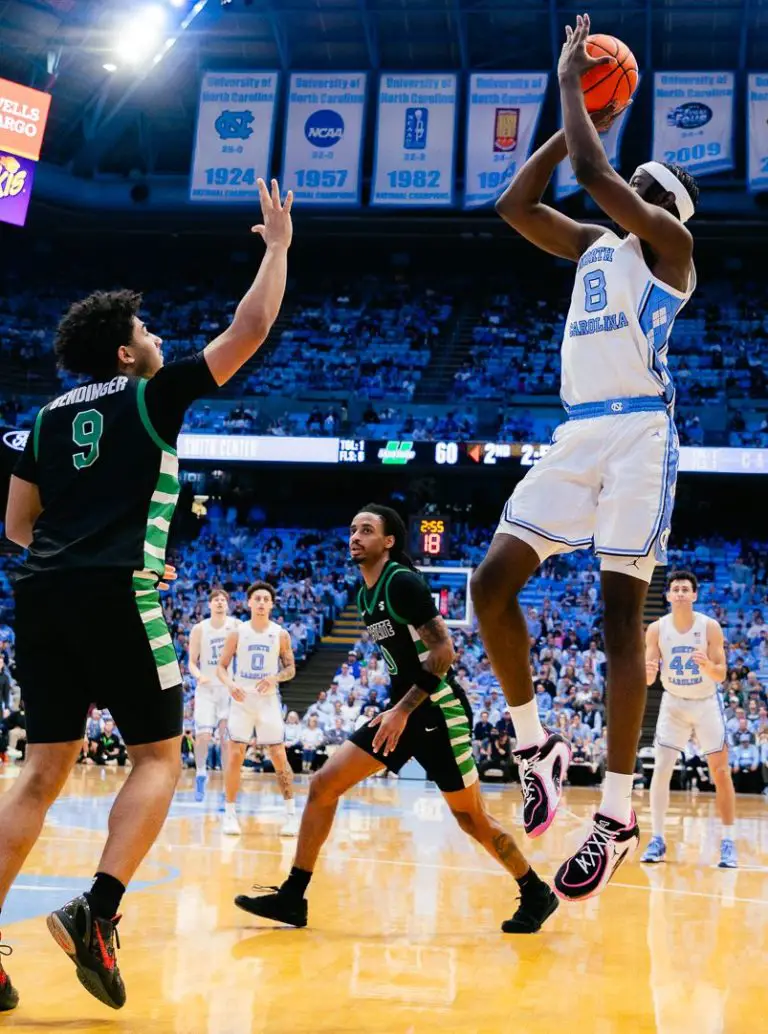
On a quiet December afternoon in Chapel Hill, No. 14 North Carolina did what it was expected to do. The Tar Heels defeated USC Upstate 80–62 at the Smith Center, improved to 9–1 on the season, and avoided the kind of upset that can linger into conference play. On the surface, it was a routine non-conference win.
But beneath the final score was a story that revealed far more about North Carolina’s identity, its current rhythm, and the player who has quickly become its emotional and competitive backbone.
Caleb Wilson wasn’t fully healthy. He wasn’t fully rested. He wasn’t even fully prepared in the traditional sense. And yet, he still walked off the floor with 20 points, 11 rebounds, and his seventh double-double of the season.
That contrast — limitation versus production — is what made Saturday quietly revealing for UNC.
A Sluggish Win That Raised Questions
From the opening tip, North Carolina never looked entirely comfortable. The energy was inconsistent. The execution came and went. There were stretches where the Tar Heels played like a ranked team asserting itself, and others where the game drifted into a slow, disjointed slog.
UNC led throughout, but never fully separated until late. The final margin suggested control, but the process told a different story. Head coach Hubert Davis acknowledged afterward that the team lacked the sharpness it usually prides itself on.
Caleb Wilson didn’t shy away from that reality either.
“As a team, we’ve just got to approach it stronger, better,” Wilson said after the game. “Just have more energy and more enthusiasm, no matter who we play.”
Those words carried more weight once he revealed what he had been dealing with behind the scenes.
Playing Through Pain
Wilson admitted after the game that he had been dealing with a foot injury leading into Saturday’s matchup. The issue limited him in practice and disrupted his normal preparation.
“I was dealing with a foot injury,” Wilson said, offering little detail beyond that. When asked for specifics, he responded with a brief “no comment.”
What mattered more than the diagnosis was the decision that followed.
There was never any real doubt Wilson would play.
“No, I’ll play through whatever I feel, as long as it’s not like going to really mess me up,” he said. “But I’m good now, so just got to play through the injury.”
Wilson estimated the injury affected him for two or three practice days, enough to disrupt rhythm but not enough to keep him off the floor. In an era where load management and caution are increasingly emphasized, Wilson’s mindset stood out.
He didn’t frame it as toughness for toughness’ sake. It was simply responsibility.
When North Carolina needed him, he was going to be there.
Why This Performance Mattered
On paper, 20 points and 11 rebounds against USC Upstate might not jump off the page. But context transforms those numbers.
Wilson entered the game as North Carolina’s most consistent player this season. Night after night, he has been the Tar Heels’ most reliable scorer, rebounder, and tone-setter. He has carried himself like a veteran, even as he continues to grow.
Against USC Upstate, he did that while compromised.
His movements weren’t always explosive. His lift wasn’t always the same. Yet he still found ways to impact the game. He scored through contact. He cleaned the glass. He anchored possessions that could have spiraled during UNC’s sluggish stretches.
It wasn’t flashy dominance. It was functional control.
And that matters far more in December than highlight plays.
The Mental Drain of Finals Week
Wilson also pointed to another factor that contributed to UNC’s uneven performance: academics.
For Wilson, this was his first experience navigating final exams at the college level. The transition took a toll.
“Exams are definitely exhausting,” he said. “You had to study for them all week. So, it’s kind of hard to switch gears from academics to athletics.”
That honesty offered a glimpse into the balancing act college athletes face, especially those expected to perform at a high level every night. Preparation wasn’t just disrupted by injury. It was disrupted by reality.
“That could be something that was going on with us,” Wilson said. “But we’ve just got to always push through it. You never know. You can’t control that. It’s not a circumstance you can control.”
Again, Wilson framed the challenge not as an excuse, but as an obstacle to overcome.
A Leader Without the Label
What stands out most about Caleb Wilson is not just his production, but his tone. He doesn’t deflect. He doesn’t dramatize. He doesn’t place himself above the group.
Even while acknowledging his injury, Wilson consistently redirected the conversation toward team standards.
That approach has quietly made him North Carolina’s emotional compass.
He plays hard. He speaks honestly. He works relentlessly.
Those traits resonate inside a locker room, especially during moments when energy dips or preparation isn’t ideal.
Free Throws, Flaws, and Growth
Wilson’s stat line wasn’t perfect. He struggled at the free-throw line, making just seven of 13 attempts. For a player who often draws contact and lives at the line, that inefficiency stood out.
Wilson brushed it off without hesitation.
“That’s just gonna happen sometimes,” he said. “Not going to sweat it. I’ll just shoot some free throws tonight. Get back to it.”
What followed was perhaps the most revealing part of his postgame comments.
“I come here pretty much every night,” Wilson said. “Honestly, I just need to do something that’s outside of practice to better myself.”
Wilson detailed his routine of staying late, working alone, and focusing on areas that still need development.
“So, I try to work on my 3-point shooting and shoot my mid-range jump shots — stuff like that, because that’s stuff I actually have to work on,” he said. “I just do it by myself. I play some music and go do it.”
There’s no entitlement in that mindset. No assumption that current success is enough.
Wilson is producing at a high level, yet he’s keenly aware of his limitations — and determined to close those gaps.
UNC’s Most Important Constant
Through 10 games, one truth has become increasingly clear: Caleb Wilson is North Carolina’s most dependable presence.
When shots aren’t falling, he rebounds.
When energy is low, he competes.
When preparation is imperfect, he adjusts.
He doesn’t need the game to be perfect to be effective.
That reliability is invaluable as the season grinds forward. North Carolina will face stronger opponents, tighter games, and nights when nothing comes easily. In those moments, having a player who can stabilize chaos matters.
Wilson has already shown he can do that — even while injured.
The Bigger Picture
Saturday’s win won’t define North Carolina’s season. It wasn’t a signature victory. It wasn’t a statement performance. But it offered something just as important in December: clarity.
The Tar Heels are still learning. Still navigating fatigue, academics, injuries, and expectations. They aren’t a finished product.
But they have a foundation.
They have a player in Caleb Wilson who understands what it means to push through discomfort, take ownership, and keep improving even when the spotlight isn’t blinding.
“Just got to play through it,” Wilson said.
That sentence may end up describing more than just one game. It may describe the approach that carries North Carolina through the long, demanding months ahead.
Because sometimes, the most telling performances aren’t the explosive ones. They’re the nights when a player admits he wasn’t right — and still found a way to take over.