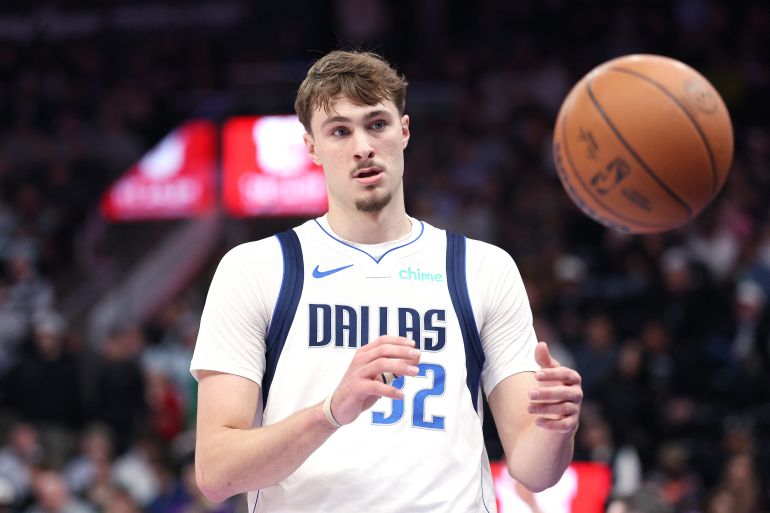
On Monday night, the NBA witnessed one of those performances that forces the entire basketball world to pause, rewind, and ask a simple question: did that really just happen? In a league built on stars, superstars, and once-in-a-generation talents, Cooper Flagg’s eruption against the Utah Jazz felt like a defining moment — not just for his rookie season, but for the future of the Dallas Mavericks and the direction of the NBA itself.
Flagg finished with 42 points, seven rebounds, six assists, and two blocks, becoming the first 18-year-old in league history to score more than 40 points in a game. Numbers alone do not always tell the full story, but in this case, they only begin to scratch the surface of how dominant, poised, and overwhelming Flagg looked from start to finish. This was not a fluky hot shooting night. This was a young star announcing himself in real time.
To fully appreciate what happened, it helps to remember where the narrative around Cooper Flagg stood just weeks ago.
When Dallas selected Flagg and immediately entrusted him with a massive role, expectations were sky-high. He arrived with the kind of hype rarely seen, even for top prospects. But his first stretch in the NBA was uneven. The Mavericks experimented with him at point guard, asking an 18-year-old rookie to orchestrate an offense against the most sophisticated defensive schemes in the world. He competed, showed flashes, but also struggled. Turnovers mounted. Efficiency wavered. The whispers began.
Is he ready?
Is the hype too much?
Did Dallas ask too much, too fast?
Was he overrated?
Those questions were loud enough that even seasoned veterans took notice. But Flagg never looked rattled. Teammates consistently praised his work ethic, his film study, and his willingness to accept coaching. Head coach and staff adjusted his role, putting him in more natural positions where his instincts, length, and feel for the game could shine.
What followed has been one of the most impressive in-season growth arcs for a teenage player in recent NBA memory.
Over the last seven games leading into the Utah matchup, Flagg was averaging 25.7 points per night. The game was slowing down for him. His reads were sharper. His shot selection cleaner. His confidence unmistakable. Still, even with those signs, no one expected what came next.
From the opening tip against the Jazz, Flagg looked locked in. Utah threw multiple defenders at him — wings, bigs, quick guards — and it didn’t matter. He attacked mismatches without hesitation, used his size to finish through contact, and displayed a mature understanding of spacing and timing. When defenders sagged, he drove. When they pressed, he passed. When they fouled, he punished them at the line.
Thirteen made field goals on 27 attempts. Fifteen made free throws on 20 tries. That stat line alone reflects something crucial: Flagg was not settling. He was dictating.
One of the most impressive aspects of the performance was his composure. Young players often chase numbers once they sense a big night brewing. Flagg never did. Every basket came within the flow of the offense. Every pass was deliberate. His six assists could easily have been more if teammates had knocked down open shots.
And then there was the defense.
Flagg’s two blocks barely hint at the impact he had on that end. He altered shots, rotated early, and used his length to disrupt passing lanes. For a player carrying such a heavy offensive load, his defensive engagement never dipped. That combination — elite scoring plus high-level defense — is what separates good young players from potential franchise cornerstones.
The Jazz were not pushovers either. Former Duke teammate Kyle Filipowski had an excellent night of his own, scoring 25 points on 9-of-13 shooting while grabbing nine rebounds. Utah moved the ball well, competed hard, and had stretches where they looked ready to make a run. Each time, Flagg answered.
A pull-up jumper.
A hard drive and finish.
A trip to the line.
A kick-out to punish a double team.
The crowd could feel it. The Jazz could feel it. The Mavericks’ bench could feel it. This was Flagg’s night, and there was nothing anyone could do about it.
What makes this performance resonate even more deeply is its historical context. The NBA has seen incredible teenage talents before — LeBron James, Kevin Durant, Luka Dončić — but the league does not hand out 40-point nights to 18-year-olds casually. Doing it requires physical readiness, mental toughness, and an advanced understanding of the game. Flagg showed all three.
For Dallas fans, the performance carried emotional weight beyond the box score. The Luka Dončić trade remains a sensitive subject. Losing a generational star is not something a fan base simply gets over. Trust has to be rebuilt. Hope has to be earned. On Monday night, Cooper Flagg took a massive step toward doing both.
This was not just a great game. It was a reassurance.
It said: the future is not empty.
It said: there is a plan.
It said: this kid can carry something real.
Flagg’s rapid rise has also reshaped the Rookie of the Year conversation. For much of the early season, former Duke teammate Kon Knueppel appeared to have the inside track, delivering steady production and consistency. But momentum matters in award races, and Flagg now has it in a big way. Signature moments often define these discussions, and few moments are more signature than dropping 42 points while making league history.
Beyond awards, though, the bigger story is trajectory.
Flagg’s improvement over a short span has been remarkable. His handle looks tighter. His decision-making quicker. His confidence stronger. He is learning when to take over and when to trust the system. Those lessons typically take young players years to internalize. Flagg is absorbing them in months.
Coaches around the league have taken notice. Opposing scouting reports are already adjusting. Defenses are shading his side earlier. Help is coming faster. And yet, he continues to adapt. That chess match — league versus prodigy — is one of the most fascinating dynamics in sports.
Another underrated element of Flagg’s breakout is his physical resilience. NBA seasons are long and unforgiving, especially for teenagers whose bodies are still developing. Despite that, Flagg has embraced contact, attacked the rim relentlessly, and shown no fear against seasoned veterans. His willingness to absorb hits and still finish plays speaks volumes about his mentality.
Mentally, he carries himself with a quiet edge. There are no exaggerated celebrations, no forced bravado. Just focus. After big plays, he resets. After mistakes, he responds. That emotional balance is rare and invaluable.
The Mavericks’ coaching staff deserves credit as well. Adjusting Flagg’s role instead of forcing an early experiment to succeed showed flexibility and trust. By putting him in positions to succeed rather than survive, they accelerated his growth. That synergy between player and organization could define the next decade of Dallas basketball.
What comes next is the real test. Big games bring bigger expectations. Defenses will game-plan specifically to slow him down. Opposing crowds will be louder. The pressure will increase. But if Monday night was any indication, Cooper Flagg is not shrinking from the moment — he is expanding into it.
Over the last seven games, his scoring average tells one story. His body language tells another. He believes he belongs. He believes he can dominate. And now, the rest of the league is starting to believe it too.
This is how stars are born — not with marketing campaigns or preseason rankings, but with nights like this. Nights where the game bends around a player. Nights where history gets rewritten. Nights where doubt disappears.
Forty-two points.
Eighteen years old.
One message sent loud and clear.
Cooper Flagg has arrived, and the NBA is officially on notice.