


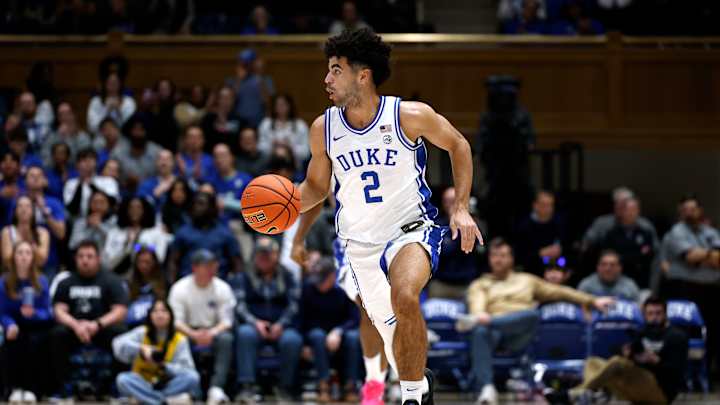
It wasn’t elegant. It wasn’t clean. But it was exactly the kind of win that championship-caliber teams stack in December.
Duke basketball improved to 11-0 on the season with a 97–73 victory over Lipscomb at Cameron Indoor Stadium, shaking off a disastrous first half to dominate the final 20 minutes. After committing 16 first-half turnovers and allowing a stunning 26–6 Lipscomb run, the Blue Devils regrouped, refocused, and reminded everyone why they are considered one of the most dangerous teams in the country.
Jon Scheyer’s group entered halftime clinging to a 48–45 lead, then flipped the switch defensively, outscoring the Bisons 49–28 in the second half while committing just six turnovers. The performance wasn’t about perfection—it was about growth, depth, and resilience. With a marquee matchup against No. 19 Texas Tech looming at Madison Square Garden, this tune-up revealed several critical truths about Duke’s identity.
Here are four critical observations Duke fans should take away from the win.
1. THE UGLY FIRST HALF IS NOT A WARNING SIGN
If there was ever a half of basketball to overreact to, Duke’s opening 20 minutes against Lipscomb might have been it. The Blue Devils looked rusty after a 10-day layoff, particularly on the defensive end. Lipscomb shot 45.2% from the field and 40% from three, while relentlessly capitalizing on Duke’s mistakes at the free throw line, going 13-of-14.
But context matters.
This was Duke’s longest break between games this season, and early sloppiness—especially defensively—is common after extended time off. What matters far more is how the team responded. In the second half, Duke re-established its defensive identity, holding Lipscomb to 33.3% shooting overall and just 23.1% from beyond the arc, while allowing only six free throw attempts.
That version of Duke—the disciplined, physical, suffocating defensive unit—is the real one. The first half was rust. The second half was reality.
2. DUKE MAY NOT NEED A “ROBIN” AFTER ALL
One of the most persistent storylines surrounding this Duke team has been the search for a consistent second scorer behind Cam Boozer. In tight, high-major games, Boozer has often been forced to carry the offensive load late, raising questions about long-term balance.
Against Lipscomb, Duke provided a convincing counterargument.
Rather than leaning on one secondary star, the Blue Devils showcased elite scoring depth. Duke finished with 37 bench points, and eight of the nine players who logged minutes scored at least six points. Even more impressively, all nine recorded at least one assist, highlighting unselfish ball movement and collective offense.
This kind of balance changes the equation. If Duke can consistently generate production from multiple sources, it alleviates pressure on players like Isaiah Evans and Caleb Foster to force offense. Instead of hunting for a singular Robin, Duke may thrive with a rotating cast of contributors—making the offense far harder to scheme against.
3. MALIQ BROWN IS EVOLVING INTO A COMPLETE IMPACT PLAYER
There’s no debate: Maliq Brown is one of the best defenders in college basketball. His instincts, versatility, and physicality anchor Duke’s defensive system. What Lipscomb revealed, however, is that Brown’s value doesn’t stop there.
The 6-foot-9 senior delivered his best offensive performance of the season, scoring 11 points on 5-of-6 shooting while grabbing nine rebounds, including six on the offensive glass, in just 21 minutes. He consistently punished Lipscomb with effort plays, finishing strong around the rim and creating second-chance opportunities.
Brown is often stationed in the dunker’s spot and tends to defer offensively—sometimes too much. This performance showed that when he looks to score, he can be a legitimate offensive weapon. Notably, this marked just his second double-digit scoring game of the 2025–26 season after none in 2024–25.
If Brown can provide even modest scoring consistency off the bench, Duke’s ceiling rises dramatically
4. REBOUNDING IS DUKE’S ULTIMATE WEAPON WHEN TRAILING
While Duke shot an efficient 52% from the field, the most dominant aspect of the performance came on the glass—and that’s where this team can separate itself against elite competition.
Duke obliterated Lipscomb 55–21 in total rebounds, including a jaw-dropping 20–3 advantage on the offensive boards. Those extra possessions translated into 26 second-chance points, completely wearing down the Bisons and flipping the game’s momentum.
This isn’t just a one-game anomaly. Duke is one of the biggest, longest, and most athletic teams in the nation, and when it commits to rebounding as a five-man responsibility, it creates a built-in offensive safety net. Missed shots don’t end possessions—they extend them.
Against stronger opponents, that ability to dominate the glass could be Duke’s go-to counterpunch when shots aren’t falling or when momentum swings the other way.
FINAL THOUGHT
The win over Lipscomb wasn’t about aesthetics—it was about answers. Duke showed it can respond to adversity, lean on depth, unlock new dimensions from key players, and impose its will physically. As the Blue Devils head to Madison Square Garden undefeated, they do so with clarity about who they are—and how dangerous they can become when everything clicks.




