


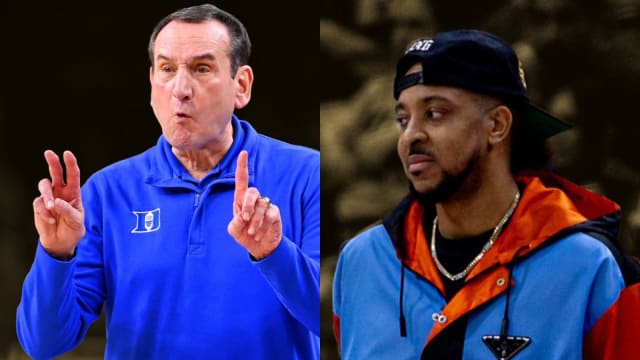
For CJ McCollum, the road to national recognition did not follow the traditional blueprint. He did not arrive at college basketball with five-star hype, national television exposure, or a list of blue-blood offers. Instead, his journey was shaped by overlooked talent, quiet dominance, and a chip on his shoulder that only grew with time. And at the center of that chip sat one program in particular — Duke.
Long before CJ McCollum became an NBA All-Star caliber guard, long before he carved out a reputation as one of the league’s most polished scorers, Duke represented something deeply personal to him. Not because they wronged him directly, but because they symbolized a system that never fully saw him. When McCollum later admitted, “I always hated Duke; they never recruited me,” it wasn’t bitterness speaking. It was honesty. And it explains why one night in March would change his life forever.
Coming out of high school, McCollum was a prolific scorer with a smooth offensive game and advanced feel for the sport. But he lacked the physical profile and national exposure that top programs often chase. Duke, like many powerhouse schools, recruits within a narrow pipeline. They look for players who check certain boxes early. McCollum did not fit neatly into that mold. As a result, he landed at Lehigh — a respected academic institution, but one rarely mentioned in conversations about Final Fours or NBA pipelines.
At Lehigh, McCollum didn’t just score. He dominated.
From his freshman season onward, he established himself as one of the most dangerous offensive players in the country. He led the nation in scoring as a sophomore and again as a junior. Night after night, he torched defenses with footwork, touch, and shot-making well beyond his years. Yet despite the numbers, the attention remained limited. Playing in the Patriot League meant fewer eyes, fewer highlights, and fewer opportunities to prove that his game translated against elite competition.
That reality only sharpened his focus.
McCollum has often spoken about motivation — about remembering who believed in him and who didn’t. Duke fell squarely into that second category. Not being recruited by the Blue Devils wasn’t an insult; it was fuel. Duke represented everything he was told he wasn’t ready for. Big stage. Bright lights. Elite athletes. NBA preparation. All of it became symbolic.
So when the NCAA Tournament bracket was revealed in 2012, and Lehigh found itself matched up against Duke in the round of 64, McCollum didn’t see a mismatch. He saw opportunity.
To most of the country, it was supposed to be routine. Duke, led by Coach Mike Krzyzewski and loaded with NBA-level talent, was expected to cruise. Lehigh was the underdog, a mid-major with little chance of survival. The storyline was predictable. The outcome felt prewritten.
Except CJ McCollum had other plans.
From the opening tip, it was clear that McCollum was playing with something extra. He attacked defenders without hesitation. He pulled up with confidence. He controlled the tempo like a seasoned pro. Duke defenders rotated, adjusted, and tried to contain him — but nothing worked. McCollum was relentless, composed, and fearless.
By halftime, the game was tight. By the second half, it was clear something historic was unfolding.
McCollum finished with 30 points, slicing through one of college basketball’s most disciplined defenses. More importantly, he led Lehigh to a stunning upset, eliminating Duke from the tournament and sending shockwaves through the sport. It wasn’t just an upset. It was a statement.
That night, CJ McCollum announced himself to the nation.
Later reflecting on the game, McCollum admitted how personal it was. Despite his respect for Coach K and the Duke program, the lack of recruitment lingered. He didn’t play with anger in a reckless sense. He played with purpose. With clarity. With the calm confidence of someone who had waited years for the right moment.
“This put me on the map right here,” McCollum said. “Just gave me a chance to play on the big stage.”
That stage mattered.
Duke was not just another opponent. It was the measuring stick. It was the program that symbolized elite validation. By beating Duke — and doing so convincingly — McCollum proved something to himself first, and to everyone else second.
The respect between McCollum and Coach Krzyzewski has always been real. McCollum has never dismissed Duke’s excellence or its legacy. In fact, he has spoken openly about admiring how the program operates. That duality is what makes his story compelling. He hated Duke in the competitive sense — not out of disrespect, but because they represented the challenge he needed to conquer.
Love and hate often coexist in sports. Respect and rivalry are not opposites. For McCollum, Duke was both the bar and the barrier.
After that tournament run, the perception of CJ McCollum shifted dramatically. Scouts began reevaluating his game. Analysts started asking whether his scoring would translate at the next level. Suddenly, his production in the Patriot League wasn’t dismissed — it was contextualized. The Duke game served as proof of concept.
He followed it up with another dominant season, averaging nearly 24 points per game as a senior. By the time the 2013 NBA Draft arrived, McCollum was no longer a curiosity. He was a legitimate lottery prospect.
The Portland Trail Blazers selected him 10th overall, a testament to how far he had climbed — and how much one night against Duke had altered his trajectory.
Looking back, it’s easy to frame the Duke game as destiny. But it was preparation meeting opportunity. McCollum didn’t suddenly become great that night. He revealed what had been there all along.
For Duke basketball, the story is a reminder of how thin the margins are in recruiting. Even the most accomplished programs miss on talent. Sometimes that talent comes back with something to prove. And sometimes, those moments become part of college basketball lore.
CJ McCollum’s night against Duke wasn’t about revenge. It was about validation. It was about showing that greatness can come from unexpected places. It was about reminding the sport that stars don’t always arrive through traditional doors.
“I always hated Duke,” McCollum said — but within that statement lies respect, competition, and the hunger that defines elite athletes.
In the end, Duke didn’t just play a role in CJ McCollum’s story. They helped write the chapter that changed everything.




