


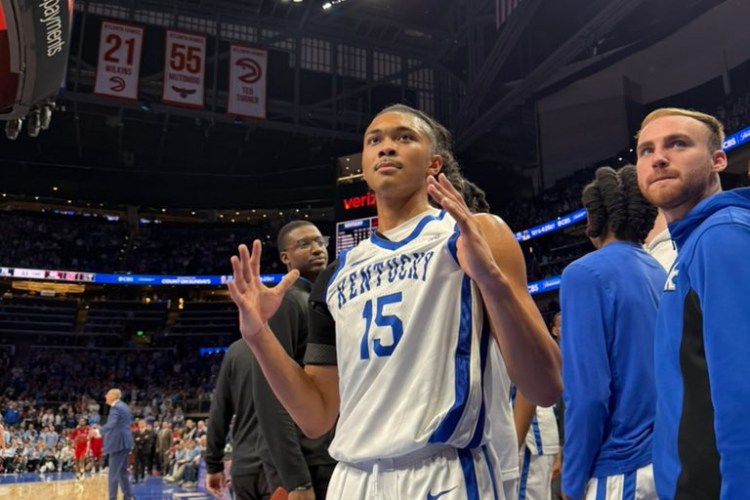
For a few uneasy minutes on Saturday afternoon, it felt like Kentucky basketball’s season was slipping through its fingers again. Not with a dramatic collapse or a shocking run by the opponent—but with one player slowly walking off the floor, holding his shoulder, and carrying the emotional weight of an entire fan base with him.
Jaland Lowe had barely settled into the game against St. John’s before disaster seemed to strike. A re-injured shoulder. A familiar fear. A sudden silence inside the arena. And for Kentucky fans who have watched this team struggle to find rhythm, leadership, and identity, the thought was unavoidable: not again.
What followed, however, wasn’t another chapter of frustration. It was a reminder of why college basketball still has moments that feel cinematic. Why one player, one decision, and one promise can flip the emotional direction of a season. Because when Jaland Lowe came back, everything changed—for the game, for the team, and for Kentucky’s outlook moving forward.
A Night Built on Anticipation… and Anxiety
Saturday’s matchup carried plenty of intrigue before the ball was even tipped. Kentucky entered the game with growing optimism, fueled by the debut of highly touted freshman Jayden Quaintance and the sense that, for once, the Wildcats might finally have a full roster available. Facing Rick Pitino and St. John’s only added to the intensity. Games involving Pitino never lack storyline, emotion, or scrutiny.
For Kentucky, this was supposed to be a measuring stick. A chance to show growth. A chance to prove that the early-season turbulence could give way to something more stable, more dangerous.
Then Jaland Lowe went down.
Within moments, the atmosphere shifted. Lowe exited early, and the initial reports sparked concern. Another shoulder dislocation? Another extended absence? For a team that looks vastly different—often unrecognizable—without him running the offense, the implications were enormous.
Jeff Goodman’s update later provided some relief: it was not a dislocation, just a shoulder shift. But in real time, Kentucky had to survive without its floor general. And what followed was all too familiar.
When Lowe Sits, Kentucky Stalls
With Lowe sidelined for virtually the entire first half, Kentucky’s offense reverted to its most troubling version. The ball stuck. Movement slowed. Decisions felt hesitant. What had been flashes of creativity earlier in the season vanished, replaced by possessions that drained both the shot clock and the crowd’s patience.
The Wildcats struggled to generate clean looks. The spacing shrank. Defensive pressure mounted. By halftime, Kentucky trailed by seven points, and the sense of unease was unmistakable. It wasn’t just about the score—it was about the eye test. Without Lowe, this team looked ordinary. Predictable. Vulnerable.
This has been the underlying concern all season. Kentucky’s ceiling is directly tied to Jaland Lowe’s presence. When he’s on the floor, the Wildcats play with pace, purpose, and confidence. When he’s not, they often look like a group still searching for an identity.
At halftime, the question wasn’t just whether Kentucky could come back in this game. It was whether Lowe would return at all—and what that decision might mean.
“I’m Gonna Go Out There and Live With It”
The turning point didn’t begin with a basket or a defensive stop. It began with music.
As the second half approached, Lowe’s entrance song played through the arena. He emerged for warmups, drawing a roar that felt less like excitement and more like relief. A few minutes later, the moment became official.
Lowe told his teammates at halftime what he intended to do.
“I told these guys at halftime, I’m gonna go out there and live with it.”
That sentence captured everything about the moment. The risk. The responsibility. The leadership. Lowe wasn’t just returning to a basketball game—he was choosing to carry his team forward despite uncertainty.
According to the exchange relayed after the game, the conversation with Mark Pope was simple and revealing.
Jaland Lowe: “I’m cleared to return.”
Mark Pope: “You sure?”
Jaland Lowe: “I promise.”
Sometimes leadership sounds exactly like that.
The Moment Everything Shifted
Lowe officially re-entered the game around the 17-minute mark of the second half. From that point on, the contest tilted decisively in Kentucky’s favor.
The offense immediately looked different. The tempo increased. Players cut with purpose. Shots came in rhythm rather than desperation. Kentucky wasn’t just executing better—it was playing freer.
Lowe finished the game with 13 points on an efficient 5-of-7 shooting, including 1-of-2 from beyond the arc. He added three rebounds and three assists, but the most telling number was his plus-minus: a game-high +20.
That stat told the story more clearly than any highlight could. When Lowe was on the floor, Kentucky controlled the game. When he wasn’t, they struggled to stay afloat.
The Wildcats erased the deficit, surged ahead, and never looked back. What felt like a game slipping away transformed into a statement win—one built on grit, adaptability, and belief.
Rick Pitino Noticed Immediately
Rick Pitino has seen thousands of basketball games. He knows when something changes.
After the game, Pitino didn’t hesitate to credit Lowe’s impact. He openly acknowledged that Kentucky is a completely different team with Jaland Lowe running the show. That kind of praise, coming from a Hall of Fame coach who has seen every style and system imaginable, carries weight.
Pitino also pointed out another crucial adjustment: Mark Pope’s decision to move away from a heavy reliance on three-point shooting when it wasn’t falling. Instead, Kentucky leaned into a more physical approach—attacking mismatches, defending with force, and playing through contact.
That combination—Lowe’s leadership and Pope’s flexibility—proved decisive.
Mark Pope’s Defining Moment
This game mattered for Mark Pope too.
Early in the season, criticism has followed him closely. Questions about rotations, offensive philosophy, and roster construction have dominated conversations among fans and analysts. Against St. John’s, Pope showed something important: adaptability.
Rather than stubbornly sticking to a failing plan, Pope adjusted. He trusted his players. He empowered Lowe to dictate the game. And he allowed Kentucky to win in a way that didn’t rely solely on jump shots.
That doesn’t solve every concern surrounding the season—but it does offer evidence that Pope is willing to evolve. In college basketball, that willingness can be the difference between stagnation and growth.
Why Jaland Lowe Is the Heartbeat of This Team
It’s no longer debatable: Jaland Lowe is Kentucky’s engine.
He doesn’t just initiate offense—he stabilizes it. He doesn’t just score—he organizes. His presence brings clarity to a team that has often looked scattered without him.
When Lowe plays, Kentucky looks dangerous. The defense tightens. The offense flows. Confidence spreads. Teammates play faster because they trust the decisions being made.
That trust was evident in the second half against St. John’s. Players cut harder. Shooters stepped into shots without hesitation. Bigs sealed defenders with conviction. Everything felt connected.
This wasn’t just about talent—it was about belief.
A Win That Means More Than the Score
Saturday’s victory won’t define Kentucky’s season on its own. There will be tougher tests ahead. Stronger opponents. More adversity.
But wins like this matter because they reveal something deeper.
They show how a team responds when its leader is tested.
They show whether adjustments can be made under pressure.
They show whether adversity fractures a group—or forges it.
Kentucky didn’t just survive this moment. It grew from it.
The Road Ahead—and the Biggest Priority
If there is one takeaway that matters more than any box score or quote, it’s this: Kentucky must keep Jaland Lowe healthy.
Everything about this team hinges on his availability. The offense. The confidence. The ceiling.
The Wildcats now have a blueprint. With Lowe directing traffic, a physical defensive approach, and flexibility in offensive philosophy, Kentucky looks capable of building momentum rather than chasing it.
But the margin for error remains thin. Another extended absence for Lowe could undo the progress made in one emotional afternoon.
From Wobble to Belief
For a brief moment, the season wobbled. Fear crept in. Doubt returned.
Then Jaland Lowe walked back onto the floor.
What followed wasn’t just a comeback—it was a reminder. A reminder that leadership still matters. That toughness still counts. That one player’s resolve can alter an entire narrative.
Kentucky didn’t just win a game against St. John’s. It rediscovered its heartbeat.
Now comes the challenge: building on it, protecting it, and turning one powerful moment into a season-defining run.




