


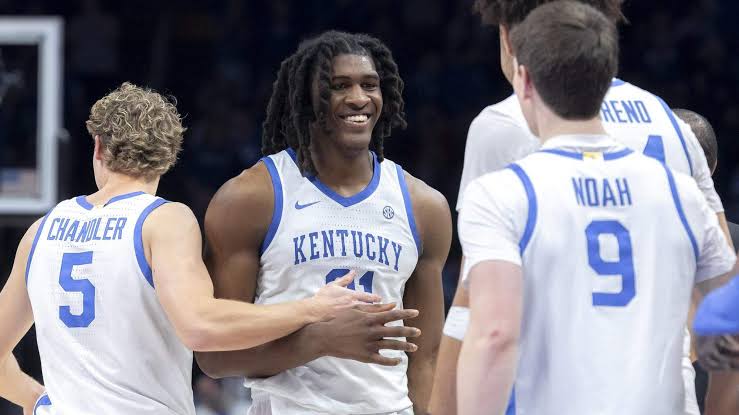
What happened at State Farm Arena on this night will be remembered for far more than the final score. Kentucky won a basketball game — yes — but what unfolded around it felt like a referendum on modern college basketball, NIL culture, portal-era identity, and whether belief can actually be rebuilt after it publicly shatters.
Just days earlier, the Kentucky Wildcats were humiliated in Nashville, dismantled by Gonzaga Bulldogs in a 35-point loss that felt less like a defeat and more like an exposure. Four games. Four name-brand opponents. Four losses. And worse than the numbers was the body language. No fire. No edge. No fight. Big Blue Nation booed. Loudly. Relentlessly.
In the aftermath, the criticism turned nuclear.
The roster — heavy with transfers, NIL deals, and short-term contracts — was labeled something far more damning than “inexperienced” or “unfinished.” They were called mercenaries. Paid. Talented. And, in that moment, seemingly disconnected from the weight of the jersey.
Even head coach Mark Pope, a former Wildcat who often speaks of Kentucky basketball as “sacred cloth,” didn’t push back. Instead, he absorbed it. Owned it. And then went quiet — at least publicly.
Rock Bottom Came With a Soundtrack of Booing
The loss to Gonzaga didn’t just bruise Kentucky’s résumé. It fractured trust.
Former players weighed in. Analysts questioned effort. Fans wondered aloud whether this team cared. And one of the harshest critiques came from within Kentucky’s own orbit, where the portal-heavy roster was accused of wearing the uniform without understanding it.
That critique lingered as Kentucky returned to the floor at State Farm Arena. This wasn’t just another neutral-site game. It was a referendum. Lose again, and the season narrative hardens. Win without passion, and the doubts remain.
But something felt different from the opening minutes.
The Win Mattered — The Response Mattered More
Kentucky didn’t look perfect. They didn’t look polished. But they looked alive.
They defended with purpose. They talked. They competed for loose balls. They reacted to mistakes instead of sulking through them. It wasn’t beautiful basketball — it was defiant basketball.
And when the final buzzer sounded, the reaction wasn’t relief. It was release.
Players hugged. Pope exhaled. And the tone around the program shifted from autopsy to argument.
Because now the question wasn’t “Is Kentucky broken?”
It became “Why did it take this long?”
A Postgame Moment That Changed the Conversation
Then came the postgame — and that’s where this night went from important to unforgettable.
In a moment that spread instantly through social media and message boards, Pope’s postgame interactions sparked what one coach later described as a “drive-by.” The moment involved Rick Pitino, Kentucky’s most complicated modern figure, whose mere presence always stirs emotion within Big Blue Nation.
What followed was commentary — and criticism — from Bruce Pearl, who publicly called out the exchange, framing it as symbolic of the tension, ego, and emotional volatility surrounding Kentucky basketball right now.
It was raw. Public. Uncomfortable.
And somehow, perfectly fitting.
The Hollywood Confession That Flipped the Script
Perhaps the most striking moment didn’t come from a coach or a player — but from the commentary surrounding it all.
One prominent voice, who had previously labeled the Wildcats “overpaid, heartless mercenaries,” offered a stunning public reversal. Quoting Happy Gilmore — “I was wrong, you were right” — the confession wasn’t sarcastic. It was sincere.
The admission carried weight because it reflected what many fans were feeling but hadn’t yet said out loud:
Maybe we buried them too fast.
Not because Kentucky suddenly looks elite — they don’t.
But because effort returned. And with it, belief.
Was This Team Ever Really Dead?
That’s the question now dividing Big Blue Nation.
One side argues the criticism was earned. That effort should never need booing to appear. That wearing Kentucky across your chest demands intensity from day one.
The other side sees something else: a young team, assembled quickly, crushed early, and finally forced to confront who they wanted to be — together.
What’s undeniable is this: Kentucky didn’t just win a game. They changed the emotional trajectory of their season.
What Comes Next Will Decide Everything
One win doesn’t erase Nashville.
One night doesn’t rebuild legacy.
And one emotional surge doesn’t guarantee consistency.
But it does reopen the door.
Mark Pope now faces the real test — sustaining accountability without panic, passion without chaos. The roster must prove this wasn’t a one-night reaction but a turning point.
Because in Kentucky, belief is currency. Lose it, and nothing else matters.
On this night, amid boos, confessions, coaching drama, and a fanbase arguing with itself, the Wildcats reminded everyone of something easy to forget:
Sometimes teams don’t die.
Sometimes they wait — until everyone stops believing — to show you who they really are.




