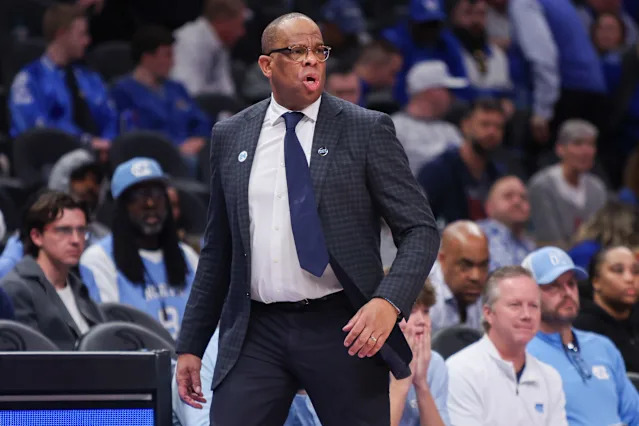
What unfolded Saturday afternoon at the CBS Sports Classic was the kind of game that reminds everyone why college basketball remains one of the most emotionally gripping sports in America. For long stretches, No. 12 North Carolina looked poised to secure a comfortable, résumé-boosting victory over Ohio State. The Tar Heels built a double-digit lead, controlled the tempo, and appeared to have the Buckeyes on the ropes. Then, suddenly, everything tightened. Ohio State surged. The lead vanished. The arena buzzed. And for a tense final minute, it felt like an upset was not only possible — it was imminent.
In the end, UNC survived. The Tar Heels executed just well enough down the stretch to escape with a narrow win, denying Ohio State what would have been one of the most impressive victories of its young season. But the final score only tells part of the story. The real insight came afterward, when North Carolina head coach Hubert Davis stepped to the podium and offered candid, thoughtful reflections on the Buckeyes, the closing moments, and what the game revealed about his own team.
Those postgame comments, delivered calmly but with clear respect for the opponent, painted a fuller picture of a game that was far closer — and far more revealing — than the result alone might suggest.
A Game That Shifted in an Instant
For much of the afternoon, North Carolina looked like the more polished team. The Tar Heels moved the ball crisply, generated quality looks, and defended with discipline. Ohio State, meanwhile, struggled to find rhythm early. Shots didn’t fall. Defensive rotations were a half-step late. And when UNC pushed its lead into double figures, it felt like the game might drift toward a routine finish.
But college basketball rarely cooperates with expectations.
Ohio State began to chip away, possession by possession. Defensive stops turned into transition opportunities. Confidence grew. The Buckeyes’ energy lifted, and suddenly UNC’s once-comfortable margin began to feel fragile. With under a minute remaining, Ohio State completed its furious rally, briefly grabbing the lead and sending a jolt of tension through the building.
That moment — when momentum fully swung — was one Hubert Davis acknowledged afterward as both challenging and revealing.
Hubert Davis on Composure Under Pressure
One of the central themes of Davis’ postgame remarks was composure — or, more specifically, the importance of maintaining it when games tighten and emotions spike.
As Ohio State surged late, Davis admitted the situation tested his group. The Tar Heels, despite their experience and ranking, were forced to respond to genuine adversity. According to Davis, those moments are where teams either fracture or mature.
Rather than panic, UNC leaned into execution. Davis praised his players for staying connected, trusting their principles, and making the simple plays that often decide close games. He emphasized that late-game situations aren’t about drawing up something spectacular — they’re about clarity, discipline, and belief.
Those final possessions, Davis suggested, reflected growth. North Carolina didn’t win because Ohio State failed; it won because, when the margin for error vanished, the Tar Heels were just a bit more composed.
Respect for Ohio State’s Talent and Toughness
Perhaps the most striking aspect of Davis’ postgame comments was the respect he showed Ohio State. There was no framing the Buckeyes as an overmatched team that simply caught fire. Instead, Davis spoke as if he expected this kind of challenge.
He highlighted Ohio State’s physicality, effort, and competitive spirit, noting that the Buckeyes never stopped playing — even when the scoreboard suggested the game might slip away. That resilience, Davis implied, is the hallmark of a well-coached team still discovering its ceiling.
In particular, Davis singled out Ohio State’s key contributors, making it clear that their late-game success was no accident.
The Challenge of Guarding Devin Royal
One of the players Davis specifically addressed was Devin Royal, whose impact on the game was felt in multiple ways. Davis acknowledged how difficult Royal was to contain, pointing to his combination of strength, activity, and instincts.
Royal’s ability to create problems around the basket, extend possessions, and disrupt defensive schemes forced UNC to adjust repeatedly. Davis noted that even when Royal wasn’t scoring, his presence demanded attention — opening lanes for teammates and putting pressure on North Carolina’s interior defense.
For a coach who values defensive accountability as much as Davis does, admitting how challenging a matchup was speaks volumes. It wasn’t criticism of his own players; it was recognition of an opponent who consistently made winning plays.
Praise for Bruce Thornton’s Leadership
Davis also made a point to acknowledge Bruce Thornton, whose leadership and poise fueled Ohio State’s comeback. Thornton’s calm under pressure, Davis noted, was evident as the Buckeyes clawed back into the game.
According to Davis, Thornton controlled the pace, made smart decisions, and gave Ohio State belief during the most critical stretch of the contest. That belief, once established, became contagious.
Davis’ comments underscored something many coaches privately believe but don’t always say publicly: great guards can change the emotional temperature of a game. Thornton did exactly that, turning what felt like a lost cause into a genuine threat.
What UNC Learned About Itself
While much of Davis’ postgame attention focused on Ohio State, he was equally reflective about his own team. Games like this, he suggested, are invaluable — especially early in the season.
Davis emphasized that North Carolina is still learning who it is. Wins matter, yes, but the lessons embedded within them matter even more. Allowing a big lead to evaporate is not something to celebrate, and Davis didn’t pretend otherwise. Instead, he framed it as a teaching opportunity.
He pointed out lapses in execution, moments where UNC could have been sharper, and stretches where urgency dipped. Those details, Davis said, will be addressed in film sessions and practices.
At the same time, he made it clear that surviving a late-game test against a desperate, talented opponent can accelerate growth. Teams that are never challenged rarely develop the habits required to win in March.
The Thin Line Between Confidence and Complacency
One subtle but important theme in Davis’ remarks was the balance between confidence and complacency. North Carolina, he implied, walked that line during the middle portion of the game.
Building a lead can sometimes relax a team — just enough for an opponent to sense opportunity. Davis suggested that Ohio State capitalized on that window, turning UNC’s brief loss of edge into sustained momentum.
That acknowledgment wasn’t harsh, but it was honest. Davis has consistently preached that effort and focus must remain constant, regardless of the score. Saturday’s game, he hinted, reinforced that message in real time.
Ohio State’s “What If” Moment
For Ohio State, the loss will linger — not because it was embarrassing, but because it was so close to transformative.
A win over a top-15 North Carolina team on a neutral floor would have instantly elevated the Buckeyes’ national profile. Instead, they’re left with questions and “what ifs.” What if the rally started two minutes earlier? What if one more defensive stop materialized? What if a single shot fell differently?
Davis acknowledged that reality indirectly, noting that Ohio State played well enough to win. Sometimes, he said, the difference comes down to a handful of possessions — and that was certainly the case here.
At 8–3, Ohio State still has ample opportunity ahead, but this game will stand as a reminder of how thin the margins are at the highest level.
Why This Game Matters Moving Forward
From North Carolina’s perspective, this wasn’t just a December win — it was a test of identity. Ranked teams are expected to win games like this, but how they win often reveals more than the result itself.
Davis’ postgame comments suggested that he views this game as a checkpoint. Not a warning sign, but a moment of reflection. The Tar Heels saw both their strengths and vulnerabilities exposed in the span of 40 minutes.
They showed they can build commanding leads against quality opponents. They also learned that maintaining intensity for a full game remains a work in progress.
A Coach’s Perspective Beyond the Scoreboard
Perhaps the most telling aspect of Hubert Davis’ postgame remarks was their tone. There was no chest-thumping, no dismissal of Ohio State’s effort, and no overreaction to the scare his team had just endured. Instead, Davis spoke with the steadiness of a coach who understands that seasons are not defined by single moments, but by how teams respond to them.
There was an absence of excuses in his words. No complaints about officiating. No emphasis on fatigue or circumstance. Davis did not frame the late Ohio State surge as something that “shouldn’t have happened.” He framed it as something that did happen — and something his team must learn from.
That tone matters. It reflects a program mindset that prioritizes accountability over comfort. Davis was not interested in protecting narratives; he was interested in protecting standards.
The Value of Being Tested Early
One of the underlying messages in Davis’ postgame reflection was that early-season adversity can be a gift if handled correctly. North Carolina, like many highly ranked teams, will often face opponents who tighten up against them or fade when things go wrong. Ohio State did neither.
Instead, the Buckeyes forced UNC into uncomfortable basketball — late-clock possessions, physical rebounds, contested decisions. Davis acknowledged that those experiences are essential if a team hopes to be prepared when the stakes rise later in the year.
He suggested that games like this expose habits that might otherwise remain hidden. How players communicate when the lead shrinks. Who demands the ball. Who makes the extra rotation. Those answers only surface under pressure.
In that sense, the narrow escape may ultimately be more valuable than a dominant win.
Trust, Communication, and Collective Response
Davis also alluded to trust — both in teammates and in the system. When Ohio State surged, UNC could have fractured into individual efforts. Instead, Davis noted, his players leaned on each other.
That trust showed in subtle ways: a pass instead of a forced shot, a switch executed cleanly, a defensive stop followed by patience on the other end. Those moments rarely generate headlines, but they often decide outcomes.
For Davis, those details reinforced belief in the group he is building. Not a perfect group, but one capable of responding collectively when tested.
Ohio State’s Performance in a Bigger Picture
While the result stung for Ohio State, Davis’ words suggested that the Buckeyes left the floor with something tangible. They proved — to themselves and to others — that they can compete with elite programs on neutral floors.
That belief can be powerful. Teams that experience near-upsets often carry that edge forward, sharper and more confident. Davis seemed aware that Ohio State’s season will not be defined by this loss, but potentially strengthened by it.
His respect was not abstract; it was grounded in recognition of quality basketball.
The Lingering Takeaway
When all is said and done, this game will not be remembered simply as a narrow UNC win or a missed Ohio State opportunity. It will be remembered as a reminder of how quickly momentum can shift, how thin the margins are, and how revealing pressure can be.
Hubert Davis’ postgame words told that story clearly. They captured the emotional swing of the game, the quality of the opponent, and the ongoing evolution of his own team.
North Carolina walked away with a victory but also with lessons. Ohio State walked away with disappointment but also with belief. And in college basketball, especially in December, that balance often shapes everything that comes next.