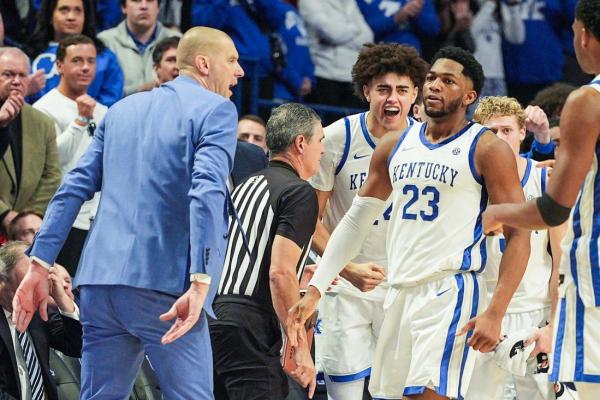
Sixteen days ago, Kentucky basketball didn’t just lose a game — it lost the room. On a neutral floor in Nashville, the Wildcats were dismantled 94–59 by Gonzaga, a loss so lopsided that the final score almost undersold how helpless it felt. Even more jarring than the margin was the sound that followed it: boos. Real ones. Loud ones. From fans wearing blue, stunned not just by defeat, but by what looked like a complete absence of fight. For a program built on pride, effort, and national relevance, it felt like a moment that could fracture something deeper.
That night didn’t end when the horn sounded. Former Kentucky star DeMarcus Cousins added fuel to the fire, publicly questioning the heart of the team on social media. It was a blunt assessment, and one many fans privately agreed with. This wasn’t just about missed shots or bad matchups. It was about identity — or the lack of one.
Sixteen days later, the conversation around Kentucky feels different. Not euphoric. Not fixed. But different. And sometimes, that’s how a season begins to turn.
Rock Bottom Has a Way of Clarifying Everything
Every season has a defining low point. For some teams, it comes early. For others, it arrives when expectations are highest. For this Kentucky group, the Gonzaga loss was unmistakably that moment. It stripped away illusions and forced an uncomfortable reckoning.
Mark Pope didn’t dodge it. He didn’t spin it. He didn’t deflect blame. When asked about Cousins’ comments, Pope’s response was telling in its honesty.
“I have no issue with what he said,” Pope said. “Starting with the coach, this problem is completely unacceptable.”
That sentence mattered. Not because it erased the loss — but because it acknowledged the truth fans felt in their gut. Kentucky wasn’t just losing. Kentucky wasn’t being Kentucky.
Accountability Before Answers
When a team hits bottom, the next step isn’t always immediate improvement. Sometimes, it’s acceptance. Pope’s willingness to absorb criticism — publicly — sent a message to his locker room. This wasn’t a coach hiding behind scheme or youth or bad luck. This was a coach demanding ownership.
Inside the program, the response wasn’t dramatic. There were no fiery press conferences or emotional guarantees. Instead, there was recalibration. Practices tightened. Roles were reexamined. The staff began to ask a harder question: Who are we actually built to be right now?
That question doesn’t produce instant wins. But it produces direction.
The First Signs of a Pulse
The turnaround didn’t announce itself with a marquee win. It started quietly. Kentucky took care of North Carolina Central, doing what good teams are supposed to do against inferior opponents. The performance didn’t erase doubts, but it steadied the floor.
Then came Indiana. Rivalry games don’t allow for half-effort. Kentucky didn’t play perfectly, but it fought. When adversity hit, it responded. That alone felt like progress.
And then came Atlanta.
Against a ranked St. John’s team — one that had bullied Kentucky in recent years — the Wildcats didn’t blink. They defended. They rebounded. They executed late. The 78–66 win snapped a six-game losing streak against ranked opponents and, more importantly, confirmed something had shifted internally.
This wasn’t a fluke.
A Team Learning How to Suffer Together
Mark Pope has spoken often about “the journey of a season,” and after the St. John’s win, his comments revealed something deeper than relief.
“We’re writing our story,” Pope said. “And I think we have the right guys to do it. It’s just been slow for us to figure out and embrace exactly who we are.”
That slowness isn’t a flaw. It’s reality for a roster learning new expectations, new roles, and a new emotional standard. Kentucky’s early struggles weren’t about talent alone — they were about cohesion. About learning how to suffer without splintering.
Great teams don’t avoid pain. They learn how to process it.
Health: The Quiet Variable That Changes Everything
One of the biggest reasons optimism is creeping back into Big Blue Nation isn’t strategy it’s availability. Kentucky is finally starting to look like itself physically.
Jaland Lowe’s return has been massive. The Pitt transfer missed time with a preseason shoulder injury, and his absence left a void in consistency and scoring punch. In his last two games, Lowe has scored 13 points in each, providing reliable production and calm on the perimeter.
He doesn’t force the game. He doesn’t disappear. He gives Kentucky something it badly needed during the skid: stability.
And then there’s Jayden Quaintance.
Jayden Quaintance Changes the Geometry of the Floor
Highly touted and long-awaited, Quaintance finally made his season debut against St. John’s. In limited minutes, the 6-foot-10 freshman delivered 10 points and eight rebounds numbers that only hint at his impact.
More important than the stat line was how Kentucky looked with him on the floor. The paint was protected. Rebounding became less frantic. Guards defended more aggressively knowing help was behind them.
Quaintance, who tore his ACL in February, looked comfortable. Confident. Ready.
“I felt like my conditioning was good,” he said. “If I was able to have my time to shine, I’d make it my moment — and I feel like I did that.”
That confidence matters. Kentucky hasn’t had a true interior anchor all season. Quaintance’s emergence doesn’t just fill a position — it stabilizes the system.
Pope’s Patience Is Intentional
Mark Pope isn’t rushing Quaintance, and that restraint is telling. He understands the long view.
“Jayden’s health is so good right now,” Pope said. “But it’s going to be a matter of how he feels in the morning.”
That comment reflects a coach thinking beyond the next possession. With SEC play looming, Kentucky doesn’t need Quaintance at 100 percent in December it needs him durable in February and March.
That kind of planning signals belief.
Effort vs. Identity
One of the loudest criticisms after the Gonzaga loss was effort. And while it was fair in the moment, Pope has since reframed the narrative.
This team hasn’t lacked effort. It’s lacked clarity.
There’s a difference between trying hard and knowing how to play hard together. Early in the season, Kentucky’s energy was scattered. Players tried to do too much individually, especially when things went wrong.
Now, the effort looks more connected. Rotations are sharper. Defensive communication is louder. Offensive possessions feel more purposeful.
That’s not coincidence. That’s growth.
Why the Timing Matters
Kentucky hosts Bellarmine next — a game that should serve as a tune-up, not a trap. After that, there’s a rare gift in college basketball: time. A 10-day break before opening SEC play at Alabama.
That stretch could be transformational.
It gives Pope a chance to:
Integrate Quaintance fully
Solidify rotations
Refine defensive principles
Reinforce offensive spacing
Build trust within lineups
Most importantly, it gives this team time to breathe — something it hasn’t done much of this season.
Big Blue Nation’s Role in the Turnaround
Kentucky fans are demanding. Always have been. But they are also deeply loyal to effort and accountability. The boos in Nashville weren’t personal — they were emotional.
What fans have seen since then is a team responding instead of retreating.
That matters.
Belief doesn’t return overnight. It rebuilds possession by possession. Game by game. And right now, Kentucky is earning the right to be believed in again.
The Story Is Still Being Written
Kentucky isn’t fixed. It isn’t finished. It isn’t fully formed.
But it’s no longer drifting.
From a humiliating night in Nashville to a ranked win in Atlanta, the Wildcats have begun to reshape their narrative — quietly, deliberately, and honestly.
Mark Pope said it best himself: even when it’s bad, the pain makes the good nights matter more.
Sixteen days ago, Kentucky hit its lowest point.
Now, it’s climbing — not loudly, not arrogantly, but with purpose.
And sometimes, that’s how belief is born.
If you want next:
A Facebook teaser caption
A strong CTA ending
A follow-up article angle (SEC preview, Pope’s culture, Quaintance spotlight)
Or a headline tweak for even higher engagement
Just say the word.