


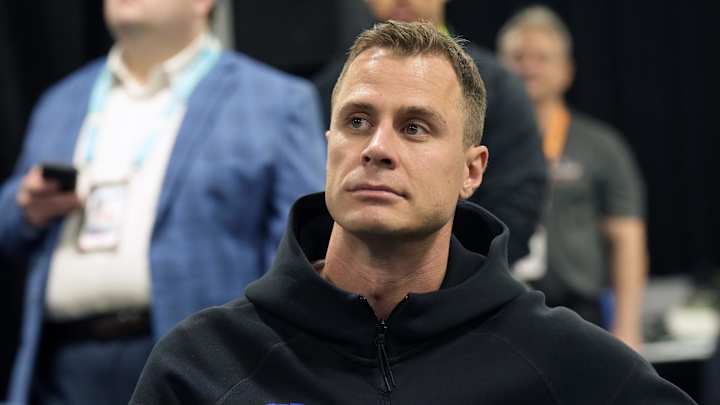
The fourth-year Duke basketball head coach fully understands that it’s impossible to please everybody all the time.
In light of Saturday night’s 82–81 loss at the hands of the Texas Tech Red Raiders in Madison Square Garden, any remaining celebratory Duke basketball mood stemming from Jon Scheyer’s 100th career win as head coach of the Blue Devils has surely long since ceased.
After all, any recognition of it now would just serve as a reminder that he’s still stuck on that count, as he would obviously prefer sitting at 101 and in preparation mode for snagging No. 102.
But during his appearance on last week’s feel-good episode of The Brotherhood Podcast alongside associate head coach Chris Carrawell, the 38-year-old Scheyer opened up about the challenges in his job. And he did so in a way that, now looking back to Saturday night, might give any folks who tend to overreact to defeats a better perspective on just how difficult it is to lead the Duke basketball powerhouse in this day and age of college hoops.
The Weight of the Logo
There may be no logo in college basketball that carries more immediate expectations than the interlocking “D” worn by Duke. Every season begins not with questions of if Duke will be good, but how far Duke will go. Sweet Sixteen? Elite Eight? Final Four? National title? Anything less is often framed as failure by sections of the fan base and media alike.
Jon Scheyer didn’t inherit just a job when he took over for Mike Krzyzewski. He inherited a standard built over more than four decades, one forged through championships, NBA stars, iconic moments, and an uncompromising culture of excellence. And as Scheyer himself acknowledged on the podcast, that reality creates his biggest challenge: managing expectations while building something authentic in his own voice.
“You’re not going to make everyone happy,” Scheyer said, explaining that leading Duke requires learning to live with criticism even when you’re doing the right things behind the scenes.
That statement may sound simple, but at Duke, it’s profound.
Living in Coach K’s Shadow — By Design
Scheyer has never run from the fact that he followed a legend. In fact, he embraces it. He played for Coach K. He won a national championship under him. He sat beside him on the bench. And yet, the transition from disciple to decision-maker is one few truly understand unless they’ve lived it.
Every rotation decision, every late-game timeout, every offensive set is inevitably compared to how Krzyzewski might have handled it. And while Scheyer benefits from that lineage, he is also judged against an almost impossible benchmark.
On The Brotherhood Podcast, Scheyer was candid about the reality that Duke basketball isn’t just about wins and losses — it’s about perception, identity, and maintaining trust across generations of fans, former players, boosters, and recruits.
That burden doesn’t go away when you win your 100th game. If anything, it intensifies.
The Modern College Basketball Minefield
Scheyer’s biggest challenge isn’t just external pressure. It’s the evolving nature of the sport itself.
College basketball in 2025 looks nothing like it did even five years ago. NIL has changed recruiting. The transfer portal has changed roster continuity. Social media has changed how players, coaches, and programs are discussed in real time.
Scheyer alluded to the fact that today’s head coach must wear more hats than ever before: recruiter, mentor, manager, psychologist, brand ambassador, and public lightning rod.
One loss — like the one against Texas Tech — doesn’t just live on the scoreboard. It lives on Twitter timelines, message boards, talk shows, and highlight clips dissected frame by frame.
That environment makes patience a rare commodity.
The Texas Tech Loss in Context
Saturday night’s one-point loss at Madison Square Garden is a perfect example of why Scheyer’s perspective matters.
Duke played a high-level opponent on a neutral floor in a pressure-packed setting. The game came down to execution in the final possessions. One bounce, one call, one defensive rotation — that’s the margin.
Yet in the aftermath, the noise grew loud. Questions surfaced about late-game play calling, rotations, toughness, and whether Duke “has it.”
Scheyer understands that reaction comes with the territory. But he also understands that building a championship-caliber team is not a straight line.
“You’re constantly evaluating,” he explained on the podcast. “You’re constantly learning. And sometimes growth doesn’t look pretty in the moment.”
That mindset is critical for a coach leading young players through adversity.
Coaching Players, Not Just Talent
One of Scheyer’s most notable points was about coaching people, not rankings.
Duke continues to recruit elite talent, but today’s roster construction is more complex than stacking McDonald’s All-Americans. Players arrive with brands, expectations, and external voices influencing their journeys.
Scheyer has made it clear that one of his core priorities is maintaining genuine relationships with his players — even when decisions are unpopular.
Playing time, roles, and accountability are sensitive topics everywhere, but at Duke, they’re magnified. Scheyer admitted that honesty, even when difficult, is non-negotiable.
That approach doesn’t always win immediate approval. But it builds long-term trust — the kind that sustains a program beyond one season.
Learning to Tune Out the Noise
Perhaps the most revealing part of Scheyer’s discussion was his acknowledgment that early in his tenure, he cared too much about outside opinions.
That’s a natural instinct, especially for a young head coach in one of the most scrutinized positions in sports. Over time, Scheyer has learned that leadership requires conviction.
“You can’t coach scared,” he said. “You can’t make decisions based on what people might say.”
That evolution is crucial. Duke doesn’t need a caretaker afraid to deviate from expectations. It needs a leader willing to make hard choices, absorb criticism, and stay the course.
Brotherhood Still Matters
Despite changes in the sport, Scheyer remains anchored to Duke’s defining principle: Brotherhood.
On the podcast, alongside Chris Carrawell, Scheyer emphasized that the program’s foundation hasn’t shifted — even if the landscape has. Accountability, connection, and pride in wearing the jersey still define Duke basketball.
That culture doesn’t always show up immediately in wins. Sometimes it reveals itself in how teams respond to losses.
How Duke responds to the Texas Tech defeat — in practice intensity, defensive commitment, and togetherness — may matter more than the loss itself.
The Long View
At 38, Jon Scheyer is still one of the youngest head coaches at the highest level of college basketball. He is learning in public, under a microscope, while trying to honor a legacy without being imprisoned by it.
His biggest challenge, as he named it, is not drawing up plays or recruiting five-stars. It’s navigating expectation, criticism, and evolution without losing himself or the program’s core identity.
That’s not a challenge with a finish line.
As Duke fans digest another close loss and reset their expectations, Scheyer’s words offer an important reminder: success at Duke has never been about avoiding adversity. It’s about responding to it with clarity, purpose, and resilience.
The win count will move past 100. No. 101 will come. So will No. 102. But the real work — leading Duke basketball in a new era — continues every day, often far away from the scoreboard.
And that may be Jon Scheyer’s greatest test — and his greatest opportunity.




