


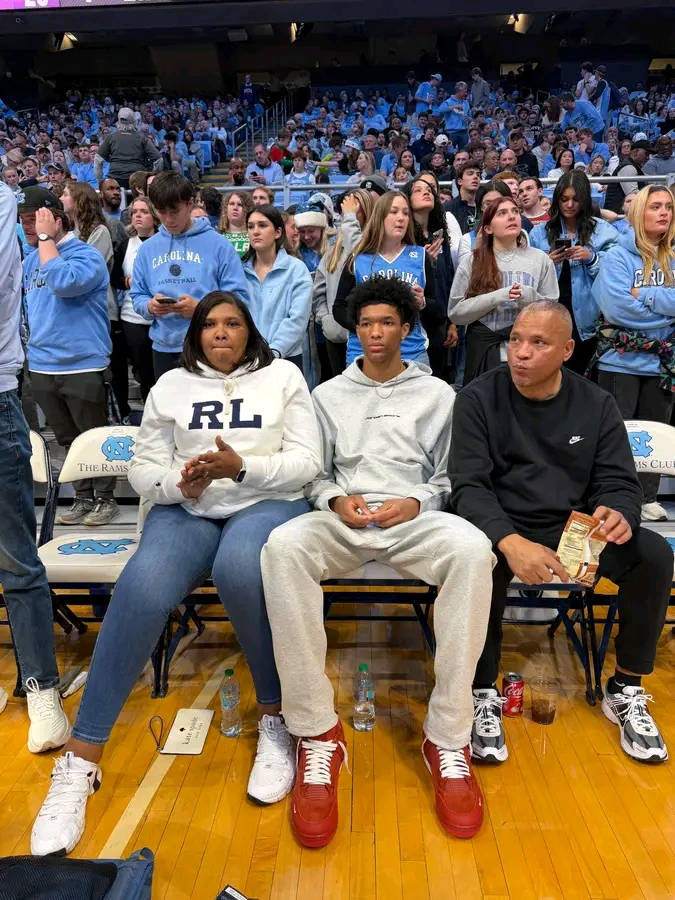
On the surface, it looked like just another college basketball night. North Carolina facing East Carolina, a packed building, noise pouring down from the stands, and fans locked in on every possession. But somewhere in that crowd sat a figure who wasn’t cheering every basket or groaning at every missed shot. He was watching differently. Studying. Processing. And by the time word began to spread that a Tar Heels basketball recruit was in attendance, the game had quietly taken on an entirely different meaning.
This wasn’t just about UNC versus ECU anymore. This was about evaluation, fit, and future.
And yes, it was also about the shoes.
A Different Kind of Spectator
College basketball arenas are filled with all kinds of people on game night: diehards, casual fans, alumni reliving old memories, students creating chaos. But recruits sit in a category all their own. When a high-level prospect attends a game, he’s not just watching the ball move from one end of the floor to the other. He’s watching everything.
How does the offense flow?
How are players used within the system?
What does the crowd sound like when the game tightens?
How does the coaching staff communicate?
Who gets empowered late?
Who gets held accountable?
So when word circulated that a Tar Heels recruit was at the UNC–ECU game, it immediately sparked speculation. Not because recruits attending games is rare—but because every detail suddenly matters.
And fans noticed one detail in particular.
The Jordans That Started the Conversation
North Carolina basketball and the Jordan Brand are inseparable. They share a history, a legacy, and a cultural footprint that few programs in any sport can match. So when fans noticed that the recruit in attendance was wearing Jordans, the symbolism felt impossible to ignore.
Was it intentional? Possibly.
Was it coincidence? Also possible.
Was it enough to set social media buzzing? Absolutely.
In the world of recruiting, nothing is officially a sign—until it is. But perception matters, and Jordan Brand affiliation has always been part of UNC’s recruiting identity. From Michael Jordan himself to generations of Tar Heels who followed, the brand carries weight. When a recruit chooses to wear Jordans while watching UNC play, fans naturally read into it.
Not as proof.
Not as a commitment.
But as interest.
And interest is where every recruiting story begins.
Watching the Game Through a Recruit’s Eyes
While fans focused on runs, whistles, and momentum swings, the recruit likely saw something entirely different. For him, the game was a live résumé of the Tar Heels program.
How does UNC space the floor?
How physical is the defense?
How do guards and bigs interact?
Is the pace compatible with his strengths?
Would his skill set be amplified or limited here?
These are not abstract questions. They are central to every recruiting decision. A prospect doesn’t commit to a logo alone—he commits to an ecosystem. A system. A role. A pathway.
And games like UNC–ECU provide a rare opportunity to see that ecosystem functioning in real time, under pressure, in front of a loud crowd.
The Crowd Matters More Than Fans Realize
One of the most underrated factors in recruiting is the environment. Not just how loud it gets, but how it feels. Recruits pay close attention to how fans engage with the team, how they respond to adversity, and how they treat players when things don’t go perfectly.
UNC has long sold atmosphere as part of its appeal—especially in games that showcase the program’s reach and passion beyond Chapel Hill itself. For a recruit sitting quietly in the stands, the crowd is part of the pitch.
Does the energy lift the players?
Does it intimidate opponents?
Does it feel like a place you’d want to play on a big night?
The ECU game may not have been a marquee rivalry, but that doesn’t matter. In some ways, it’s the perfect setting to evaluate authenticity. Big games can feel staged. Smaller moments reveal culture.
Why “Fit” Is the Real Story
Modern recruiting is no longer just about talent accumulation. Elite prospects are increasingly selective about fit. They want to know where they’ll be developed, how they’ll be used, and whether their game will translate to the next level.
For UNC, that evaluation cuts both ways.
The Tar Heels staff is watching the recruit.
The recruit is watching the Tar Heels.
He’s looking at:
Player movement without the ball
Defensive communication
Transition habits
Coaching adjustments
Body language in tough stretches
These details tell a story no highlight tape ever could.
And that’s why his presence mattered—even without a single word spoken.
The Silence That Fuels Speculation
One of the reasons this moment gained traction is because it happened quietly. No official visit announcement. No public quotes. No on-camera spotlight. Just a recruit in the stands, observing.
Silence in recruiting is powerful. It creates space for imagination, hope, and debate. Fans begin connecting dots. Analysts start weighing probabilities. Message boards light up with theories.
Is UNC leading?
Is this a serious evaluation?
Is this the kind of game that could tip the scales?
None of those questions have definitive answers yet—but the fact they’re being asked speaks volumes.
UNC’s Recruiting Identity in a New Era
North Carolina basketball sits at an interesting intersection. Tradition remains a powerful draw, but the modern game demands adaptability. NIL, the transfer portal, and changing player priorities have reshaped how recruits view programs.
UNC still sells:
Development
Exposure
Brand power
NBA pathways
A passionate, national fan base
But recruits today also want:
Clear roles
Honest communication
Flexibility
Long-term growth
By attending the UNC–ECU game, this recruit was likely assessing whether the Tar Heels align with both worlds—the historic and the modern.
Why Fans Care So Much
Fan reaction isn’t just about excitement. It’s about identity. Recruiting is the future made visible. When fans see a recruit in the building—especially one wearing Jordans—it feels like a glimpse into what’s coming next.
UNC fans are deeply invested not only in wins, but in continuity. They want to believe the next great Tar Heel is already imagining himself in Carolina blue. Moments like this feed that belief.
And while overreaction is easy, curiosity is natural.
What This Does—and Does Not—Mean
Let’s be clear.
This does not mean:
A commitment is imminent
UNC is the leader
The shoes confirm anything
A decision has been made
But it does mean:
UNC is firmly on the recruit’s radar
The program was being evaluated seriously
The environment mattered enough to show up
The experience left an impression—good or bad
In recruiting, impressions are everything.
The Long Game
Some recruiting stories unfold quickly. Others simmer for months or even years. This moment falls squarely into the latter category. It’s a chapter, not a conclusion.
But it’s an important chapter because it reminds everyone that recruiting doesn’t only happen in gyms, offices, or living rooms. It happens in the stands, in the noise, in the quiet moments when a recruit leans back and asks himself one simple question:
“Can I see myself here?”
On this night, at the UNC–ECU game, one Tar Heels recruit gave himself the chance to answer that question honestly.
And whether or not it leads to a commitment, it explains why fans can’t stop wondering.
Because sometimes, the most important recruiting moments don’t come with announcements or graphics.
They come with a quiet presence.
A focused gaze.
And a pair of Jordans in the stands.




