


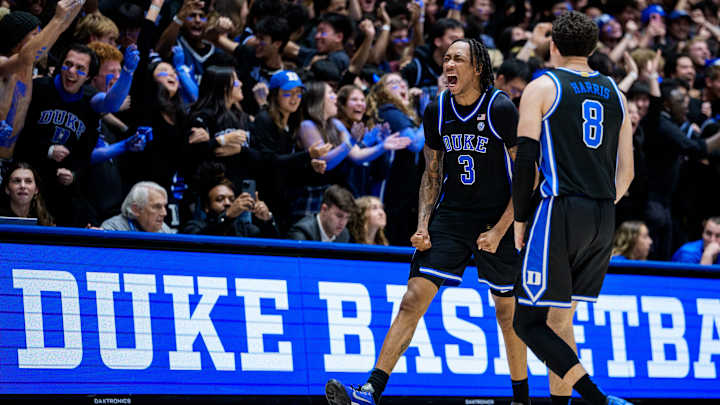
Duke basketball has once again positioned itself among the nation’s elite, but perfection is rarely sustainable—especially in a revitalized ACC. After suffering its first loss of the 2025–26 season in heartbreaking fashion, an 82–81 defeat to No. 15 Texas Tech at Madison Square Garden on December 20, Jon Scheyer’s Blue Devils enter conference play with an 11–1 record, confidence intact, and championship expectations firmly in place.
That narrow setback did little to damage Duke’s national standing. If anything, it served as a reminder that even the best teams must navigate adversity before March. Now, following a lengthy layoff, Duke returns to action on December 31 at Cameron Indoor Stadium against Georgia Tech, officially opening ACC play. The question looming over the rest of the season isn’t if Duke will lose again—it’s when.
A STRONG START LOOMS IN CONFERENCE PLAY
The early portion of Duke’s ACC schedule appears forgiving. Georgia Tech, ranked 133rd at KenPom, doesn’t possess the depth or firepower to seriously threaten the Blue Devils in Durham. Florida State, though always athletic and dangerous at home, currently sits outside the top 100 at KenPom and lacks the offensive consistency to exploit Duke’s elite defense.
A 2–0 start to conference play feels nearly inevitable. In fact, Duke should be heavily favored in its next several games, with Scheyer’s roster boasting a rare blend of length, perimeter defense, and developing offensive versatility. The Blue Devils are once again the standard-bearer in the ACC—but this version of the conference is deeper and more competitive than it has been in years.
THE ACC IS NO LONGER A CAKEWALK
Last season, Duke steamrolled through a mediocre ACC, finishing 19–1 in league play and capturing both the regular season and conference tournament titles. This year is different. Several programs have reloaded through recruiting and the transfer portal, creating legitimate challengers capable of knocking off the Blue Devils on any given night.
That reality begins to set in during Duke’s first marquee conference matchup: a January 6 road date against No. 16 Louisville at the KFC Yum! Center.
THE LOUISVILLE TEST—ROUND ONE
Louisville entered the season widely viewed as Duke’s primary competition in the ACC, and for good reason. Pat Kelsey has assembled one of the most dynamic backcourts in the country, led by Mikel Brown Jr. and Ryan Conwell. Their ability to score at all three levels, push tempo, and catch fire from the perimeter makes Louisville dangerous against any opponent.
Defensively, the Cardinals have shown vulnerability, which plays into Duke’s hands. If the Blue Devils can find rhythm offensively—something that has occasionally eluded them—they should be able to control the game and escape Louisville with a hard-fought road win. It won’t be easy, but Duke’s discipline and defensive prowess give them the edge.
Assuming Duke passes that test, the path to a 7–0 start in ACC play becomes very real.
CRUISING THROUGH THE MID-JANUARY STRETCH
Following the road battle at Louisville, Duke’s schedule lightens up considerably. Home games against SMU (40th at KenPom) and Wake Forest (58th) favor the Blue Devils heavily, particularly at Cameron Indoor Stadium. Road trips to California (60th) and Stanford (85th) present logistical challenges but little reason to expect an upset.
Duke should be favored in all four contests, and anything less than victories would be a surprise. At that point, the Blue Devils would be undefeated in ACC play, riding momentum, and likely ranked among the top teams in the nation.
And that’s exactly when things get dangerous.
THE PERFECT TRAP GAME AT CAMERON
Louisville’s return trip to Durham looms as the most likely spot for Duke’s next loss. If the Blue Devils enter that matchup 7–0 in conference play, the conditions for a slip-up are firmly in place: comfort, confidence, and a familiar opponent with nothing to lose.
Unlike the first meeting, Louisville will have a full game of film to study Duke’s defensive schemes. If the Cardinals get hot from three-point range—and they are more than capable of doing so—they can turn the game into an offensive shootout. While Duke excels defensively, even elite units can be stretched thin when facing multiple high-level shot creators.
This rematch has all the ingredients of an ACC classic: two top-tier teams, contrasting styles, star power, and postseason implications. In games like these, margins are razor-thin. A cold shooting stretch or a few defensive lapses could be all it takes.
A LOSS THAT COULD HELP IN THE LONG RUN
If Duke is going to lose again, this is the game where it makes the most sense. A competitive home loss to a top-20 Louisville squad would hardly damage the Blue Devils’ résumé. More importantly, it would provide Scheyer and his staff with valuable insight before the heart of the season arrives.
Championship teams often benefit from adversity. A well-timed loss can sharpen focus, expose weaknesses, and reinforce urgency. For Duke, falling to Louisville at Cameron could serve as a catalyst rather than a setback.
The Blue Devils remain the team to beat in the ACC. But in a stronger, deeper conference, perfection won’t last forever. Expect Duke’s next stumble to come not early—but right when the stakes start to rise.




