


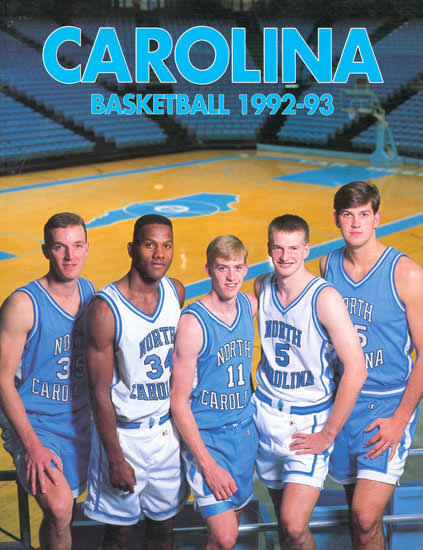
For more than three decades, one of the most significant championships in college basketball history has lived in the public imagination under the wrong label. Say “1993 national title game,” and most casual fans don’t immediately picture Donald Williams raining jumpers, George Lynch doing the dirty work, or Dean Smith finally silencing an unfair narrative. Instead, they remember a timeout that never came, a moment frozen in maize and blue, and a championship framed more as Michigan’s mistake than North Carolina’s triumph. That imbalance—subtle but persistent—is exactly what the ACC Network aims to correct with its upcoming documentary, We’re No. 1: 1993 North Carolina Tar Heels, a long-overdue reclamation of a championship that deserves to be remembered on its own terms.
For UNC fans, the announcement of the documentary feels less like a television premiere and more like a historical correction. While the ACC Network has invested heavily in telling stories of championship programs across the conference, North Carolina’s six NCAA title teams—among the most influential in the sport’s history—have largely gone unexplored in standalone documentary form. That changes now. Airing next Saturday following the UNC–Wake Forest game in Chapel Hill, this film marks the first time the network has devoted an entire documentary to a Tar Heel national championship team, and it begins with perhaps the most misunderstood title of them all.
The 1993 Tar Heels occupy a strange place in college basketball lore. They were champions, yet rarely celebrated with the reverence afforded to other title winners. Their victory is often discussed not in terms of execution, toughness, or coaching brilliance, but as a footnote to Michigan’s Fab Five era. The game-ending timeout call—or lack thereof—has become shorthand for the entire championship, flattening a 40-minute battle into a single moment. In doing so, history has unintentionally minimized what North Carolina accomplished that season and what it took to beat one of the most talented, culturally significant teams the sport has ever seen.
This documentary sets out to flip that perspective.
At its core, We’re No. 1: 1993 North Carolina Tar Heels is about context—about restoring the full arc of a season that was anything but inevitable. The film traces the journey from the preseason expectations placed on Dean Smith to the mounting pressure he faced in the early 1990s. Despite being widely regarded as one of the greatest coaches in the history of the game, Smith entered the decade with just one national title, a statistic that critics wielded unfairly given his consistent excellence and Final Four appearances. Meanwhile, Duke’s rapid ascent and back-to-back championships in 1991 and 1992 intensified the spotlight, reframing the rivalry and adding urgency to every Carolina season.
Into that environment stepped a team that was talented but not universally hyped. The 1993 Tar Heels were not built around a singular superstar destined for instant NBA fame. Instead, they were a study in balance, development, and cohesion—hallmarks of Dean Smith’s philosophy. The documentary revisits the heralded recruiting class led by Eric Montross, whose arrival brought size, skill, and expectations to Chapel Hill. Alongside Montross came Derrick Phelps and Brian Reese, players who would help define the team’s depth and identity. But as the season unfolded, it became clear that this title run would hinge just as much on internal growth as on incoming talent.
One of the documentary’s most compelling threads is its focus on Donald Williams, the sophomore guard whose name should be synonymous with the 1993 championship but often isn’t. Williams’ performance in the title game—25 points, relentless shot-making, and complete composure on the sport’s biggest stage—was not an accident or an outlier. It was the culmination of a season-long evolution, one that the film contextualizes through interviews, practice footage, and reflections from teammates who understood his importance long before the national audience did.
Equally central is George Lynch, the emotional and competitive backbone of the team. As a senior, Lynch embodied everything Dean Smith valued: toughness, versatility, unselfishness, and accountability. The documentary highlights how Lynch’s leadership extended beyond box scores, shaping the team’s mentality during moments of doubt and adversity. In an era increasingly dominated by individual stardom, the 1993 Tar Heels were unapologetically collective, and Lynch was the standard-bearer for that ethos.
The film does not shy away from the season’s turbulence. It revisits the infamous Florida State game at the Smith Center, when Sam Cassell’s “wine and cheese” comment ignited a furious comeback and a crowd that nearly rebelled against the moment. That game, often remembered as a quirky footnote, is reframed as a turning point—a crystallizing moment when the team embraced its edge and rediscovered its urgency. From there, the documentary traces how North Carolina steadied itself, navigating the ACC and NCAA tournaments with increasing confidence and clarity.
Of course, no telling of the 1993 story would be complete without addressing Michigan. The documentary does so, but on Carolina’s terms. Rather than centering the Fab Five as protagonists or villains, the film situates them as the formidable opponent they were—a team UNC had already faced once that season, losing on a last-second basket by Chris Webber. That earlier meeting looms large in the documentary, not as a wound but as a lesson. By the time the teams met again in New Orleans, North Carolina was better prepared, more disciplined, and more resilient.
One of the most refreshing aspects of the documentary is its refusal to reduce the championship game to a single play. The timeout is acknowledged, but it is not allowed to eclipse everything else. The film emphasizes defensive possessions, offensive execution, and the cumulative pressure UNC applied throughout the game. It underscores that mistakes do not happen in a vacuum—they are often forced, and North Carolina forced plenty of them. By reframing the game this way, the documentary invites viewers to rewatch the contest with new eyes and a deeper appreciation for what Carolina actually did.
Perhaps the most poignant dimension of the film comes from voices that have not often been heard. The documentary features interviews with opposing coaches and players, including Dave Odom, Roy Williams, and Jimmy King, providing texture and perspective from beyond Chapel Hill. Their inclusion adds credibility and nuance, reinforcing that this is not a one-sided celebration but a comprehensive examination of a championship season.
Yet the emotional heart of the documentary may lie with Eric Montross and his family. The film incorporates behind-the-scenes footage captured through Montross’ home videos, offering rare access to a team that existed long before the age of social media and constant exposure. Dean Smith was famously protective of his program, limiting access and controlling narratives. These personal recordings provide an intimate counterbalance, revealing moments of vulnerability, camaraderie, and humanity that fans have never seen.
The inclusion of Montross’ children, Andrew and Sarah, lends the documentary an added layer of resonance. Their reflections connect the past to the present, reminding viewers that championships are not just banners or box scores—they are lived experiences that ripple through families and communities. For longtime Tar Heel fans, hearing from voices tied so closely to one of the program’s most beloved figures deepens the sense of legacy and continuity.
Another standout presence is Mick Mixon, former color commentator for the Tar Heel Sports Network, who offers a broadcaster’s perspective alongside the late Woody Durham. Mixon’s recollections capture the rhythm of that season as it sounded to fans across North Carolina, when radio calls carried the emotion of games into living rooms, cars, and workplaces. His inclusion reinforces the documentary’s commitment to telling the story as it was experienced, not just as it appears in hindsight.
What makes this documentary truly significant is not just what it includes, but what it represents. This is the first time the ACC Network has dedicated a full documentary to a UNC national championship team, a surprising omission given the program’s central role in the conference’s identity. That fact alone underscores why this project matters. For years, Carolina’s titles have existed as shared cultural memory rather than curated history. We’re No. 1: 1993 North Carolina Tar Heels signals a shift—a recognition that these teams deserve the same deep, thoughtful treatment afforded to others.
The timing is also notable. As college basketball continues to evolve amid NIL deals, transfer portals, and shifting conference landscapes, the documentary offers a window into a different era—one defined by continuity, development, and institutional identity. Dean Smith’s methods, sometimes caricatured or oversimplified, are presented here with nuance and respect. The film illustrates how his insistence on fundamentals, trust, and collective responsibility produced not just wins, but enduring standards.
Ultimately, this documentary is about reclamation. It is about reclaiming a championship that has too often been framed as an accident of history rather than an achievement earned. It is about reclaiming the voices of players and coaches whose work has been overshadowed by a single moment. And it is about reclaiming the idea that North Carolina’s 1993 title was not remembered wrong because it lacked drama or brilliance, but because the lens through which it was viewed was too narrow.
When the documentary premieres next Saturday, it will not rewrite history so much as restore it. For UNC fans, it will feel like validation. For neutral viewers, it may be a revelation. And for college basketball itself, it serves as a reminder that championships are stories—complex, layered, and deserving of being told in full.
Thirty-two years later, North Carolina’s 1993 team is finally getting the chance to speak for itself.




