


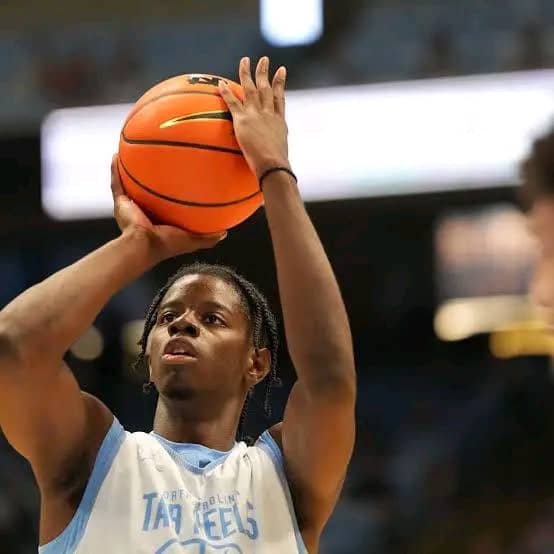
There are moments in a college basketball season that live far beyond the box score. Plays that don’t swing the outcome on their own, but linger because they reveal something deeper — about growth, about vulnerability, about the unforgiving nature of high-level basketball. For North Carolina, Saturday afternoon’s loss at SMU featured one of those moments. It came quietly, in the flow of the game, without a whistle or timeout to frame it. But by the time it replayed across social media and message boards, everyone watching knew the same thing: Caleb Wilson had just been given a lesson he’ll remember for the rest of his career.
And maybe more importantly, it was a lesson every UNC fan knew was coming eventually.
The play that froze the room
Midway through the second half at Moody Coliseum, the Tar Heels found themselves switching defensively, something they’ve done more frequently this season as Hubert Davis searches for versatility and coverage solutions. The switch put Wilson — UNC’s star freshman forward, a player built to dominate the paint — out on the perimeter against SMU guard Boopie Miller.
On paper, it looked manageable. Wilson has length. He has instincts. He’s shown surprising mobility for his size. But Miller had something else: experience, craft, and an understanding of space that only comes from years of playing against elite defenders.
Wilson shaded him toward the baseline, hips opened just enough to cut off the drive. Miller hesitated, read the angle, pulled the ball back with a quick dribble retreat, and stepped behind the three-point line. Wilson’s weight shifted just enough to betray him. The result wasn’t dramatic — no full spill to the hardwood — but it was decisive. Miller rose, released, and drilled the shot.
In real time, it was just two points.
In context, it was everything.
Why that moment mattered
UNC didn’t lose the game because of that possession. The Tar Heels fell 97–83 because SMU shot lights-out, controlled the physicality, and executed a clear, disciplined game plan. But the reason that play resonated is because it crystallized a reality UNC will have to confront repeatedly moving forward.
College basketball, especially at the top level, is increasingly played in space.
For bigs — even elite ones — the margin for error is microscopic. You’re not just guarding post-ups anymore. You’re guarding actions, angles, counters, and guards who are comfortable weaponizing your size against you.
Caleb Wilson is learning that in real time.
The burden of brilliance
Wilson arrived in Chapel Hill with as much hype as any freshman big man in recent memory. And for much of the season, he’s lived up to it. Entering the SMU game, he was averaging nearly 20 points and double-digit rebounds, anchoring UNC’s offense and establishing himself as one of the most impactful newcomers in the country.
But with dominance comes attention.
SMU’s defensive approach wasn’t subtle. From the opening possession, they crowded Wilson’s catches, pushed him off his preferred spots, and sent help early and often. Every touch came with a cost. Every move was contested. And when UNC tried to counter by pulling him away from the rim defensively, the Mustangs were ready to test him in space.
That’s not disrespect — it’s recognition.
SMU’s blueprint: pressure, physicality, patience
Andy Enfield’s game plan was rooted in three principles: be physical early, force decisions late, and trust your guards to win in space.
SMU didn’t double Wilson randomly. They doubled with intent — timing help from the five, rotating out with discipline, and daring UNC’s perimeter players to beat them consistently. When Wilson did score, it often came on tough finishes or quick reads before the defense could load up.
But the real advantage came on the other end.
By forcing switches and pulling Wilson into perimeter actions, SMU flipped the script. Instead of UNC dictating matchups, the Mustangs were hunting them. Miller, in particular, was masterful at reading Wilson’s positioning — never rushing, never panicking, always probing for the moment when the big man’s feet told the truth.
That’s what happened on *the play. It wasn’t about speed. It was about timing.
Guarding in space: the hardest lesson for big men
Every elite big man goes through this stage.
Anthony Davis did. Joel Embiid did. Even Tim Duncan, in a different era, had to learn when to give ground and when to close. Guarding in space is not about winning every possession — it’s about surviving them without compromising the team structure.
For Wilson, Saturday was a reminder that instincts built in the paint don’t always translate cleanly beyond it. The angles are different. The reads are faster. The consequences are immediate.
And yet, this is exactly the kind of challenge that accelerates growth.
What Wilson didn’t say — and why it mattered
After the game, Wilson didn’t step to a microphone to address the moment. There was no viral quote, no attempt to spin it, no shrugging it off. And that silence mattered.
Because what followed on the court told a more important story.
Wilson didn’t shy away. He didn’t ask out of switches. He didn’t retreat into himself. He kept competing — rebounding, facilitating, fighting for position, absorbing contact. His stat line (13 points, seven rebounds, four assists) wasn’t dominant by his standards, but it reflected engagement, not discouragement.
For a freshman carrying expectations like his, that response is everything.
Hubert Davis’ perspective: growth through discomfort
Hubert Davis has been clear all season: this team is still learning who it is. Losses like this aren’t endpoints — they’re checkpoints.
After the game, Davis emphasized SMU’s physicality and defensive discipline, noting how difficult it was for UNC to initiate offense comfortably. He spoke about learning to handle pressure, learning to read double teams, learning to operate when nothing comes easy.
He didn’t single out Wilson.
He didn’t need to.
Moments like that perimeter switch aren’t failures in Davis’ framework — they’re film sessions waiting to happen. Teaching moments that can’t be replicated in practice. Lessons that only come when the lights are on and the opponent knows exactly what they’re doing.
Why UNC fans shouldn’t panic
If anything, this game — and that moment — should reassure UNC fans.
Because Wilson’s ceiling hasn’t changed. His tools haven’t disappeared. His confidence didn’t shatter. What happened was exposure, not regression. And exposure, handled correctly, is how elite players evolve.
UNC’s frontcourt is still one of the most talented in the country. But conference play and high-level nonconference opponents will continue to test them in uncomfortable ways. Teams will copy SMU’s blueprint. They’ll double early. They’ll force switches. They’ll pull bigs into space and see who blinks first.
The question isn’t whether Wilson will face this again.
It’s how he responds next time.
The next step in the evolution
Guarding in space is a skill — one that can be refined. Footwork, angles, anticipation, understanding personnel. Learning when to concede a step and when to challenge the shot. Learning that sometimes the best defense is forcing a guard into a shot they *want* less, even if it looks clean.
Wilson will get there.
And when he does, moments like Saturday won’t be remembered as embarrassments. They’ll be remembered as mile markers.
The moment everyone noticed — and why it matters long-term
Every season has a snapshot that fans point back to later and say, that’s when it started to change. For Caleb Wilson, the SMU game might be that moment.
Not because he was beaten.
But because he was tested.
And because he kept going.
UNC basketball has always been about growth under pressure. About learning the hard way, then applying it when it matters most. If Saturday taught Wilson anything, it’s that greatness isn’t about avoiding tough moments — it’s about absorbing them and moving forward stronger.
The moment everyone noticed wasn’t just a crossover or a made shot.
It was the beginning of
the next phase of Caleb Wilson’s journey.
And for North Carolina, that might be the most important takeaway of all.




