


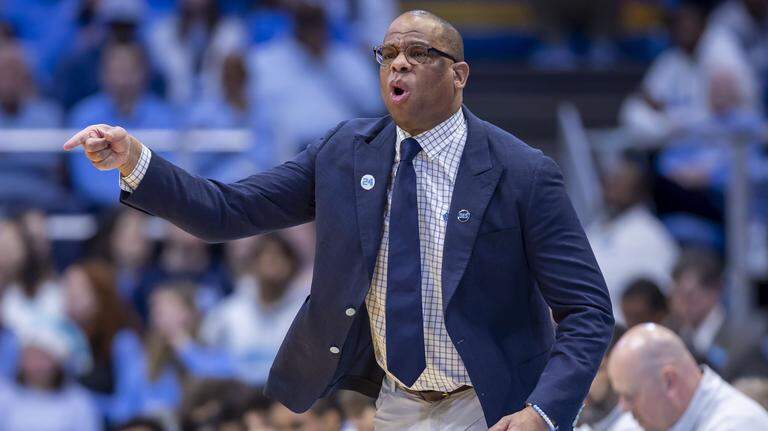
In college basketball, stars often shine brightest, but championships are rarely won by a team’s superstars alone. North Carolina has one of the most talented duos in the country with Caleb Wilson and Henri Veesaar, but the story of this season may not be about them. Instead, it’s about the players who are often overlooked — the secondary scorers whose confidence, rhythm, and aggression could determine whether the Tar Heels are legitimate ACC contenders. For Hubert Davis, the challenge isn’t coaching talent; it’s unlocking it at the precise moments when the team needs it most.
Through the first half of the season, UNC has leaned heavily on Wilson and Veesaar. Their offensive ratings — 121.9 and 128.5, respectively — are the highest by a Tar Heel duo playing at least 70% of available minutes since Brice Johnson and Joel Berry in 2016. Add senior captain Seth Trimble into the mix, and the offensive engine looks unstoppable, at least on paper. Trimble, returning from a brief absence, has averaged 17.8 points per game over his last four contests with an offensive rating of 120.5, and sits on pace for a career-high mark for the season.
Yet the questions around UNC’s offense lie not with the stars but with what happens when they are neutralized, as happened in Dallas against SMU. Opponents have learned to gameplan around Wilson’s scoring, doubling him whenever possible and daring the role players to make shots. It is in these moments that Hubert Davis’ coaching acumen is tested, and the team’s depth is exposed.
“Whether they’re feeling comfortable out there or struggling with their confidence, I do have conversations with them,” Davis said on the latest Hubert Davis Live radio show. “I talk to players all the time about how to approach moments like this, how to stay aggressive, how to stay ready. Confidence doesn’t come from me, but I do everything I can to create the environment for it to grow.”
The examples are clear. Jarin Stevenson, after nine games without a double-figure scoring performance, exploded for 16 points off the bench against SMU, shooting 3-for-4 from three-point range. His performance was more than just a spark — it was a blueprint for how UNC can unlock its bench and create a multidimensional offense. But the bigger question remains: can this level of production become consistent?
Other secondary players have flashed similar potential but struggle to sustain it. Luka Bogavac, after scoring in double figures in nine of his first ten games, has managed just one such outing in the past five, with three games scoring two points or fewer. Derek Dixon, who had a promising stretch against Kentucky and Georgetown, has yet to reach double digits since and has made only one field goal in each of his recent contests. Kyan Evans showed promise with 15 points against Florida State but followed that with a three-point output in just 14 minutes against SMU.
The inconsistencies among UNC’s supporting cast aren’t a reflection of talent — they are a reflection of the mental side of the game. Confidence ebbs and flows, and while the stars thrive in high-pressure environments, the bench needs a coach to cultivate belief. Davis’ message is clear: he can’t force confidence, but he can build the conditions for it to flourish.
The stakes are high. ACC play is notoriously grueling, and opponents will continue to design schemes to neutralize Wilson, Veesaar, and Trimble. If the secondary scorers fail to rise to the occasion, UNC risks becoming one-dimensional and vulnerable to teams with length, athleticism, and disciplined defensive schemes. But if the bench steps up consistently, the Tar Heels have a legitimate chance to challenge for the ACC crown and make a deep postseason run.
The season’s narrative is also a test of resilience. Moments like Stevenson’s breakout or Evans’ high-scoring outing against Florida State are critical, but the challenge is to string these performances together. Davis has emphasized that success isn’t built on isolated flashes but on consistent execution, on making the correct reads and taking the right shots in every possession.
It’s not just about scoring, either. UNC’s secondary players have to defend, rebound, and understand spacing. A player like Stevenson can ignite the offense with hot shooting, but without complementary effort on defense and attention to rotations, the Tar Heels’ overall performance suffers. The ACC is littered with teams that can exploit gaps in transition and defensive assignments, meaning every bench contribution matters, both offensively and defensively.
The statistics paint a picture of opportunity. With Wilson and Veesaar performing at elite levels, defenses are forced to overcommit. This opens driving lanes, kick-out opportunities, and spacing advantages for role players. But these advantages are only meaningful if the players are confident and aggressive. Even a single missed rotation or hesitation can nullify the advantage. Davis’ task is ensuring the bench internalizes their role in these high-leverage situations.
Historically, North Carolina has thrived when secondary scorers step up. Think of the moments when players like Justin Jackson, Theo Pinson, or Kennedy Meeks became pivotal contributors during critical ACC and NCAA games. These performances aren’t anomalies; they are a function of a culture that nurtures depth and instills confidence in the supporting cast. Davis’ job is to replicate this culture and adapt it to the current roster, where role players must embrace both opportunity and responsibility.
As the ACC season unfolds, the Tar Heels will face defenses specifically designed to exploit weaknesses beyond the stars. Teams like Duke, Virginia, and Miami are adept at neutralizing perimeter threats and clogging passing lanes. This leaves UNC’s bench with the dual responsibility of scoring efficiently and maintaining spacing and flow. Every possession becomes a test of readiness, poise, and execution — qualities that are harder to teach than pure skill.
Davis’ coaching philosophy emphasizes accountability and communication. Players like Stevenson, Bogavac, Evans, and Dixon are being encouraged to not only see themselves as complementary scorers but as game-changers in their own right. Confidence, Davis has said repeatedly, comes from preparation, understanding one’s role, and trusting one’s instincts. Bench players can’t wait for moments to happen; they have to make them happen.
Early season struggles illustrate both the challenge and the potential. Games where the bench fails to score consistently highlight the importance of development, while performances like Stevenson’s against SMU showcase what UNC looks like when the pieces click. For North Carolina to contend in the ACC, these flashes must evolve into steady contributions — a reliable second wave that opponents cannot ignore.
The narrative for the rest of the season is straightforward but daunting: Wilson, Veesaar, and Trimble can’t carry the load alone. The Tar Heels need depth, and Davis must guide the team in cultivating confidence, consistency, and poise among the bench players. If successful, UNC will be well-positioned for both conference success and postseason advancement. If not, the Tar Heels risk becoming a one-dimensional team exposed by elite competition.
For the fans, the message is equally compelling. Watching stars dominate is thrilling, but the excitement grows when role players step into the spotlight, changing games and proving their value. The potential is there — the challenge lies in sustaining it.
Follow-up Perspective: Unlocking the Bench is About More Than Minutes
Beyond statistics and scoring lines, Hubert Davis’ focus on the bench is about trust, leadership, and psychology. Secondary players need to understand that their contributions matter not just numerically, but strategically. Every defensive rotation, every open-court cut, every confident pull-up shot is a vote of confidence in themselves and in the team’s system.
Davis has made it clear: he isn’t trying to manufacture confidence. He’s trying to remove barriers. By providing clear roles, encouraging assertiveness, and offering consistent feedback, he is creating an environment where secondary scorers can thrive. The challenge is making that environment permanent — not just situational.
For UNC’s bench, the next stretch of games will be the ultimate test. ACC opponents will scout Wilson and Veesaar heavily, and the secondary scorers must prove they can step into the spotlight, repeatedly and consistently. When that happens, the Tar Heels’ ceiling isn’t just high — it’s elite.
It’s a lesson in patience, preparation, and opportunity. When the stars are doubled, the unsung players become the difference-makers. For Hubert Davis and North Carolina, unlocking that potential may determine the difference between a good season and a historic one. The pressure is real, the opportunity is real, and the Tar Heels’ supporting cast has a chance to define their legacy — if they can rise to the occasion.




