


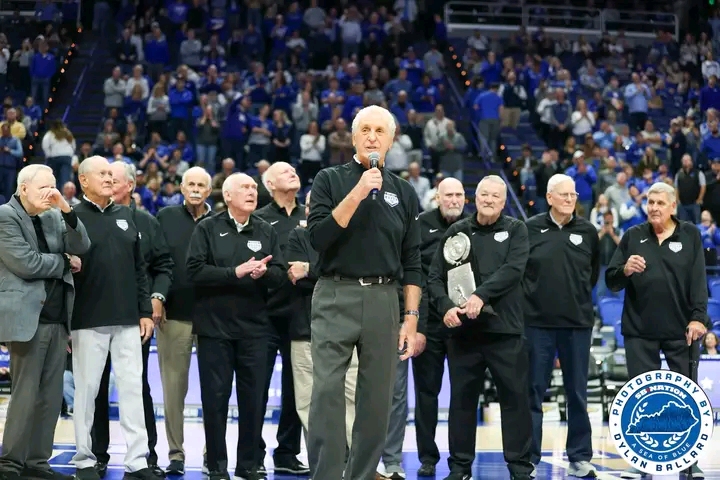
There are moments inside Rupp Arena that feel louder than noise. Louder than a made three, louder than a defensive stop, louder than a final buzzer. They’re moments that don’t show up in box scores or highlight reels, but they linger long after the crowd files out into the Lexington night. On Saturday night, during halftime of Kentucky’s matchup against Mississippi State, Big Blue Nation experienced one of those rare moments — a pause in time where the past, present, and future of Kentucky basketball stood in the same space.
It wasn’t scripted. It wasn’t flashy. It didn’t need to be.
For a few minutes, Rupp Arena remembered who it’s always been.
A Program Built on More Than Wins
Kentucky basketball has never been just about the score. Yes, banners hang. Championships are counted. All-Americans are celebrated. But the real power of the program has always lived deeper — in expectation, in pride, in the understanding that wearing “Kentucky” across your chest means you are connected to something far bigger than yourself.
That’s what made the halftime scene so powerful.
As members of the legendary 1965–66 Kentucky team — famously known as Rupp’s Runts — walked onto the court, the arena didn’t erupt the way it does after a dunk or a three. Instead, there was something heavier in the air. Something reverent. The kind of silence that only comes when people understand they are witnessing history, not entertainment.
At the center of it all stood Pat Riley, flanked by his teammates — men who carried Kentucky basketball through an era defined by toughness, discipline, and relentless excellence.
Sixty Years, One Standard
Sixty years is a long time in sports. Styles change. Rules evolve. Players come and go. Coaches rise and fall. Entire eras pass.
And yet, the standard doesn’t.
That 1965–66 team didn’t just win games. They embodied everything Adolph Rupp demanded from his players: physical toughness, mental strength, and an unshakable belief that Kentucky basketball was supposed to lead, not follow. They went undefeated in the regular season. They played with edge. They played with purpose. And they helped cement Kentucky’s identity as a national benchmark.
Saturday night wasn’t just about honoring a team. It was about honoring the idea that Kentucky basketball doesn’t reset with every season — it continues.
That’s what Big Blue Nation felt in that moment.
When the Arena Went Quiet
Rupp Arena is famous for noise. Deafening noise. But when Pat Riley began to speak, something different happened. The crowd leaned in. Phones lowered. Conversations stopped.
It wasn’t because he was loud.
It was because he was real.
Riley didn’t speak as a Hall of Fame coach or NBA legend. He spoke as a Kentucky player. As someone who had lived the pressure, the expectations, the weight of the jersey. His words weren’t polished for television. They didn’t need to be. They carried the authority of experience — the kind you can’t fake.
In that moment, it didn’t matter who Kentucky was playing or what the score was. The message cut through everything: this program has always demanded resilience, accountability, and belief when things aren’t easy.
And everyone inside Rupp knew exactly what he meant.
A Message for the Present
While the ceremony honored the past, its true power was aimed squarely at the present.
Kentucky basketball, like every great program, lives under constant scrutiny. Every possession is dissected. Every loss is magnified. Every player is judged not just against opponents, but against history. That pressure doesn’t fade — it intensifies.
That’s why moments like Saturday night matter.
Seeing former players return — men who once carried the same burden — reminds today’s Wildcats that struggle is part of the journey, not a sign of failure. It reminds them that greatness at Kentucky has never been smooth or easy. It has always required response.
Response to adversity.
Response to doubt.
Response to expectation.
That’s the lesson Rupp’s Runts brought back to the floor.
A Bridge Between Generations
One of the most beautiful things about Kentucky basketball is how it connects generations.
In the stands Saturday night were fans who remember that 1965–66 team vividly — who can still describe the way they played, the toughness they showed, the pride they carried. Sitting near them were younger fans who weren’t alive for a single second of that era but still stood and applauded, feeling the importance of the moment even if they couldn’t fully explain it.
That’s Big Blue Nation.
It’s not just loyalty to a roster. It’s loyalty to a tradition. A belief passed down, season after season, family to family.
Saturday night reminded everyone that Kentucky basketball isn’t just something you watch — it’s something you inherit.
Why It Hit So Deep
There was no championship banner being raised. No jersey retirement. No dramatic reveal.
And that’s why it worked.
The simplicity of the moment stripped everything down to what matters most: identity.
Kentucky basketball has always been about showing up when it’s hard. About answering the bell when expectations are heavy. About understanding that wearing this uniform means you don’t get to hide from pressure — you embrace it.
Pat Riley and his teammates didn’t need to say all of that explicitly. Their presence said it for them.
They stood there as proof that the program has endured because its foundation is stronger than any single season.
Rupp Arena’s Memory
Rupp Arena has seen it all. Titles. Heartbreak. Legends. Controversy. Comebacks. Collapse.
But every once in a while, it remembers something deeper than any one game.
Saturday night was one of those times.
For a brief halftime moment, the arena didn’t belong to the current roster or the scoreboard. It belonged to the idea of Kentucky basketball — the version built on pride, toughness, and unrelenting expectation.
That’s who Rupp Arena has always been.
And that’s why the moment mattered so much.
Because it reminded Big Blue Nation that no matter the season, no matter the noise, no matter the doubts — the standard never leaves.
It waits.
And every generation is called to meet it.




