


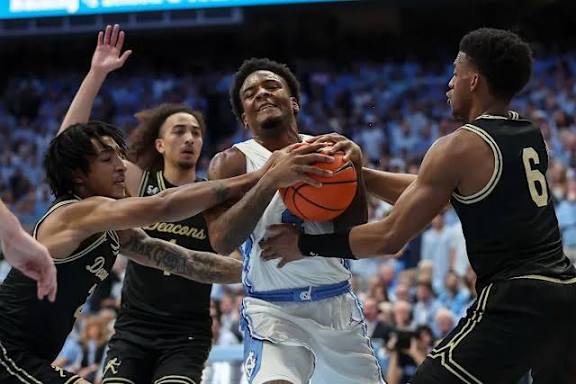
For a stretch inside the Smith Center, it felt like North Carolina had finally found the answer it had been searching for.
The offense moved with purpose. The energy shifted. The crowd leaned forward. And at the center of it all was Jaydon Young, playing with the kind of confidence that changes the temperature of a game the moment it appears.
But college basketball has a cruel habit of reminding teams that sparks alone don’t finish games.
North Carolina beat Wake Forest — yet the final minutes told a far more complicated story.
The Moment Everything Changed — Briefly
UNC didn’t need a miracle. It needed a jolt.
That jolt arrived when Jaydon Young stepped onto the floor and immediately attacked the game rather than feeling it out. He pushed pace, challenged defenders, and forced Wake Forest to react instead of settle.
What stood out wasn’t just the scoring — it was the decisiveness. Every touch felt intentional. Every possession carried urgency. For the first time in the game, UNC looked like it was dictating terms.
For a moment, it looked like the night had found its headline.
A Lead That Should Have Ended the Story
As Young’s energy spread, North Carolina created separation. The ball moved. Defensive rotations sharpened. Wake Forest suddenly had less space and fewer answers.
This was the moment when good teams close.
Instead, UNC hesitated.
What followed wasn’t a collapse — but it wasn’t control either. The Tar Heels slowed offensively, lost focus defensively, and allowed Wake Forest to hang around far longer than the situation demanded.
The game stayed alive when it shouldn’t have.
When the Clock Became the Opponent
Late-game basketball exposes habits.
For UNC, the final minutes revealed issues that continue to resurface: rushed shots, missed box-outs, and possessions that lacked clarity. Wake Forest didn’t force chaos — UNC invited it.
Each mistake added pressure. Each empty trip shifted momentum just enough to make things uncomfortable.
The Tar Heels never fully lost command, but they never fully reclaimed it either.
Why Jaydon Young’s Emergence Still Matters
Lost in the tension of the closing stretch was something significant.
Jaydon Young didn’t fade.
Even as UNC’s execution wavered, his poise remained. He didn’t force plays. He stayed aggressive without being reckless. Defensively, his effort never dipped.
That matters — especially for a team searching for guards who can change momentum without unraveling structure.
Young’s performance wasn’t a solution to everything, but it felt like a glimpse of something UNC may need sooner rather than later.
Wake Forest Took What UNC Gave Them
To Wake Forest’s credit, they never stopped competing.
They sensed UNC’s uncertainty and capitalized with physical defense and timely responses. The Demon Deacons didn’t need a run — just consistent pressure and patience.
UNC’s late-game lapses gave Wake Forest hope.
Against stronger opponents, that hope becomes danger.
A Win That Raised More Questions Than Cheers
The result went into the win column. But the feeling lingered.
North Carolina proved it has pieces capable of flipping games — Jaydon Young made sure of that. Yet the inability to close cleanly remains a concern that won’t disappear on its own.
This wasn’t about failing.
It was about unfinished control.
The Question UNC Still Has to Answer
Can North Carolina turn sparks into certainty?
Can it finish games with the same conviction it shows in flashes?
Against Wake Forest, the Tar Heels escaped with the win. But the ending made one thing clear:
Until UNC learns to close with authority, every promising moment will come with a question attached — not about whether they can take control, but whether they can keep it.




