


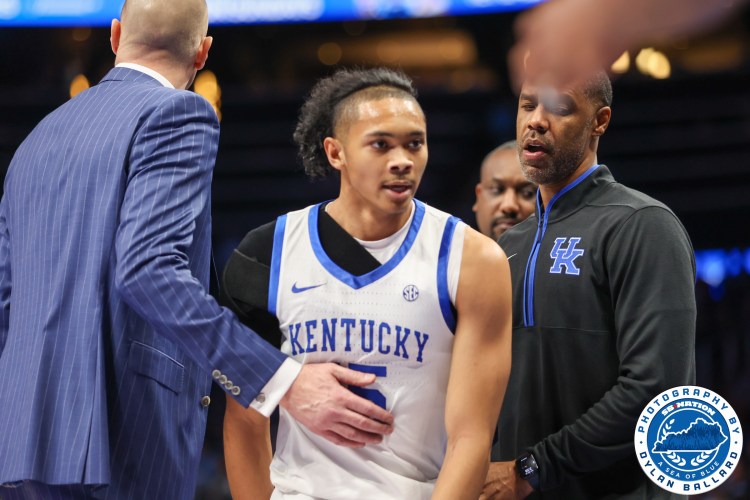
LEXINGTON, Ky. — The waiting is over. The questions have been answered. And the decision, difficult as it was, has finally been made.
Jaland Lowe’s first season with the Kentucky Wildcats has come to an end.
During his Monday radio show, head coach Mark Pope confirmed that Lowe will undergo shoulder surgery, a move that will sideline the talented guard for the remainder of the 2025–26 college basketball season. It is a development that had been looming for weeks — even months — but one that still lands with weight for a Kentucky program navigating injuries, transition, and growing expectations under a new head coach.
“This has been something we’ve been monitoring for a while,” Pope said. “At this point, surgery is the best option for Jaland’s long-term health.”
With that announcement, a season defined by promise, perseverance, and physical setbacks reached its inevitable conclusion.
A Decision That Had Been Coming
In many ways, the news came as little surprise.
Lowe has battled repeated shoulder dislocations throughout the season, an issue that has persisted despite rehabilitation, protective bracing, and conservative management. Each return to the court came with risk, and each setback reinforced the reality that this was not a problem that would simply resolve itself with time.
The breaking point arrived Saturday night.
During Kentucky’s win over Mississippi State, Lowe suffered yet another dislocation of the same injured shoulder — his latest setback in a season that had become increasingly difficult to sustain. Though he attempted to push through earlier episodes, the accumulation of injuries left little room for optimism that he could safely finish the year without surgical intervention.
At some point, the question stopped being if and became when.
Monday provided the answer.
Why Surgery Was the Only Real Option
Shoulder instability is among the most challenging injuries for basketball players, particularly guards who rely on ball control, contact absorption, and shooting mechanics. Recurrent dislocations don’t just compromise performance — they threaten long-term durability and career longevity.
Each dislocation weakens surrounding tissue, increases inflammation, and raises the likelihood of future episodes. For Lowe, continuing to play carried significant risk of permanent damage.
Mark Pope made it clear that the decision was about more than this season.
“This is about Jaland’s future,” Pope said. “We want him healthy, confident, and able to play the way he’s capable of playing.”
In modern college basketball — where players’ careers stretch beyond campus and into professional opportunities — programs increasingly prioritize long-term health over short-term availability. Kentucky’s decision reflects that reality.
A Season of Interrupted Momentum
Lowe arrived at Kentucky with optimism and opportunity.
He brought athleticism, defensive intensity, and two-way potential to a roster undergoing transformation under Pope’s leadership. Early on, Lowe showed flashes of why the staff believed he could become a meaningful contributor in the SEC.
But momentum proved elusive.
Each time Lowe began to find rhythm, another setback followed. Practices were interrupted. Minutes fluctuated. Confidence had to be rebuilt — not because of performance, but because of physical limitations.
Despite that, Lowe remained engaged. He stayed active on the bench, supportive of teammates, and committed to rehab. Coaches repeatedly praised his attitude and toughness, especially given how frustrating shoulder injuries can be for guards.
“This kid wanted to play,” one staff member said privately earlier this season. “He kept fighting.”
That fight, however, has reached its limit.
The Mississippi State Moment
Saturday’s game against Mississippi State felt like a turning point.
Lowe was back on the floor, trying once again to contribute through discomfort. But when the shoulder dislocated again, the reality became unavoidable. Continuing to play through the injury no longer served the player or the program.
What followed were conversations — between Lowe, the medical staff, his family, and the coaching staff — centered on what truly mattered.
Those discussions led to surgery.
What the Surgery Means
While Kentucky has not released specific medical details, shoulder surgeries for instability typically involve labrum repair or stabilization procedures, followed by several months of rehabilitation.
The good news: these surgeries are common and have high success rates when managed properly.
The challenge: recovery requires patience.
Lowe’s offseason will now be defined by rehab, strength rebuilding, and gradual return to basketball activity. The timeline will stretch into the summer and possibly early fall, depending on healing and progress.
But there is optimism.
By addressing the issue now, Lowe gives himself the best chance to return fully healthy, without restrictions or fear of recurrence.
Impact on Kentucky’s Rotation
From a basketball standpoint, Lowe’s absence reshapes Kentucky’s backcourt for the remainder of the season.
Pope and his staff will now rely more heavily on:
Younger guards stepping into expanded roles
Veterans shouldering increased minutes
Lineup flexibility to compensate for lost athleticism and defense
Lowe’s defensive versatility — particularly his ability to pressure ball handlers and switch assignments — will be missed. So will his energy, toughness, and willingness to do the little things.
However, Pope emphasized that the team must adapt.
“Injuries are part of the game,” he said. “Our job is to adjust, grow, and keep competing.”
The Mental Side of a Season Ending Early
For Lowe, the physical recovery is only part of the challenge.
Season-ending injuries test players emotionally. Watching teammates compete while confined to rehab can be isolating. The daily routine changes. The adrenaline fades.
But those who know Lowe believe he is built to handle it.
“He’s resilient,” a teammate said. “He’s still around us every day. He hasn’t checked out.”
Kentucky’s staff expects Lowe to remain actively involved — attending practices, film sessions, and games — continuing to contribute as a teammate even while sidelined.
A Broader Injury Picture at Kentucky
Lowe’s surgery comes amid a season where injuries have played a significant role in shaping Kentucky’s narrative.
Earlier updates from Pope included concerns around other rotation players, forcing constant adjustment and testing the roster’s depth. For a team still building chemistry under a new head coach, continuity has been difficult to maintain.
Yet Pope has consistently stressed that adversity is part of growth.
“This team is learning how to respond,” he said recently. “Not just to wins and losses, but to adversity.”
Lowe’s situation is the latest — and perhaps most definitive — example.
What This Means for Lowe’s Future at Kentucky
While the immediate focus is recovery, the long-term outlook remains open.
By opting for surgery now, Lowe positions himself for a fresh start, free from the constant concern of another dislocation. A healthy offseason could allow him to return stronger, more confident, and better prepared to contribute moving forward.
Kentucky has invested in his development. The program believes in his ability.
This chapter may have closed early — but it does not define the entirety of his Kentucky career.
Fans React: Support Over Speculation
As news of the surgery spread, Kentucky fans responded with a mix of disappointment and support.
There was frustration, of course — losing a player mid-season always stings. But there was also understanding.
Many fans recognized that this decision was about health first, not basketball urgency. Social media quickly filled with messages wishing Lowe a smooth recovery and strong return.
In Big Blue Nation, effort matters. And Lowe never lacked that.
Mark Pope’s Message Is Clear
Throughout his comments, Pope returned to one central theme: doing what’s right for the player.
“This is the right call,” he said. “Not just for now, but for the future.”
In an era where pressure can push players to risk long-term health for short-term results, that message resonates.
Final Thoughts
Jaland Lowe’s season didn’t end the way anyone hoped.
There will be no late-season surge, no March moments, no gradual return. Instead, there will be surgery, rehab, and patience.
But there is also clarity.
The uncertainty is gone. The decision has been made. And now, the focus shifts forward.
For Kentucky, it’s about adapting and continuing the season.
For Lowe, it’s about healing and rebuilding.
Sometimes, the toughest calls are the right ones.
And for Jaland Lowe, this was that moment.




