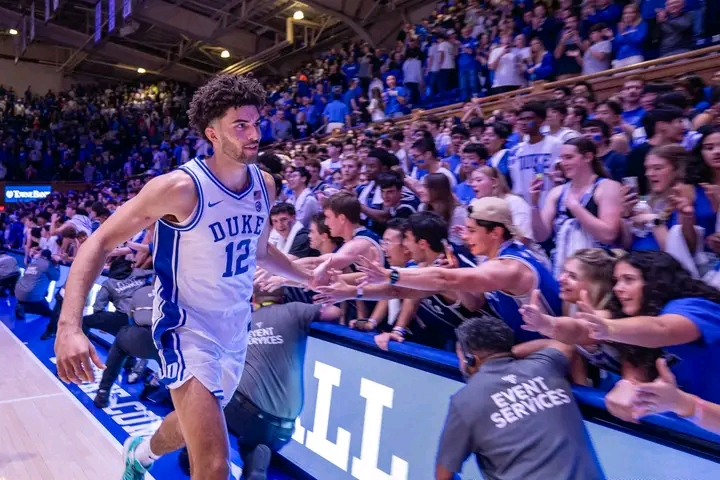
For much of the early season, Duke basketball looked like the complete package. The offense was efficient, versatile, and confident. The talent was obvious. The rotation felt settled. And perhaps most importantly, the defense — long the calling card of championship-caliber Duke teams — was sharp, connected, and punishing. Opponents struggled to find rhythm, shots were contested, and stops came when they mattered most.
Fast forward a few weeks, and an uncomfortable question has begun to surface among Duke fans and analysts alike: has Duke’s defense regressed at the worst possible time? And if so, could that slippage be the single biggest obstacle between this team and a national championship run?
It’s not a question rooted in panic. Duke is still winning games. The Blue Devils remain highly ranked, firmly in the NCAA Tournament picture, and loaded with NBA-level talent. But championships are rarely decided by what a team does well in December. They are decided by what holds up under pressure in March. And right now, Duke’s defense is showing cracks that simply weren’t there earlier in the season.
A Tale of Two Defensive Identities
Early in the season, Duke’s defensive numbers were elite by any standard. Against power-conference opponents in its first five marquee matchups — Texas, Kansas, Arkansas, Florida, and Michigan State — Duke held teams to just 37 percent shooting from the field and 28 percent from three-point range. No opponent made more than 26 field goals or more than ten three-pointers in any of those games. The Blue Devils were physical, disciplined, and aggressive without being reckless.
Those performances weren’t flukes. They reflected a team that was fully bought into Jon Scheyer’s defensive principles: ball pressure, help defense, strong closeouts, and finishing possessions with rebounds. Duke looked connected. Five players moved as one. Communication was crisp. Mistakes were quickly covered.
Then came the shift.
Over the next stretch of games against Texas Tech, Georgia Tech, Florida State, Louisville, and SMU, the numbers told a far more troubling story. Duke’s opponents shot 51.3 percent from the floor and 40.9 percent from beyond the arc. Every team in that stretch made at least 26 field goals, and three of them knocked down ten or more three-pointers. That is not championship-level defense — not even close.
The contrast is jarring. It’s the difference between being a defensive juggernaut and being merely average. And while Duke’s offense has been good enough to cover up many of those issues, history shows that relying solely on offensive firepower in March is a dangerous gamble.
Jon Scheyer Knows the Stakes
Perhaps the most telling sign that this is more than just a minor blip came directly from Jon Scheyer himself. After Duke allowed SMU to shoot 56 percent from the field in a win, Scheyer didn’t sugarcoat the issue.
“It’s hard to feel very good when they shoot 56-percent from the field all game,” he admitted.
That’s not the language of a coach brushing off a concern. That’s the voice of someone who understands exactly how thin the margin is between winning games now and winning championships later.
Scheyer has consistently emphasized that defense isn’t about one player or one scheme. It’s about habits, accountability, and collective effort. He’s also been candid about the challenges of adjusting scouting reports and defensive approaches as opponents change styles and personnel.
“You have to adjust. You have to move on. You have to have a different scouting report now,” Scheyer said. “SMU is a different team, and they do different things.”
That adaptability is crucial but it also highlights a problem. Duke’s defense hasn’t been consistently adapting. Instead, it’s been allowing teams to get comfortable far too early.
Turnovers, Transition, and Easy Buckets
One of the underlying issues contributing to Duke’s defensive regression has been carelessness with the basketball. Turnovers don’t just cost possessions; they often lead to transition opportunities, where defenses are most vulnerable.
Scheyer pointed directly to this concern.
“It gives teams life when we’re careless with the ball and then they get to see the ball go in,” he said. “Those are easy baskets.”
Easy baskets are poison for a defense. They energize opponents, quiet home crowds, and force teams to play uphill. Even elite half-court defenses struggle once opponents find rhythm through layups, dunks, and open transition threes.
When Duke was at its defensive best, it controlled tempo. It forced teams to execute in the half court and earn every point. Recently, too many possessions have ended with Duke scrambling, rotating late, or fouling to stop momentum.
Individual Effort Isn’t the Problem Consistency Is
One of the more frustrating aspects of Duke’s defensive issues is that the pieces are clearly there. Scheyer himself pointed out standout moments from players like Dame Sarr and Maliq Brown, whose energy and activity can completely change the tone of a game.
Those flashes show that Duke can defend at an elite level. The problem is that those moments haven’t been sustained across full games — or across multiple games in a row.
Defense isn’t built on highlights. It’s built on repetition. It’s about guarding for 25 seconds, not 5. It’s about getting back in transition every time, not most of the time. It’s about trusting teammates and resisting the urge to gamble.
When Duke slips defensively, it’s rarely because of a lack of talent. It’s because of lapses missed rotations, late closeouts, or breakdowns in communication. Those are correctable issues, but only if they’re addressed with urgency.
The Numbers Still Like Duke But Numbers Don’t Tell the Whole Story
Statistically, Duke’s defense remains strong. According to KenPom, the Blue Devils still rank No. 10 nationally in adjusted defensive efficiency. On paper, that’s the profile of a Final Four contender.
But anyone watching the games knows that metrics don’t always capture momentum, confidence, or trendlines. A defense can rank highly overall while still trending in the wrong direction. And when March arrives, recent form often matters more than early-season dominance.
The eye test suggests that Duke’s defense isn’t nearly as imposing as it was in November and early December. Opponents are shooting with confidence. Ball movement is producing open looks. Duke is being forced into shootouts rather than controlling games.
That’s a dangerous identity for a team with championship aspirations.
March Madness Demands Defensive Reliability
Every NCAA Tournament run follows a familiar script. Offense ebbs and flows. Shooters go cold. Whistles tighten. Games slow down. When that happens, the teams that survive are the ones that can defend without fouling, get stops late, and manufacture points through effort.
Duke has been on both sides of that reality over the years. Some of the program’s most painful tournament exits came when defensive lapses proved fatal. Conversely, its greatest championship teams — from 1991 to 2015 — were built on defensive toughness and adaptability.
This current Duke roster has the talent to add its name to that history. But talent alone won’t be enough. The margin between cutting down nets and going home early is razor-thin.
Can Duke Flip the Switch Again?
The most encouraging part of this conversation is that the season is far from over. Duke hasn’t lost its defensive ceiling — it has lost its defensive consistency. Those are very different problems.
Scheyer has shown a willingness to be honest with his team and himself. The players have already demonstrated that they can defend at an elite level. The challenge now is rediscovering that identity and sustaining it when the grind of conference play intensifies.
If Duke can tighten up its rotations, value possessions, and recommit to defensive fundamentals, the Blue Devils can absolutely re-emerge as a national title favorite. If not, the cracks we’re seeing now could widen under the bright lights of March.
So yes — major regression of Duke basketball defense could be the one thing standing between the Blue Devils and a national championship. But it doesn’t have to be.
And that, more than anything, is what makes the rest of this season so compelling.