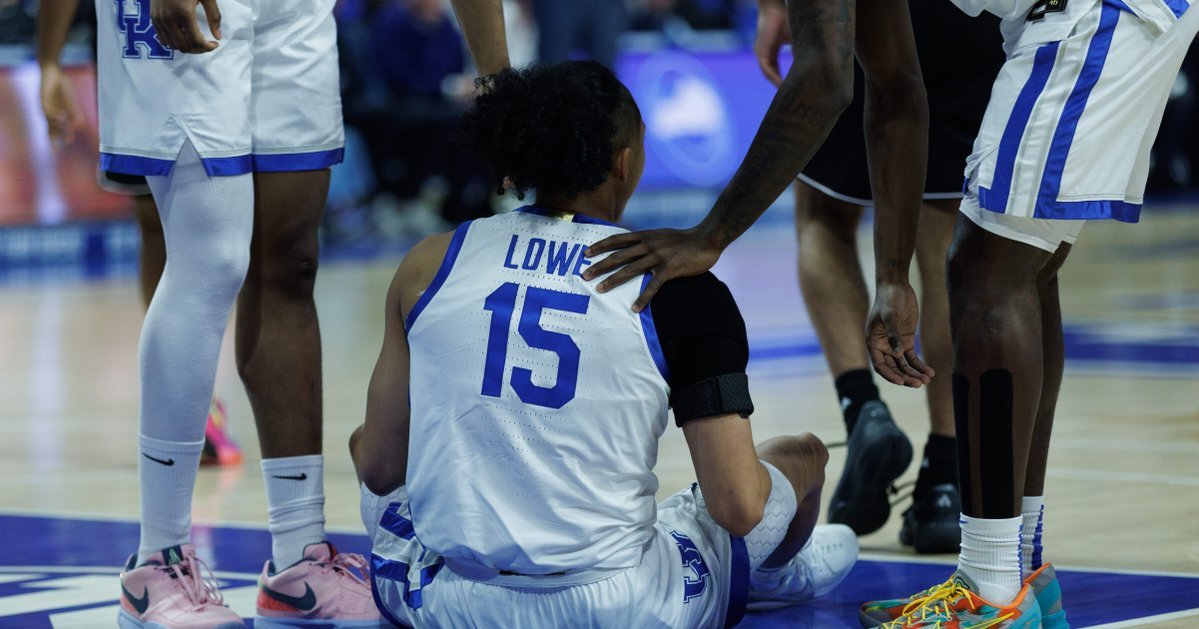
The moment didn’t arrive with fireworks or a standing ovation. There was no dramatic timeout speech, no obvious pivot that screamed season-defining decision. Instead, it unfolded quietly — almost uncomfortably — as Kentucky’s season once again brushed up against the kind of adversity that has already reshaped its identity.
The Wildcats were still processing the reality of losing Jaland Lowe when the truth became unavoidable: this wasn’t just about replacing a player. It was about redefining control, rhythm, and trust at the most delicate position on the floor.
And that’s where everything began to change.
Kentucky entered the stretch battered but not broken. After stumbling out of the gate and absorbing early-season losses against elite competition, the Wildcats had steadied themselves. Wins returned. Confidence followed. Momentum began to build. Yet beneath the surface, one lingering concern remained — and it had nothing to do with rankings, matchups, or bracketology.
It was health. And more specifically, what happens when it disappears.
When Lowe’s shoulder injury ultimately ended his season, the immediate assumption was that Kentucky would need to scramble — patching together lineups, increasing usage for scorers, and hoping talent alone could bridge the gap. Instead, something far more interesting happened. The Wildcats slowed down. The offense simplified. Possessions became purposeful.
At the center of that shift stood Denzel Aberdeen.
Against Mississippi State, the turning point arrived almost before anyone realized it. Lowe exited early, forcing Kentucky to adjust on the fly. What followed wasn’t chaos — it was clarity. The ball moved with intention. Spacing improved. Defensive pressure was absorbed instead of rushed. Kentucky finished the night with 21 assists, its best mark against a high-major opponent this season, and the majority of that production came after the injury reshaped the rotation.
Aberdeen didn’t dominate the box score, but he dominated the feel of the game. Sixteen points. Four assists. Just two turnovers. More importantly, he dictated tempo. He got Kentucky into sets. He read the floor. He knew when to attack and when to reset. For a roster that had often played on the edge of speed and improvisation, the difference was striking.
Head coach Mark Pope noticed immediately.
In postgame evaluations, Pope pointed not to scoring bursts or highlight passes, but to subtleties — Aberdeen getting downhill, stopping on two feet, and making the correct read in traffic. Those plays don’t always show up as assists, but they bend defenses. They create margins. They allow shooters to breathe and bigs to establish position.
That skill set matters now more than ever.
Kentucky doesn’t have another guard who mirrors Lowe’s creativity or shot-making, and Pope has been transparent about that reality. This wasn’t a plug-and-play situation. It required a retooling of how the Wildcats function offensively. In that retooling, Aberdeen’s steadiness became indispensable.
Over the past five games, he has logged the highest percentage of minutes at point guard on the roster. The Wildcats’ most effective lineups consistently feature him initiating the offense, often alongside Otega Oweh, Kam Williams, and Malachi Moreno. Against Mississippi State, those combinations outscored the Bulldogs by 18 points — a telling margin that reflected control more than explosiveness.
Crucially, Aberdeen isn’t being asked to carry the entire load.
Freshman Jasper Johnson has grown into a reliable secondary handler. Oweh has expanded his playmaking role. Moreno’s passing from the post has added another layer of structure. But Aberdeen remains the connective tissue — the player who keeps possessions from dissolving into isolation-heavy sequences when pressure mounts.
There’s also an element that can’t be quantified: experience.
Aberdeen has been here before. He’s played in high-stakes environments. He understands how winning basketball looks when games tighten and expectations rise. For a Kentucky team still searching for consistency, that composure has been stabilizing — especially as injuries continue to test depth and continuity.
None of this diminishes what Lowe brought to the floor. His creativity, shot-making, and unpredictability are irreplaceable. Kentucky is not suddenly better without him. But until health returns — and that remains the program’s biggest priority moving forward — the Wildcats may have uncovered something equally vital.
Not a star. Not a savior.
A stabilizer.
In a season defined by resets and recalibration, Kentucky didn’t find its footing through force. It found it through control. And in the quiet moments where possessions matter most, that discovery could end up deciding just how far this turnaround truly goes.