


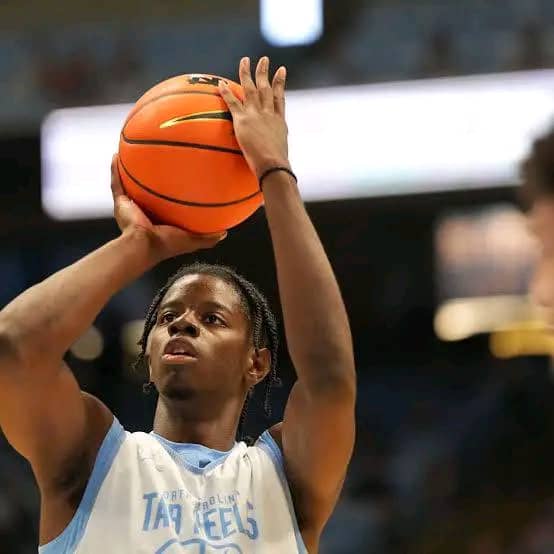
This can’t continue to be a trend as North Carolina moves deeper into conference play.
The UNC basketball program enters a critical stretch of the season holding an impressive 14–2 overall record and a 2–1 mark in ACC play as the Tar Heels prepare for a two-game West Coast trip that begins with a matchup against Stanford on Wednesday night.
On the surface, everything appears to be trending in the right direction for North Carolina. The wins are piling up, confidence remains high inside the locker room, and the roster continues to showcase one of the most talented collections of players in the conference. But beneath the shiny record lies an uncomfortable truth that is becoming harder to ignore with each passing ACC game.
While the Tar Heels have done plenty right this season, particularly on the offensive end, there remains a glaring weakness that has already begun to show cracks against conference competition. And unfortunately for UNC, it’s an issue that even one of the team’s most impactful players, Caleb Wilson, cannot fix on his own.
There is still plenty of room for growth for this team, especially on the defensive side of the floor. More specifically, North Carolina’s perimeter defense has become a growing concern, and ACC opponents have wasted little time exposing it.
Even Caleb Wilson Can’t Solely Fix This Problem
Caleb Wilson is an elite-level basketball player. His versatility, basketball IQ, and two-way impact make him one of the most valuable players on the roster. Wilson can score at multiple levels, rebound effectively, defend multiple positions, and elevate the play of those around him. He is often the player UNC turns to when momentum needs to be stabilized or when a spark is required.
However, even players of Wilson’s caliber have limitations, especially when the issue at hand is systemic rather than individual.
North Carolina’s biggest problem through three ACC games has been its inability to consistently defend the three-point line. Conference opponents have found far too many clean looks from beyond the arc, and they’ve made the Tar Heels pay for it.
In three ACC games so far, opponents have shot the basketball from deep at alarming rates:
Florida State: 12-for-40
SMU: 14-for-27
Wake Forest: 14-for-35
That’s a combined 40-for-102 from three-point range, good for 39.2 percent shooting.
Simply put, allowing conference opponents to shoot just under 40 percent from beyond the arc is not a recipe for sustained success, regardless of how talented the roster may be.
What makes the numbers even more concerning is the context behind them. Florida State attempted an unusually high volume of three-pointers, many of which were contested or taken late in the shot clock. If you remove that game from the equation, the picture becomes far more troubling.
Against SMU and Wake Forest, two teams with capable shooters, opponents knocked down 28 of 62 three-point attempts. That’s 45 percent shooting from deep, an elite level by any standard.
That kind of efficiency doesn’t happen by accident.
This isn’t just about a few tough shots falling. It’s about defensive breakdowns, late rotations, poor closeouts, and communication lapses that have become too frequent for a program with championship aspirations.
Something Has to Give
At some point, something has to change.
North Carolina cannot continue to rely on offensive firepower to outscore teams that are lighting them up from the perimeter. That approach might work against lesser opponents or in short bursts, but it becomes far more dangerous as conference play intensifies and the margin for error shrinks.
ACC teams are too well-coached and too disciplined to consistently bail UNC out with missed shots. Once shooters find a rhythm, especially at home or in high-energy environments, stopping them becomes exponentially harder.
The Tar Heels have to do a better job of limiting wide-open three-point opportunities. Too often, opponents are getting comfortable looks early in possessions, allowing shooters to see the ball go through the net without much resistance. And as any basketball player knows, once a shooter sees a few shots fall, the basket starts to look bigger.
After a few makes, a confident shooter doesn’t need much space. Even a hand in the face won’t matter. At that point, defensive recoveries feel late, rotations feel rushed, and panic starts to creep in.
That’s exactly the scenario North Carolina must avoid.
The issue isn’t simply effort. The Tar Heels are playing hard. The issue is discipline and connectivity on the defensive end. Help defense has been a step slow. Closeouts have been too aggressive at times, leading to blow-bys, and too passive at others, allowing shooters to step into clean looks.
These are fixable issues, but only if the entire team commits to addressing them.
Why This Matters More in ACC Play
Non-conference games often allow for defensive imperfections to be masked. Talent gaps, unfamiliar opponents, and early-season inconsistency can cover up flaws that don’t immediately show up in the win-loss column.
Conference play is different.
ACC teams know North Carolina inside and out. They scout tendencies, exploit mismatches, and relentlessly attack weaknesses. If the Tar Heels continue to struggle defending the perimeter, opponents will make it a focal point of every game plan.
This becomes even more dangerous on the road, where role players tend to shoot with more confidence and officiating can be less forgiving.
North Carolina’s upcoming schedule is filled with teams that can shoot the basketball. If the Tar Heels don’t clean up their defensive rotations, they risk turning every conference game into a three-point contest, which dramatically increases variance and unpredictability.
That’s not where a team with championship expectations wants to live.
The Encouraging Part: The Potential Is There
The most frustrating aspect of this issue is that North Carolina has already shown it is capable of playing elite-level defense.
Early in the season, the Tar Heels were sharp, connected, and disruptive on that end of the floor. Ball pressure was consistent. Rotations were crisp. Shooters were forced into difficult attempts late in the shot clock.
That version of UNC still exists.
The challenge is sustaining it across the grind of a long season. Defensive excellence requires constant communication, trust, and accountability. One missed rotation often leads to another, and suddenly a possession that should have ended with a contested jumper turns into an uncontested three.
Caleb Wilson can anchor the defense, set the tone, and make plays that energize the group, but he cannot be everywhere at once. Perimeter defense is a five-man responsibility. Guards must fight through screens. Wings must close out under control. Bigs must communicate and recover.
It takes all five players moving as one.
What Happens If This Trend Continues?
If North Carolina doesn’t improve in this area, ACC play could become far more uncomfortable than the record currently suggests.
Games will tighten. Late leads will evaporate quickly. Momentum swings will favor opponents who feel confident they can generate open looks from deep whenever they need them.
Over the course of a season, that kind of vulnerability is difficult to overcome, especially when March arrives and every possession is magnified.
The good news is that it’s still early. There’s time to correct course. The coaching staff is well aware of the issue, and the players have shown they can rise to the challenge when locked in.
But awareness alone isn’t enough.
North Carolina must turn that awareness into consistent action on the defensive end. If they do, the Tar Heels have the talent to compete with anyone in the country. If they don’t, even standout performances from players like Caleb Wilson won’t be enough to carry them through the gauntlet of ACC play.
As the conference schedule unfolds, the answer to this question will define UNC’s season: can the Tar Heels rediscover their defensive identity before this weakness becomes a fatal flaw?
Because one thing is clear — this trend cannot continue.




