


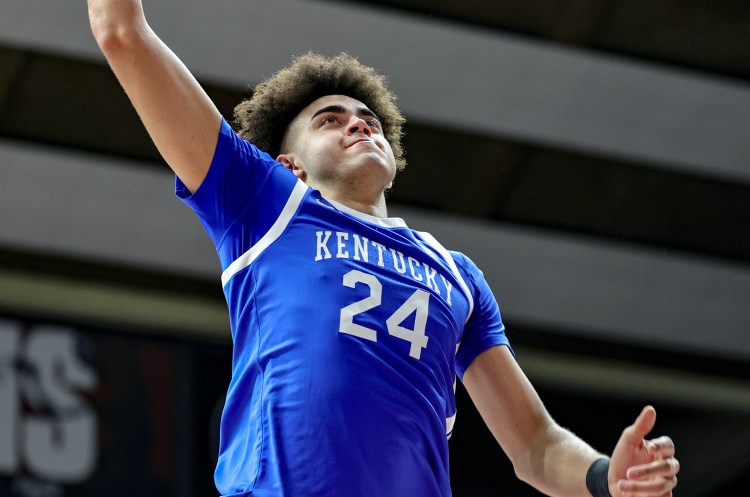
What unfolded Wednesday night in Baton Rouge wasn’t just another road win — it was the kind of game that redefines a season, reshapes belief, and reminds everyone why college basketball still owns moments no script can touch.
Kentucky walked into the Pete Maravich Assembly Center battered, doubted, and still searching for consistency under first-year head coach Mark Pope. They walked out with a 75–74 win over the LSU Tigers that felt closer to a miracle than a box-score result — capped by a buzzer-beater that instantly entered program lore.
A night that looked lost before it ever began
For the first 20 minutes, this didn’t resemble a team capable of saving its season.
Kentucky’s offense was disjointed, hesitant, and painfully stagnant. The Wildcats didn’t reach double figures until more than 12 minutes had ticked off the clock, an almost unthinkable drought for a program built on tempo and shot-making. LSU smelled blood early, pressuring passing lanes, winning loose balls, and punishing Kentucky’s indecision.
By halftime, the Wildcats trailed by 16 points. The body language was grim. The energy was flat. And for a fan base that has already endured early-season struggles and mounting questions, it felt like another long night was inevitable.
At that point, the idea of momentum from Kentucky’s previous win over Mississippi State felt distant — almost irrelevant.
The second half reversal nobody saw coming
Whatever was said in the locker room didn’t just flip the script — it tore it up.
Kentucky came out of halftime sharper, more aggressive, and suddenly connected. Defensive rotations tightened. Rebounding improved. The ball finally moved with purpose instead of panic. Possessions that once ended in forced shots turned into controlled attacks.
Slowly, the gap closed. Ten points. Eight. Five.
LSU, meanwhile, began to feel the pressure of a game that refused to end quietly. Missed opportunities piled up. Open looks rimmed out. The crowd, once roaring, grew tense as Kentucky continued to chip away.
When the Wildcats took the lead with under three minutes remaining — after trailing by as many as 18 — disbelief spread across the building. Yet even then, nothing about this game was settled.
One possession. One pass. One shot.
With the score tied and the clock bleeding toward zero, LSU scored to go up one, leaving Kentucky with what appeared to be one desperate chance.
Then chaos turned cinematic.
A full-court pass. 1.6 seconds remaining. One catch in rhythm.
Malachi Moreno rose, unfazed by the moment, and buried a clean jumper as time expired — a play instantly likened to Christian Laettner’s iconic NCAA tournament winner, only this one came in January with a season hanging in the balance.
The horn sounded. Kentucky’s bench exploded. LSU’s arena fell silent.
In a single second, despair flipped into delirium.
Why this win matters far beyond the score
This wasn’t just about erasing an 18-point deficit. It was about survival.
Under Mark Pope, Kentucky has searched for identity, rhythm, and confidence. Critics questioned whether the Wildcats could close games, respond to adversity, or manufacture offense when things broke down.
Wednesday night answered all three — imperfectly, dramatically, and memorably.
Moreno’s shot will live forever, but the comeback itself may prove just as important. It showed resilience. It showed growth. And perhaps most critically, it showed belief at a moment when belief was in short supply.
Postgame emotion and a fan base reawakened
The aftermath was pure release.
Players mobbed Moreno. Teammates screamed. Coaches exhaled. Online, Big Blue Nation erupted — not just celebrating the shot, but what it symbolized. Hope. Momentum. Proof that this season still has a pulse.
Kentucky didn’t play a perfect game. Far from it. But in college basketball, perfection isn’t required — belief is.
And on a night when everything pointed toward another painful chapter, the Wildcats authored something entirely different.
They didn’t just beat LSU.
They reminded everyone — including themselves — that this season is far from over.




