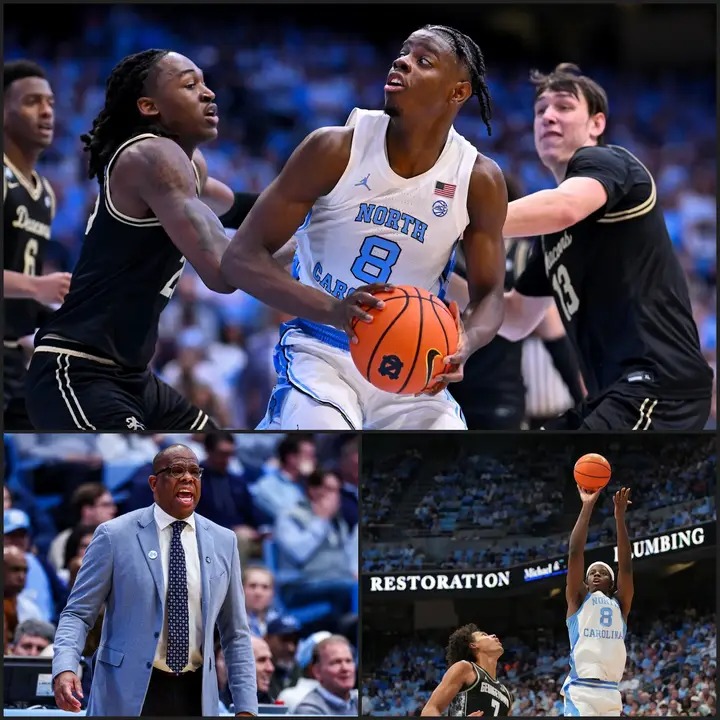
The noise arrived quickly — and loudly.
By the time the final horn sounded in Chapel Hill, the conversation around North Carolina Tar Heels wasn’t just about another ACC result. It had shifted into something far more uncomfortable: questions about trust, offensive identity, and whether one of the program’s brightest young talents was being used — or misused — when it mattered most.
That tension is what forced head coach Hubert Davis to step forward and publicly defend Caleb Wilson following the matchup against the Wake Forest Demon Deacons.
A first half that changed expectations
For 20 minutes, Wilson looked unstoppable.
The freshman guard was electric early, scoring with confidence, pace, and a freedom that immediately tilted the floor in North Carolina’s favor. He attacked closeouts, punished switches, and played with the kind of rhythm that makes defenses scramble. Wake Forest had no clean answer for him, and the Tar Heels fed off that energy.
By halftime, Wilson wasn’t just leading the team — he was setting the tone.
And then, almost inexplicably, everything changed.
When momentum quietly disappeared
After the break, Wilson’s touches dropped. His involvement faded. Possessions came and went without him initiating, finishing, or even threatening the defense the way he had earlier. Whether by design or circumstance, North Carolina’s offense drifted into slower, more predictable patterns.
Wake Forest adjusted. The Tar Heels did not — at least not in a way that re-centered their hottest hand.
To fans watching, the shift felt glaring. Social media lit up with criticism, much of it aimed squarely at Wilson: questions about his aggressiveness, his composure, even his readiness for high-pressure moments.
That narrative didn’t sit well with Davis.
Hubert Davis draws a line
In his postgame remarks, Davis made it clear the criticism was misplaced.
The head coach emphasized that Wilson didn’t suddenly stop wanting the ball — the flow of the offense simply didn’t put him in positions to attack the way it had earlier. Davis pointed to spacing issues, missed reads, and breakdowns that limited Wilson’s opportunities, rather than any lack of confidence or effort from the player himself.
More importantly, Davis reframed the conversation.
This wasn’t about one freshman failing to deliver. It was about a team learning how to recognize — and trust — what’s working in real time.
A bigger issue than one game
The moment exposed a lingering concern around this North Carolina roster: late-game clarity.
When pressure rises, who becomes the focal point? Who dictates tempo? And does the team consistently reward the player who has already proven he can bend the defense?
Wilson’s first half showed what the offense can look like when it’s decisive and aggressive. The second half showed how quickly that edge can disappear without intentional structure.
That contrast is why this game sparked deeper questions in Chapel Hill.
The delicate balance with a young star
Davis has been clear all season about managing expectations for his younger players. Development, he often says, isn’t linear. But games like this complicate that message. When a freshman is clearly the best offensive option on the floor for extended stretches, pulling back — even unintentionally — sends mixed signals.
Wilson handled the moment with composure, never showing frustration publicly. But the film tells its own story: missed chances, delayed actions, and a player ready to attack who wasn’t always empowered to do so.
Why this conversation matters now
This isn’t just about Wake Forest.
As ACC play grinds forward, North Carolina will face tighter margins, smarter scouting, and games that hinge on a single stretch — sometimes just a few possessions. Knowing who to trust, and when, isn’t optional. It’s foundational.
Davis’s defense of Wilson wasn’t simply about protecting a player. It was about protecting the team’s long-term identity — one that can’t afford to mute its most dangerous weapon when momentum is begging to be seized.
The first half showed what North Carolina can be.
The second half showed what happens when certainty disappears.
And now, the real work begins — not just on the court, but in the conversations behind closed doors in Chapel Hill.