


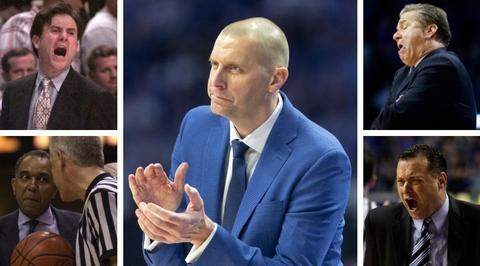
Relative to Kentucky basketball’s long and fiery history, the home sideline at Rupp Arena has been an unusually calm place lately. For a fan base accustomed to demonstrative coaches, animated disagreements with officials, and sideline theatrics that sometimes rival the action on the floor, the past season and a half has felt almost serene. That calm, however, finally cracked last week.
Mark Pope, the typically cool and composed head coach of the Wildcats, reached a boiling point during Kentucky’s game against Missouri. His projected NBA lottery pick, Jayden Quaintance, had just been knocked hard to the floor on the far end of the court. Play continued. The whistle never came. And in that instant, the dam broke.
Pope exploded.
Stomping his foot hard enough for the sound to carry clearly through the television broadcast, Pope unleashed a stream of words in the direction of any referee within shouting distance. The Kentucky bench, normally a place of measured instruction and controlled emotion under Pope, became the focal point of the game’s emotional temperature. It was a rare sight in Lexington — and one that did not last long before consequences followed.
Referee Rob Rorke had seen enough. Tired of the verbal barrage and accompanying theatrics, he whistled Pope for a technical foul. It was the first technical of Pope’s tenure as Kentucky’s head coach. It took 51 games for it to happen.
By Kentucky basketball standards, that might be the most surprising part of the entire sequence.
At programs like Kentucky, where passion is not just encouraged but expected, a coach making it more than a full season without a technical foul is almost unheard of. For decades, the Kentucky sideline has been one of the loudest, most expressive, and most scrutinized spaces in college basketball. From Hall of Fame coaches to fiery interim leaders, the Wildcats’ bench has rarely been quiet — especially when officiating becomes part of the story.
Yet Pope had managed to navigate his first season in Lexington without crossing that line. And not just barely. He rarely flirted with it.
The Missouri game changed that.
Pope’s protests did not stop once the technical was assessed. As Missouri lined up for the free throws, he paced the sideline, back and forth, still visibly furious. The stomping continued, punctuated by sharp turns and exaggerated steps. At one point, official Doug Shows walked over to check on the situation, attempting to cool things down. Veteran referee Pat Adams soon followed, approaching the Kentucky bench to see if Pope had anything left to say.
Pope did not engage.
Instead, he turned his back on Adams without a word. Adams, perhaps sensing the moment had already passed, responded with a theatrical shrug and walked away, a moment that drew chuckles from those watching closely.
The scene was striking not because of its intensity — college basketball is full of moments like this — but because of who it involved. Mark Pope is not known for these kinds of outbursts. In fact, they are almost entirely absent from his coaching resume.
The audible stomp that preceded the technical foul was clear on the broadcast. The words that followed it were even clearer. And those words, by Pope’s own standard, are rarely directed at officials.
That restraint has been intentional.
Pope has spoken often since arriving in Lexington about his respect for referees and the difficulty of their job. He has publicly acknowledged how fast the game moves, how challenging it is to see every angle, and how easily fans — and coaches — forget the human element involved. Compared to many of his peers, Pope almost never curses in the direction of officials and rarely engages in prolonged arguments.
For someone in his position, that makes him an outlier.
That history is why this technical foul felt less like a loss of control and more like the culmination of something building beneath the surface. Kentucky was already struggling in the game. The missed call involving Quaintance felt egregious in real time. And the moment arrived where restraint finally gave way to raw emotion.
UK assistant coach Cody Fueger knows Pope as well as anyone. He has been on Pope’s staff for all 11 years of Pope’s head coaching career, spanning multiple programs and thousands of possessions. When asked about Pope’s relationship with officials, Fueger didn’t hesitate.
Pope, he explained, simply doesn’t live in that space very often.
Fueger reflected on the 2024–25 season and tried to recall moments when Pope came close to receiving a technical foul. One stood out: Kentucky’s road loss at Alabama. During that game, referee Terry Oglesby took an extended verbal lashing from Pope. At one point, Oglesby even followed Pope down the sideline in Coleman Coliseum after Pope had already turned away.
That day, cooler heads prevailed.
“But Terry’s given him one in the past,” Fueger noted, referencing a game years earlier when Oglesby assessed Pope a technical foul while Pope was the head coach at BYU.
The fact that individual moments like that are easy to remember tells the story. There simply haven’t been many of them.
Pope’s restraint is not accidental. It’s philosophical.
As a coach, he has long believed that constant arguing with officials drains energy from players, distracts from execution, and creates an atmosphere of complaint rather than accountability. He has preached composure, next-play mentality, and emotional control — not just to his players, but to himself.
That philosophy has been on display throughout his early tenure at Kentucky. While the program has navigated injuries, roster turnover, and the weight of massive expectations, Pope has consistently presented a calm, steady presence. His demeanor has stood in contrast to the emotional volatility often associated with high-profile college basketball jobs.
That’s part of why his first technical felt so jarring — and, paradoxically, so understandable.
Kentucky basketball is different.
The pressure is constant. Every possession is scrutinized. Every decision is debated. Every whistle, or lack thereof, carries outsized significance. Even the most composed coaches eventually encounter moments that test their emotional ceiling.
Pope’s came with Quaintance sprawled on the floor and no call in sight.
In that instant, the balance tipped. Not because Pope suddenly abandoned his values, but because the emotional stakes of the moment overwhelmed his usual restraint. The frustration wasn’t just about one missed call. It was about protecting his player, defending his team, and feeling the weight of a game slipping away.
That matters.
Coaches often talk about earning a technical foul — about moments when taking one is worth it to send a message to officials or to galvanize a team. Pope has rarely subscribed to that idea. But in this case, the technical seemed less strategic and more human.
It was the sound of a coach who cared deeply and reached his limit.
By Kentucky standards, waiting 51 games for that moment is remarkable. For perspective, many Kentucky coaches in the past would have reached that mark within their first month. The Wildcats’ sideline has long been a place of visible passion, animated gestures, and frequent conversations with officials — some productive, some not.
Pope has largely avoided that tradition. Instead, he has tried to redefine what leadership on the Kentucky bench can look like in a modern era. Calm instruction. Controlled emotion. Let the players speak with their play.
But Kentucky basketball has a way of pulling emotion out of even the most composed figures.
This technical foul does not signal a change in Pope’s coaching identity. If anything, it reinforces it. One technical in 51 games does not indicate a pattern; it highlights how rare moments like this are for him. It also shows that, despite his restraint, Pope is not immune to the pressures of the job.
And perhaps that’s what makes this moment resonate.
Kentucky fans expect passion. They want to see their coach fight for players. They want to know missed calls are felt as deeply on the sideline as they are in the stands. Pope’s outburst, brief as it was, checked that box in a way his usual calm demeanor does not.
At the same time, it did not cross into recklessness. There was no ejection. No prolonged confrontation. No postgame rant. The moment came, passed, and the game moved on.
In the broader arc of Pope’s tenure, this technical will likely be remembered less for the call itself and more for what it symbolizes. It marks the point where Kentucky’s pressure cooker finally cracked Pope’s composure — if only for a moment.
That it took so long says everything about who he is as a coach.
By Kentucky basketball standards, Mark Pope’s first ‘T’ wasn’t just a long time coming. It was almost inevitable. And when it finally arrived, it told a deeper story about restraint, pressure, and the unique emotional gravity of leading one of college basketball’s most demanding programs.




