


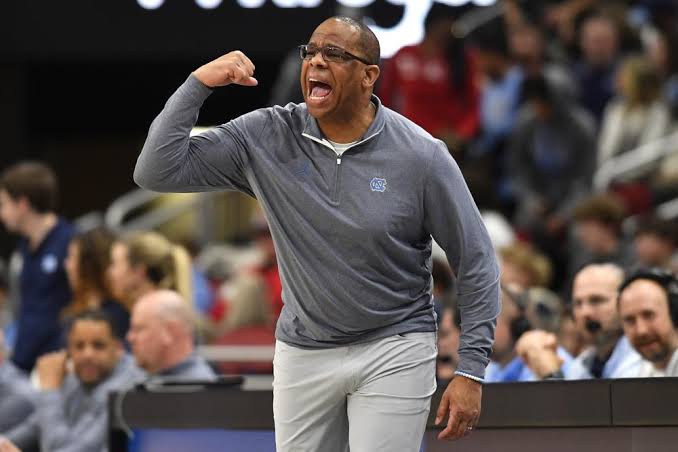
The North Carolina Tar Heels opened their West Coast road trip on a sour note Wednesday night, falling to Stanford 95-90 in a game that saw the Tar Heels relinquish not one but two double-digit leads. North Carolina led by 12 points on two separate occasions, only to watch the Cardinal claw their way back and close the contest with an 11-3 run that sealed the upset.
For a program used to a level of consistency that borders on the historic, this game reinforced some troubling trends for Hubert Davis and his squad. North Carolina has struggled in similar ways throughout the season — difficulties guarding the three-point line, inconsistent free-throw shooting, and, notably, surrendering over 80 points in three consecutive games. Each of these elements has contributed to the Tar Heels’ uneven start in conference play and continues to raise questions about whether this team can compete at the level many expected in the ACC this season.
With the loss to Stanford now in the rearview, UNC turns its focus to Saturday’s matchup at Cal. For the Tar Heels, that game now feels like a must-win, not just to stay above .500 in conference standings, but also to regain confidence after a demoralizing defeat. Yet the bigger story isn’t just what happened on the scoreboard; it’s what Hubert Davis said — and, perhaps more importantly, what his answers reveal about the bigger challenges facing this team.
Struggles defending the three-point line
One of the most glaring issues for North Carolina Wednesday night was its continued inability to defend against three-point shooting. Stanford consistently found open looks from beyond the arc, and the Tar Heels were slow to close out or rotate effectively on defense. After the game, Davis addressed the issue directly, emphasizing that it was a multi-layered problem rather than the result of one single mistake.
“I don’t think you can point to one specific thing,” Davis said. “I think it’s coming from a number of different directions. I think not getting picked up in transition, short close outs, no pressure on the ball, late rotations, kick outs from offensive rebounds. Just coming from a number of different directions.”
Davis’ answer is revealing in several ways. On one hand, it shows a clear awareness of the complexity of the problem. There isn’t a single breakdown in North Carolina’s defensive system — rather, it’s a combination of errors and missed assignments. On the other hand, the very fact that this has become a recurring problem raises questions about practice habits, defensive schemes, and personnel decisions.
If the Tar Heels are to regain control in the ACC, addressing this issue must become a priority. Three-point defense in today’s game isn’t just about individual effort; it’s about anticipation, communication, and rotation. The fact that Davis points to “a number of different directions” suggests that the problem is systemic rather than isolated, which can be harder to correct midseason.
Stanford’s scoring versatility
Another point of concern was Stanford’s ability to score from multiple positions and in multiple ways. Some observers noted that the Cardinal seemed to run the same plays repeatedly, particularly from horn sets at the top of the key. Davis pushed back against that idea, emphasizing the diversity of Stanford’s offensive approach.
“I would respectfully disagree with that,” Davis said. “In regards to — it was coming from, as I said before, a number of different situations. They were scoring threes in transition. It was coming off of isolation, it was coming off of ball screens, late communication, close outs in terms of rotations. And so whether it was running a consecutive play, they were getting different things …”
The Tar Heels’ inability to disrupt Stanford in these various situations speaks to a broader defensive concern. When a team can exploit multiple types of offense — isolation, transition, and structured sets — it forces defenders into constant adjustment. If rotations are late or communication falters, it can quickly become chaotic. For a team already struggling with defensive fundamentals, facing a versatile offense like Stanford’s magnifies weaknesses.
Ebuka Okorie and matchup challenges
A particularly difficult matchup for UNC was Stanford guard Ebuka Okorie. The sophomore has shown himself to be not only a prolific scorer but also an elite passer, making him a dual threat on the floor. When asked about Okorie’s performance, Davis highlighted the unique challenges he posed.
“Obviously, he’s a really gifted player, and it’s much different from a guard who has the ball in his hands,” Davis said. “And something else that should be talked about with him is he’s an elite and a willing passer as well. So it’s not just that he can get fouled and get to the free-throw line. Put a number of different defenders, our best one-on-one defenders, we did things differently defensively where we didn’t do any switching off the ball, to keep matchups, to keep our best defenders on him. And again, he had a big night, but there were others that stepped up and did the job.”
Davis’ explanation suggests that North Carolina was aware of Okorie’s impact and tried to mitigate it through matchup strategies rather than standard defensive rotations. Still, the fact that Okorie had a “big night” indicates that these measures were only partially successful. In other words, even with awareness and tactical adjustments, the Tar Heels were unable to consistently contain one of the game’s most dangerous offensive threats.
Questions on defensive communication
Throughout his answers, Davis repeatedly referenced communication, rotations, and situational awareness. The recurring theme is clear: North Carolina’s defensive struggles are not isolated to a single player or error. They are systemic, and they raise broader questions about coaching adjustments, player development, and accountability.
Consider this exchange on whether Stanford ran the same play repeatedly, as suggested by UNC guard Caleb Wilson. Davis declined to comment directly on Wilson’s remark, instead offering a broader acknowledgement of Stanford’s overall effectiveness.
“Yeah, I mean, I’m not going to again… That would be negligent on my part to answer a question based on what somebody else said. I don’t know how you asked it. I don’t know the context in which he answered it, the tone in which he answered it, but congratulations to Stanford for winning tonight.”
While careful and professional, this response underscores a key tension in the Tar Heels’ season: defensive breakdowns are occurring, but Davis appears cautious about attributing blame or highlighting specific errors publicly. This raises important questions about how feedback is handled internally and whether the team is fully addressing recurring issues in a proactive way.
Implications for North Carolina moving forward
The loss to Stanford is not just another defeat on the road. It is a case study in recurring vulnerabilities and systemic problems that could affect North Carolina’s trajectory in ACC play. The Tar Heels now face a must-win at Cal, where correcting defensive lapses will be crucial to avoid falling below .500 in the conference standings.
Several takeaways from Davis’ postgame remarks are worth emphasizing:
Defensive complexity – Multiple breakdowns across rotations, closeouts, and communication point to a larger systemic problem rather than isolated mistakes.
Opponent versatility – Stanford’s ability to score from transition, isolation, and structured sets highlights UNC’s struggles against diverse offensive schemes.
Star player containment – Even with intentional strategies, containing elite performers like Ebuka Okorie remains a challenge.
Internal accountability – Davis’ careful public responses suggest a professional approach, but they also raise questions about how players are corrected and prepared for repeated scenarios.
Ultimately, the game against Stanford may serve as a wake-up call for both players and coaches. North Carolina’s talent is unquestioned, but translating that talent into consistent defensive execution has been elusive. The answers provided by Hubert Davis after the loss offer insight into the coaching philosophy and decision-making but simultaneously reveal the bigger questions about team identity, preparation, and resilience under pressure.
Conclusion
Hubert Davis’ postgame comments following the Tar Heels’ 95-90 loss to Stanford highlight both awareness and complexity. North Carolina’s defensive struggles — guarding the three-point line, rotations, communication lapses, and matchups against elite opponents — are not new, but the cumulative effect is increasingly costly.
What Davis said, and what he carefully avoided saying, points to a team in transition, one still searching for consistency and clarity on both ends of the court. As UNC heads to Cal, the challenge is clear: resolve systemic defensive issues, execute under pressure, and prove that the talent and preparation can overcome recurring weaknesses.
The answers Hubert Davis provided after the loss raise bigger questions not just about Saturday’s matchup, but about the identity of this North Carolina team — questions that will continue to define the season until addressed fully.




