


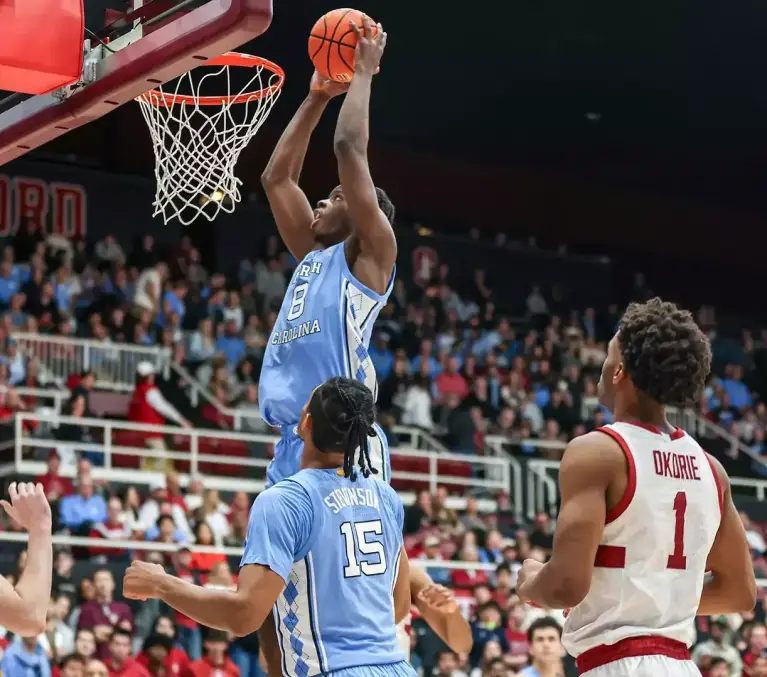
North Carolina’s trip to the West Coast began with a jolt. The Tar Heels, who had built a double-digit lead not once but twice, saw Stanford chip away and eventually take a 95-90 victory at Maples Pavilion. On paper, it was another close loss in the early ACC grind. But dig a little deeper, and this game tells a much larger story — one about defensive breakdowns, communication failures, and a team still trying to define its identity under Hubert Davis. Caleb Wilson, who poured in a season-high 26 points, put it bluntly after the game: “They ran the same play, pretty much every time down the court.” That simple statement encapsulates a problem far bigger than a single opponent or a single night on the road.
The Stanford game in context
UNC entered Wednesday night with a defense that had been showing cracks against tougher competition. Over the first 14 games, the Tar Heels allowed an average of 63.6 points per game and ranked No. 17 in the country in adjusted defensive efficiency. Those numbers suggested a team capable of holding its own on the defensive end. But the last three games told a different story. Opponents had scored 92 points per game, and UNC’s adjusted defensive efficiency had plummeted to No. 280 nationally. The trend was clear: what had once been a strength was becoming a glaring weakness.
Stanford took full advantage. The Cardinal came ready with horn sets, crisp ball movement, and the best shooting night of the season against a power-five opponent. They shot 57.1% from the field and hit 16 of 28 threes, a display of offensive execution that made UNC’s defensive problems painfully obvious. For the Tar Heels, keeping up with the tempo and adjusting to Stanford’s schemes proved impossible.
Caleb Wilson’s candid critique
Wilson’s frustration was easy to understand. His observation that Stanford “ran the same play, pretty much every time down the court” cut to the heart of UNC’s struggles. The plays were predictable, yes, but the Tar Heels lacked the adjustments and discipline to disrupt them. Stanford paired these predictable sets with dynamic execution, moving the ball efficiently and finding open shooters after screens or isolations.
“They brought the three and the four up, came off the right side, and basically just played isolation basketball,” Wilson said. “One or two more stops would have made the difference between a win and the 95–90 loss.”
Even against a team like Stanford, which had previously scored 40 points against Notre Dame, Carolina’s defense simply couldn’t rise to the occasion. The recurring theme: poor rotations, late closeouts, and a lack of pressure on the ball.
Defensive breakdowns across the board
Henri Veesaar, who also scored 26 points in the loss, highlighted similar issues. “We clearly have a lot of mistakes on defense,” he said. “Just not communicating or not talking or not listening. We’ve got to be just aware, to have a lot more defensive awareness than we have right now.”
UNC’s struggles extended to defending ball screens. Double-teaming often left shooters wide open on the perimeter, and players frequently failed to rotate quickly enough to cover gaps. “Just those little things. We can’t win that way,” Veesaar said.
Even with elite defenders on the floor, containing Stanford’s freshman guard Ebuka Okorie proved nearly impossible. Okorie set a Stanford freshman record with 36 points, combining scoring with smart passing and excellent decision-making. The Tar Heels tried multiple defensive schemes, including sticking their best one-on-one defenders on him, but the team as a whole still couldn’t limit his impact.
Hubert Davis’ perspective
When asked about Stanford’s offensive approach, Davis pushed back on the idea that the Cardinal relied solely on horns sets or repeated plays. “I would respectfully disagree with that,” Davis said. “It was coming from a number of different situations. They were scoring threes in transition; it was coming off of isolation; it was coming off of ball screens, late communication, closeouts, and in terms of rotations. And so whether it was running a consecutive play, they were getting different things.”
Davis’ answer reflects a careful, measured approach. Rather than blame a single element or highlight a failure publicly, he framed the problem as multifaceted, emphasizing situational awareness and communication breakdowns. While professional, the response underscores a critical point: UNC’s defensive struggles are systemic and may not be solved by simply focusing on one aspect of Stanford’s offense.
Stanford’s strategic execution
Stanford coach Kyle Smith employed a simple yet highly effective strategy: use horns sets to create isolation opportunities for Okorie while mixing in ball movement to find open shooters. “Our offense is pretty simple,” Smith said. “I thought we had one of the best players in the gym tonight, and we just disguised a lot of different ways to get him with the ball and try to get two on the ball with him. We disguised a lot of those horns a lot of different ways, where this guy had the ball and there’s a screen or two behind it.”
The result was devastating for Carolina. Stanford maintained constant ball movement, made extra passes to open shooters, and hit shots in transition and in half-court sets alike. UNC’s defensive lapses — in rotations, awareness, and communication — were magnified by Stanford’s execution.
The implications of repeated failures
For the Tar Heels, this loss is emblematic of broader defensive issues that have become increasingly pronounced in ACC play. The pattern is unmistakable: UNC struggles to guard the three-point line, fails to rotate effectively on screens, and lacks a cohesive defensive identity. These aren’t one-off mistakes; they are repeated breakdowns that signal a systemic problem.
Wilson and Veesaar’s postgame comments highlight a team aware of these deficiencies. “When somebody has 36 points on us, and two other players had 20? Shit can’t happen,” Wilson said bluntly. Veesaar echoed the sentiment: the team must be quicker, more communicative, and more disruptive to opponents’ schemes.
In other words, the issues extend beyond personnel and touch on preparation, strategy, and execution. For a team that has prided itself on defensive efficiency in the past, this represents a significant challenge.
Looking ahead to Cal
UNC now has a brief window to regroup before facing Cal on Saturday. The team will have two days of practice in Berkeley to analyze film, adjust schemes, and refocus on defensive fundamentals. Veesaar emphasized the urgency: “Just go back, learn from this game, watch film on this game, and then concentrate on the next opponent and do whatever we can do to have the best defensive game there. … Show how physical we can be and how good we can be defensively, because I think that’s what coaches take pride in, and we’re not doing our job.”
The stakes are high. A loss to Cal could push UNC below .500 in conference play, making the road trip even more challenging. But perhaps more importantly, it represents an opportunity for the Tar Heels to confront the defensive issues that have plagued them and begin to redefine their identity as a team capable of executing under pressure.
Conclusion
Caleb Wilson’s postgame statement — that Stanford “ran the same play, pretty much” — cuts to the core of North Carolina’s defensive struggles. The Tar Heels were exposed on multiple levels: ineffective rotations, poor communication, failure to guard the three-point line, and an inability to contain dynamic offensive players like Ebuka Okorie.
Hubert Davis’ responses, measured and professional, point to systemic issues rather than isolated failures. While UNC’s record is better than last season’s at this stage, defensive play has regressed, and the adjustments that need to be made are clear.
The Stanford loss is more than a single game on the schedule; it is a warning. The Tar Heels must confront recurring defensive issues, adapt quickly, and build a stronger team identity if they hope to remain competitive in the ACC. What Wilson and Veesaar highlighted — predictability, lack of communication, and defensive inefficiency — will be the key factors in whether North Carolina can turn a season that looks promising on paper into tangible results on the court.




