


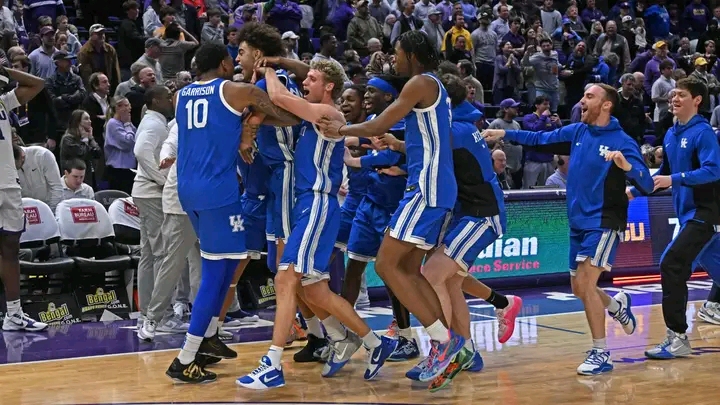
Kentucky basketball fans are often quick to get excited or worried about freshman recruiting classes. Year after year, Wildcats supporters obsess over which five-star prospects will land on the Rupp Arena hardwood. But as college basketball evolves, especially with the rise of the transfer portal, the calculus for Kentucky has changed dramatically. It’s no longer just about landing the next household-name freshman; it’s also about managing the returning core, retaining talent, and navigating a system that incentivizes movement like never before.
At first glance, Mark Pope’s Kentucky roster looks impressive. The Wildcats could bring back a substantial core of players who have already proven themselves in the program: AJ Griffin, Kam Thomas, Chandler, Garrison Brooks, Jasper Wilson, and Malachi Moreno. Add in a healthy Jalen Looney, Jaylen Johnson (J Lo), and Noah Clowney, and that’s a foundation most programs would envy. Redshirt players like Hawthorn and Potter provide even more depth. On paper, it seems like Kentucky could ride this experienced nucleus into another strong season.
But dig deeper, and the picture becomes far less certain. Even with so much returning talent, the program may still need big-name freshman recruits to remain competitive. The reason? The transfer portal has fundamentally changed college basketball, creating a system where players can leave whenever they feel their immediate needs playing time, exposure, or development are not being met.
The transfer portal effect
In today’s game, players are more willing than ever to move. Gone are the days when committing to a program meant multi-year stability. Kam Thomas, for example, may choose to leave to seek more playing time elsewhere. Garrison Brooks, similarly, might look for opportunities where he can play a leading role rather than compete with an already loaded frontcourt. Jasper Wilson, though he has publicly pledged loyalty, could be tempted by offers from programs that promise a starring role or better draft positioning. And Jalen Looney and Jaylen Johnson? While Looney might return, Johnson is almost certainly heading to the NBA.
Transfers are no longer exceptions; they are part of the strategy. Programs must recruit with this reality in mind. Even if Kentucky manages to keep a large portion of its roster intact, the uncertainty around these key contributors makes the addition of high-level freshmen essential.
Returning players vs. new recruits
Let’s break down the potential returners and the implications for Kentucky’s recruiting needs:
AJ Griffin: A cornerstone of the program and a projected lottery pick. His return is critical but not guaranteed, given professional prospects.
Kam Thomas: A high-upside forward who may explore the portal for more playing time.
Chandler: Likely to return, bringing stability to the backcourt.
Garrison Brooks: Experienced forward; could leave for a bigger role elsewhere.
Jasper Wilson: Loyal but possibly tempted by external opportunities.
Malachi Moreno: Core player, likely returning.
Jalen Looney (J Lo): Health is a factor; might return for continuity.
Jaylen Johnson (JQ): Likely to leave for NBA, creating a major void.
Noah Clowney: Health and development permitting, could return as a key contributor.
Even in the best-case scenario, Kentucky faces uncertainty in several critical positions. Losing one or two of these players, especially in positions that demand size, athleticism, or leadership, could significantly impact the team’s competitiveness.
Why big-name freshmen still matter
Given this uncertainty, pursuing top-level freshmen remains a strategic necessity. A single elite freshman can provide immediate scoring, versatility, and upside that offsets potential departures. Unlike transfers, freshmen can be developed within Kentucky’s system from day one, giving Pope more control over rotations and team culture.
Redshirt players such as Hawthorn and Potter provide depth, but they cannot replicate the talent and ceiling of a five-star freshman. Depth is valuable, but when it comes to explosive athleticism, scoring, and impact in big games, top-tier freshmen remain irreplaceable.
The reality is that even with a largely intact roster, Pope cannot assume every player will stay healthy, committed, or develop as expected. Injuries, NBA aspirations, and the lure of the portal all create unpredictability. High-level freshmen act as insurance and potential difference-makers, ensuring Kentucky remains competitive in a conference and national landscape that is increasingly unpredictable.
The role of transfers
Transfers will still be a part of Kentucky’s strategy. Pope has already shown a willingness to integrate transfers who fit his system, providing immediate experience and depth. However, the transfer portal is highly competitive, and even successful programs can miss out on top-tier names. Relying exclusively on transfers is risky; the market is saturated, and other high-profile programs are vying for the same players.
Furthermore, transfers may bring talent but not necessarily continuity. They are accustomed to different systems, coaching styles, and team cultures. Freshmen, by contrast, are malleable — they can be taught Pope’s defensive schemes, ball movement philosophy, and culture from day one. That kind of integration is difficult to achieve mid-season with transfers.
Challenges beyond the court
It’s not just talent evaluation that complicates Kentucky’s recruiting strategy. According to multiple sources, the program has faced criticism over administrative and contractual matters, particularly related to Mitch’s contract with JMI. Some players reportedly chose other programs due to concerns about the influence of advisors and back-office dynamics. While this is not a Pope issue — players have consistently spoken positively about him — these external factors can still impact recruiting decisions.
Players want stability, professional guidance, and a clear path to development. If they perceive that administrative or financial considerations are interfering with their growth, they are more likely to explore other programs. This adds another layer of urgency to secure elite freshmen who are motivated, focused, and fully committed to the program’s vision.
Balancing expectations with reality
For Kentucky fans, it can be easy to overreact when freshman recruiting classes don’t meet sky-high expectations. But a realistic assessment reveals that even with most of the core returning, top-level freshmen remain necessary. The roster is strong, but the combination of potential departures, injuries, and the ever-present lure of the transfer portal means Pope must plan for contingencies.
It’s also about positioning Kentucky for long-term success. While the returning players provide immediate competitiveness, a freshman class loaded with high-upside talent ensures the program remains sustainable and flexible. It gives Pope options: different rotations, depth at multiple positions, and the ability to develop talent that could become the cornerstone of the next generation.
Conclusion
In a college basketball landscape dominated by the transfer portal, Kentucky’s reliance on returning talent is both a blessing and a challenge. While retaining players like AJ Griffin, Chandler, Moreno, and potentially others would be a huge advantage, there is no guarantee everyone will stay, stay healthy, or perform at peak levels.
That’s why big-name freshmen are still critical. They offer talent, flexibility, and the ability to integrate seamlessly into Pope’s system. They act as insurance against departures, injuries, and unpredictability in player development. And perhaps most importantly, they ensure that Kentucky continues to compete at the highest level in a rapidly evolving college basketball landscape.
In short, the Wildcats may have a strong returning core, but the reality is clear: even with most players coming back, top-tier freshmen are far from optional — they are essential to keeping Kentucky basketball elite.




