


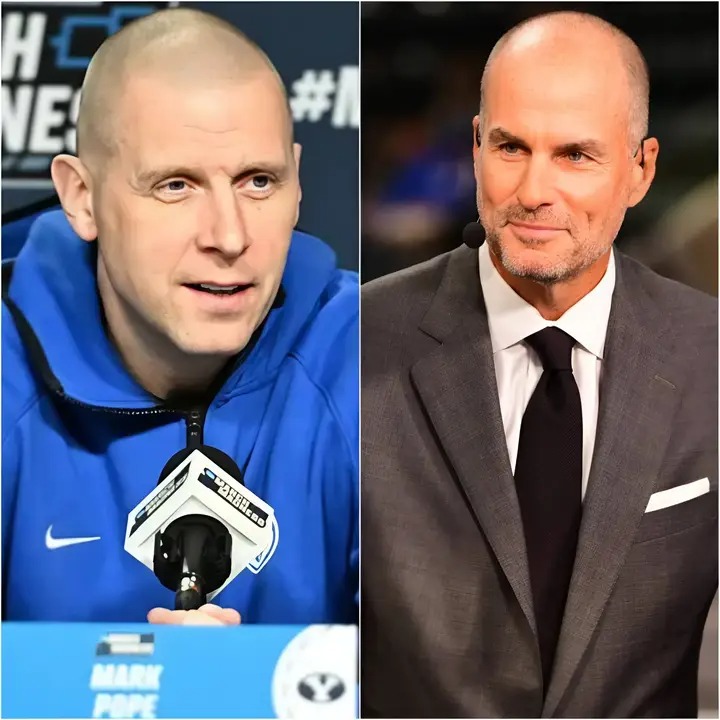
The final buzzer had barely finished echoing through the PMAC when the story of the night took a sharp, unexpected turn — and suddenly, Kentucky’s dramatic 75–74 win over LSU felt almost secondary.
What unfolded next wasn’t just postgame analysis. It was a full-blown national debate that exploded in real time, fueled by a blistering on-air monologue, a fanbase already on edge, and one icy response that cut straight through the noise.
A Win That Should’ve Been Celebrated — But Wasn’t
On paper, the comeback was the kind of moment Big Blue Nation lives for.
The Kentucky Wildcats trailed by as many as 18 points, looked lifeless for long stretches, then somehow rallied behind defensive pressure, timely shooting, and one final, unforgettable possession. When the ball finally dropped through the net with 1.4 seconds left, Kentucky had stolen a road win that could define its season.
But instead of replaying the shot, the focus shifted to the broadcast desk.
And then the tone changed completely.
Jay Bilas Lights the Match
As highlights rolled, Jay Bilas leaned forward, voice calm at first — then increasingly sharp.
“Let’s get something straight,” he began. “That victory wasn’t earned. It was purchased.”
The words landed like a punch.
Bilas didn’t stop there. He questioned whether the Wildcats won with execution or with resources, pointing directly at the modern NIL landscape and the growing imbalance between programs. He suggested Kentucky’s roster depth, late-game composure, and even whistle-friendly moments weren’t coincidences, but symptoms of a system tilted in their favor.
“You don’t beat a team like LSU with grit,” he continued. “You beat them with money.”
Within minutes, clips of the segment were circulating everywhere. Fans froze the frame. Group chats ignited. Hashtags trended. The phrase “bought, not won” took on a life of its own.
LSU’s Effort, Kentucky’s Shadow
To Bilas’ point, the LSU Tigers had controlled much of the game. They dictated tempo, punished Kentucky’s early mistakes, and fed off a home crowd that sensed something special.
For nearly 30 minutes, LSU looked like the sharper, more cohesive group.
That’s what made the ending sting — and what gave Bilas’ comments oxygen. A one-point loss always invites scrutiny. A miraculous finish invites suspicion.
And in today’s college basketball climate, no conversation stays purely on the court for long.
Social Media Turns the Heat Up
Within an hour, timelines were split clean down the middle.
One side echoed Bilas’ sentiment, arguing that NIL has created a two-tier sport where programs like Kentucky operate with built-in advantages. The other fired back just as loudly: talent doesn’t guarantee execution, and money doesn’t make last-second shots fall.
Memes followed. Reaction videos followed those. Every replay of the final possession was dissected frame by frame.
And looming over it all was one question:
Would Kentucky respond?
Mark Pope Steps In — and Ends It
Eventually, Mark Pope walked to the podium.
The room buzzed. Cameras zoomed in. Everyone waited for a rebuttal — a defense of NIL, an explanation of officiating, or perhaps a pointed counterattack.
Instead, Pope paused… and delivered a single sentence.
Eleven words.
No raised voice. No names mentioned. No follow-up.
Just enough to stop the room cold.
Reporters glanced at each other. Phones dropped back to laps. The moment passed almost as quickly as it arrived — but the effect was immediate. The narrative shifted. The debate softened. The noise receded.
Whatever Pope said, it didn’t inflame the fire.
It extinguished it.
A Bigger Conversation, Still Unfinished
Kentucky didn’t just survive Baton Rouge — it walked out with momentum, belief, and another chapter in a season already defined by extremes. But the fallout from this game reached far beyond the scoreboard.
It exposed the tension gripping college basketball:
- What counts as “earned” anymore?
- Where does preparation end and advantage begin?
- And how much of the modern game is talent… versus infrastructure?
The Wildcats will move on. The next opponent awaits. The standings will change.
But this night — the comeback, the accusation, and the sentence that silenced everything — will linger far longer than the final score.
Because sometimes, the loudest moment in basketball doesn’t happen at the rim.
It happens after the game is already over.




