


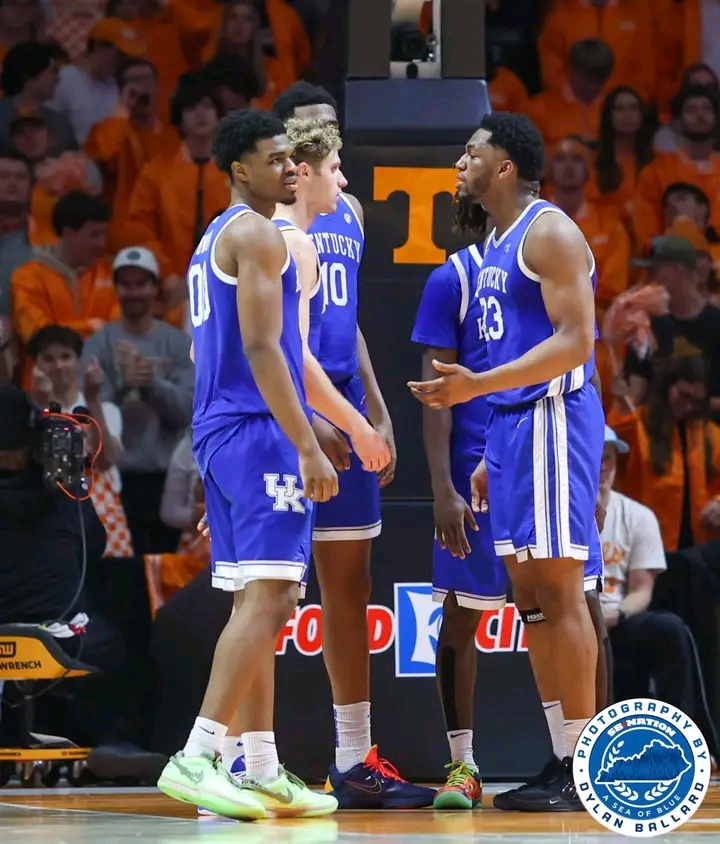
For weeks, Kentucky basketball existed in a strange middle ground — not bad enough to dismiss, not convincing enough to fully trust. The talent was obvious. The effort was there. The belief inside the program never wavered. Yet every time the Wildcats stepped onto the floor against a quality opponent, the same doubt followed them: Can this team actually make shots when it matters? It was the kind of question that lingers quietly until it becomes loud — until one night, in one hostile arena, against one elite defense, Kentucky didn’t just answer it… they flipped the entire conversation.
What has changed everything for the Wildcats isn’t a sudden surge of confidence, a miracle lineup tweak, or a lucky shooting night that can be explained away. It’s something far more dangerous for the rest of the SEC — and far more believable moving forward. Kentucky is finally shooting the basketball the way Mark Pope insisted it always could. And now that it’s happening against real competition, the Wildcats no longer look like a team surviving conference play. They look like a team evolving in real time.
The doubt wasn’t imaginary — it was statistical
Let’s be clear: skepticism about Kentucky’s shooting didn’t come out of thin air.
During the nonconference portion of the schedule, the Wildcats shot 33.7% from three-point range, ranking No. 175 nationally. That alone would be enough to raise eyebrows at a program with Kentucky’s expectations, but the numbers became downright alarming when the competition stiffened.
Against six nonconference high-major opponents, Kentucky hit just 23.9% of its attempts from beyond the arc. Open looks weren’t falling. Momentum-killing misses piled up. Opposing defenses packed the paint, dared the Cats to shoot, and often got exactly what they wanted.
And then came the most uncomfortable truth of all: once SEC play started, there would be no relief. Every night would be high-major. Every night would be physical. Every night would demand shot-making.
Kentucky’s league opener only deepened the concern. In an 89–74 loss at Alabama on Jan. 3, the Wildcats went 4-for-19 from three. Same story. Same questions. Same conclusions from the outside.
Except internally, nobody panicked.
Mark Pope never stopped believing — even when no one else did
While fans debated lineups and analysts pointed to percentages, Mark Pope and his players kept saying the same thing: this isn’t who we are.
It sounded like coach-speak at the time — the kind of optimism every coach projects whether the numbers support it or not. But Pope wasn’t asking his team to stop shooting. He wasn’t changing the philosophy. He wasn’t shrinking the floor or abandoning spacing principles.
He doubled down.
The message inside the Joe Craft Center was consistent: take the right shots, trust the work, and don’t confuse misses with inability.
Guard Denzel Aberdeen summed it up with refreshing honesty during the rough stretch.
“I mean, to be honest, I just say, ‘Keep shooting.’ Like, eventually they gotta go in at some point,” Aberdeen said with a laugh. “But we just have to take the right shots… when we get the chance to shoot wide-open, catch-and-shoot shots — or attack the basket — we just got to make them.”
At the time, it sounded hopeful. Now, it sounds prophetic.
The numbers flipped — and not by accident
Since that loss at Alabama, Kentucky’s shooting hasn’t just improved — it has transformed.
Over the last four games — a loss to Missouri followed by wins over Mississippi State, LSU, and Tennessee — the Wildcats have gone a combined 37-for-87 from three-point range.
That’s 42.5%.
Even when including the Alabama dud, Kentucky has been the best three-point shooting team in the SEC since conference play began, ranking first in the league in percentage five games into the schedule.
This isn’t a one-game spike. It’s not one hot shooter carrying the load. It’s not desperation threes late in games inflating percentages.
It’s process-driven offense producing sustainable results.
And nowhere was that more evident than Saturday afternoon in Knoxville.
Tennessee wasn’t supposed to let this happen
Winning at Tennessee is never easy. Doing it while climbing out of a 17-point first-half hole is even harder. Doing it while torching one of the nation’s toughest defenses from the perimeter? That’s supposed to be impossible.
Yet Kentucky did exactly that in an 80–78 comeback win that felt like a turning point.
The Wildcats went 11-for-24 from three, their best long-range performance of the season against a quality opponent. More importantly, those shots didn’t come from broken plays or defensive mistakes. They came from discipline, patience, and execution.
Even Tennessee noticed.
After the game, freshman star Nate Ament didn’t sugarcoat what went wrong.
“It’s tough when you’re dealing with great shooters,” Ament said. “And credit to them, because they are really good shooters.”
No one outside Kentucky was saying that a few weeks ago.
Now, opposing players are.
The comeback that revealed everything
Kentucky trailed by 17 in the first half and 11 at halftime. The crowd was alive. Tennessee had control. Another road loss felt inevitable.
But the Wildcats didn’t rush. They didn’t force shots. They didn’t abandon the plan.
They trusted it.
Before halftime, Collin Chandler and Jasper Johnson knocked down timely threes that prevented the game from spiraling. Those shots didn’t flip the score — but they flipped the feel. Kentucky stayed connected.
And then the second half became a clinic in how Pope’s offense is supposed to work.
How Kentucky earned its threes
Early in the half, Aberdeen used a screen from Mouhamed Dioubate set well beyond the arc. Tennessee stayed back, protecting the paint. Aberdeen calmly stepped into a three from the top of the key.
A possession later, Aberdeen drove left, stopped on a dime, and hit a step-back three over Ament, who couldn’t recover in time.
When Malachi Moreno drew help in the paint, he kicked to Chandler — splash.
When Dioubate rolled hard and pulled three defenders, the ball whipped around the perimeter until Aberdeen buried a rhythm three after a pump fake.
When Tennessee helped off shooters to contain penetration, Kentucky punished them — over and over.
In a span of less than two minutes, Kentucky hit three threes, each one stopping Tennessee from pushing the lead back to double digits.
That sequence mattered.
Because it showed this wasn’t about one guy getting hot.
It was about everyone reading the same play.
The possession that said it all
With eight minutes left and Kentucky down six, Otega Oweh swung the ball to Johnson on the wing. Johnson attacked just enough to draw help. The defense collapsed. The ball kicked back to Oweh at the top of the key.
No hesitation.
Three points.
65–62.
Game on.
Kentucky didn’t make another three in the final seven minutes — both misses came from Aberdeen — but here’s the detail that matters: the Wildcats grabbed the offensive rebound on both possessions and scored anyway.
That’s maturity. That’s trust. That’s belief in the system beyond just shot-making.
Why this shooting surge is different
Hot streaks happen. Anyone can have a good week.
But what makes Kentucky’s transformation believable is how the shots are coming.
Off penetration
Off ball movement
Off screens set with purpose
Off unselfish reads
This isn’t isolation basketball. It’s not bailout shooting. It’s not relying on one star to save possessions.
It’s five players connected.
Tennessee head coach Rick Barnes and guard Ja’Kobi Gillespie pointed to ball-screen defense breakdowns after the game. But that explanation only tells half the story.
Kentucky forced those breakdowns.
They didn’t stumble into easy threes.
They worked for them.
The ripple effect across the SEC
Here’s where things get interesting.
If Kentucky can shoot like this — even at a slightly reduced level — the entire scouting report changes. Defenses can’t pack the paint. Help defenders hesitate. Driving lanes open. Offensive rebounding improves because defenders are scrambling.
Suddenly, Kentucky’s athleticism becomes harder to contain.
Suddenly, close games tilt in their favor.
Suddenly, this doesn’t look like a team clinging to wins — it looks like one building toward something.
Belief is no longer internal
For weeks, the Wildcats asked everyone else to trust what they already knew.
Now they don’t have to ask.
The numbers support it. The film confirms it. Opponents acknowledge it.
Kentucky basketball is no longer a mystery with a fatal flaw.
It’s a team finding its identity at exactly the right time.
And if this shooting continues — not perfectly, but purposefully — the Wildcats won’t need convincing anymore.
They’ll force belief.
One possession at a time.




