


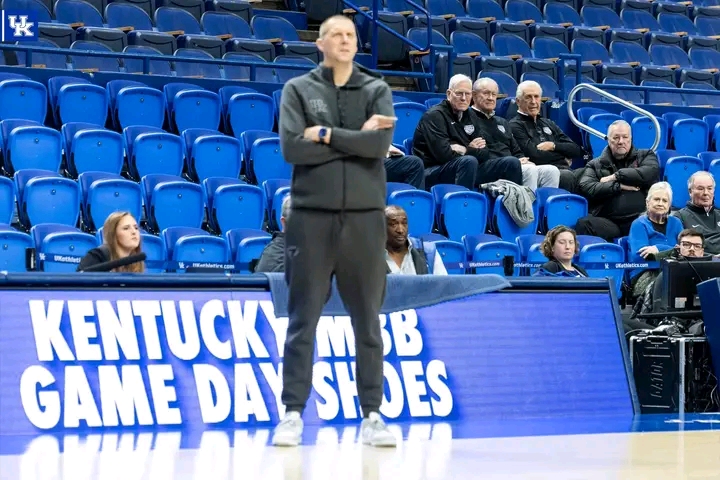
There was a time — not that long ago — when Kentucky basketball fans would glance at the lineup card before tipoff and feel a sense of comfort. The frontcourt was defined. Roles were clear. Minutes were predictable. But quietly, almost without announcement, that certainty has disappeared. And here’s the twist: Kentucky is winning because of it. As the Wildcats stack victories and settle into SEC play, one of the most important truths about this team is also the most unsettling for opponents — there is no longer a “starter” in Kentucky’s frontcourt. No hierarchy. No rigid rotation. Just options. And Mark Pope wouldn’t have it any other way.
A winning streak built on flexibility, not familiarity
Kentucky’s three-game winning streak didn’t come from a sudden superstar emergence in the paint or a dramatic schematic overhaul. Instead, it’s been powered by adaptability — on both ends of the floor — and by a coaching staff willing to adjust on the fly.
With Jaland Lowe lost for the season, the Wildcats needed answers. Those answers arrived first in the backcourt, where Denzel Aberdeen and Jasper Johnson seized expanded roles and stabilized the offense. But while the spotlight often shines on guards when a team finds its rhythm, Kentucky’s resurgence has also been fueled by something less obvious and far more strategic: a frontcourt rotation that refuses to be boxed in.
The traditional approach would be to identify a replacement, crown a starter, and ride it out. Pope did the opposite. He embraced the chaos.
“By committee” — and proudly so
When Mark Pope describes Kentucky’s frontcourt, he doesn’t speak in absolutes. He speaks in possibilities.
“Yeah, it’s very much matchup dependent, scheme dependent, situation in the game, and how guys are playing, actually,” Pope said. “So that’s a little bit of a position by committee right now. It’ll probably continue to be, and it gives us some flexibility in how we approach the game.”
That flexibility isn’t accidental. It’s intentional. And it’s reshaping how Kentucky plays — especially at the four, a position that has become the fulcrum of Pope’s offensive spacing and defensive versatility.
The four spot: Kentucky’s chess piece position
If there’s one position that embodies Pope’s philosophy, it’s the power forward spot.
On any given night, that role could belong to Mouhamed Dioubate, Kam Williams, or Andrija Jelavic — and occasionally even someone else entirely. The decision isn’t about seniority or recruiting ranking. It’s about what the game demands.
Some nights require physicality and rebounding. Others demand spacing and perimeter shooting. Some call for defensive switchability. Others require energy and pace.
Kentucky has answers for all of it.
Mouhamed Dioubate: The closer
There’s a reason Dioubate often finishes games, even if he doesn’t always start them.
Against Tennessee, his impact down the stretch was undeniable. In the final three minutes and 15 seconds, Dioubate grabbed three offensive rebounds — possessions that directly preserved Kentucky’s narrow lead and broke Tennessee’s momentum. He also delivered one of the game’s defining defensive moments, stonewalling Nate Ament in isolation when the Volunteers needed a bucket most.
Dioubate’s value isn’t flashy. It’s foundational.
He sets bruising screens. He defends multiple positions. He thrives in chaos. And when games tighten, Pope trusts him to make winning plays that don’t always show up in the box score.
Andrija Jelavic: The tone-setter
If Dioubate closes games, Andrija Jelavic often opens them.
Against Tennessee, Jelavic gave Kentucky an early jolt — knocking down a shot, attacking downhill, and delivering a perfectly timed pocket pass that energized the offense. His ability to stretch the floor forces defenses to make uncomfortable choices early in games, creating space for Kentucky’s guards to operate.
Jelavic doesn’t need volume to be effective. His presence alone changes how opponents defend ball screens and post actions. And when he’s playing confidently, Kentucky’s offense flows with a freedom that’s hard to disrupt.
Kam Williams: The wild card
Then there’s Kam Williams, the piece that can flip a matchup on its head.
Williams’ versatility allows Kentucky to play five-out basketball without sacrificing size. When he’s slotted at the four, the floor opens dramatically. Defensive bigs are pulled away from the rim. Closeouts become longer. Driving lanes widen.
Pope chooses his moments with Williams carefully — but when the matchup is right, the impact is immediate.
“When we find the right matchup, Kam can really change the dynamic for us at the four,” Pope said. “Because it spaces the floor so much.”
In a league as physical as the SEC, that spacing can be lethal.
The trickle-down effect at the five
The committee approach doesn’t stop at the four.
Kentucky’s center rotation is equally fluid, with Malachi Moreno, Brandon Garrison, and Jayden Quaintance each offering something different depending on the opponent.
Moreno brings positional defense and patience. Garrison provides strength and interior presence. Quaintance adds athleticism and rim pressure. None are guaranteed minutes — and all are ready when called upon.
Even more telling? Pope has experimented with lineups where Garrison slides to the four, adding another layer of unpredictability to Kentucky’s frontcourt combinations.
Why this works now — and didn’t before
The “by committee” approach only works if players buy into it. Kentucky’s frontcourt has.
There are no sulking starters. No visible frustration. No forced shots to prove a point. Instead, there’s trust — in the system, in the staff, and in each other.
That buy-in has allowed Pope to adjust on a possession-by-possession basis, leaning into hot hands, defensive matchups, or situational needs without disrupting chemistry.
And because no one’s role is locked in, everyone stays engaged.
Spacing: the hidden payoff
One of the biggest beneficiaries of Kentucky’s fluid frontcourt has been the offense as a whole.
With more shooting at the four and varied skill sets at the five, defenses can’t collapse as easily. That spacing has directly contributed to Kentucky’s recent surge from three-point range — a transformation that has changed how opponents guard the Wildcats.
When the frontcourt can stretch the floor, the entire offense breathes.
A nightmare to scout
For opposing coaches, Kentucky has become a puzzle with too many solutions.
Game-planning is no longer about stopping one big man or exploiting one matchup. It’s about preparing for multiple looks — often within the same half.
One possession might feature a physical post presence. The next might spread the floor with five shooters. The next might switch everything defensively.
That uncertainty favors Kentucky.
The long-term benefit
Perhaps the most underrated advantage of Pope’s approach is sustainability.
By sharing the load, Kentucky keeps players fresher late in games and over the grind of SEC play. It also accelerates development, giving younger players meaningful minutes in high-pressure situations.
Come March, that depth could be the difference.
Why Mark Pope loves it — and won’t change it
This isn’t a temporary solution. It’s a philosophy.
Pope isn’t searching for a permanent starter. He’s building a frontcourt ecosystem — one that adapts, evolves, and responds.
As long as the Wildcats keep winning, and as long as this approach continues to produce confident, connected basketball, there’s no reason to expect a shift.
Kentucky doesn’t need a defined frontcourt identity.
It has something better.
Options.




