


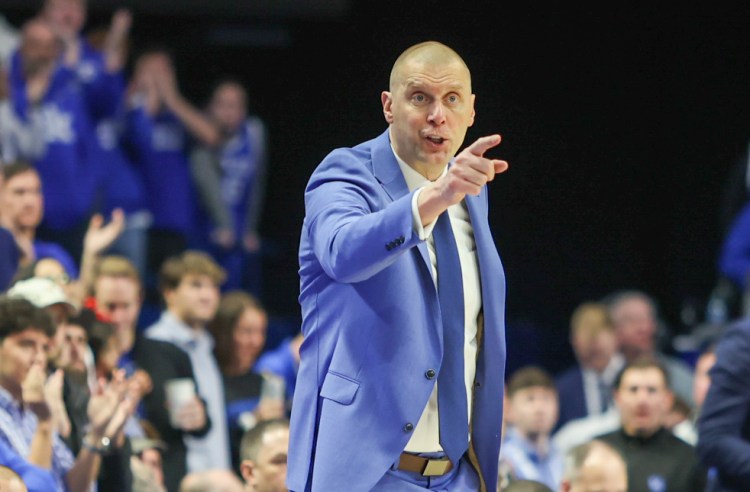
For years, college basketball has lived with gray areas — eligibility waivers, transfer loopholes, medical redshirts, legal appeals. But every so often, a case comes along that doesn’t just blur the lines, it threatens to erase them entirely. When former Alabama center Charles Bediako, who last played college basketball in 2023 and has since signed multiple NBA contracts, was granted a temporary court order allowing him to suit up again for the Crimson Tide, it forced a familiar but uncomfortable question back into the spotlight: Who is really in charge of college basketball anymore? After Kentucky’s win over Texas, Mark Pope didn’t dodge that question. Instead, he leaned into it — and offered a suggestion that may quietly reveal where the NCAA’s remaining leverage actually lies.
A ruling that stunned the sport
Bediako’s return is not just unusual — it’s unprecedented in the modern era. A 7-foot big man who has already lived a professional basketball life, Bediako has been away from the college game for nearly three years. Since leaving Alabama, he has signed multiple NBA contracts, including a two-way deal with the San Antonio Spurs. Under any traditional understanding of amateur eligibility, his college career appeared long finished.
Yet this weekend, Bediako will take the floor for Alabama again.
The ruling, granted via temporary court order, allows him to play while the broader legal battle unfolds. In the eyes of many observers, it represents the latest and most dramatic example of the NCAA’s authority being challenged — and, in some cases, overridden — by the courts.
For coaches across the country, the implications are unsettling.
Why this case feels different
College basketball has already adjusted to NIL, open transfers, immediate eligibility, and a more athlete-friendly legal environment. Most of those changes, however disruptive, followed a certain internal logic. Bediako’s case does not.
This isn’t a player seeking an extra year due to injury. This isn’t a transfer arguing hardship. This is a former professional player re-entering the college ranks through the legal system.
That distinction matters.
If allowed to stand broadly, the precedent could invite a wave of similar challenges — players leaving college, testing professional waters, then returning through litigation. The concept of eligibility itself becomes less a rulebook and more a negotiation.
That reality is what prompted Mark Pope to speak carefully — but pointedly — about the NCAA’s remaining power.
Pope’s comments, and what they really mean
After Kentucky’s win over Texas, Pope was asked about the ruling. His response was measured, but revealing.
“The NCAA does get to decide who gets to go to the NCAA Tournament,” Pope said. “They have that power.”
On the surface, it sounds obvious. Dig deeper, and it’s a strategic observation.
Pope acknowledged that the NCAA may lose court battles over eligibility rules. He acknowledged the growing limits on enforcement. But he also pointed out the one area where the NCAA still holds near-absolute authority: the NCAA Tournament itself.
“They still get to decide what games count toward the NCAA Tournament,” Pope continued.
In other words, while courts can grant temporary eligibility, the NCAA controls the currency that matters most — tournament access, selection criteria, and legitimacy.
A bold but risky idea
Pope’s suggestion — that the NCAA could assert control through tournament eligibility rather than regular-season enforcement — is both bold and fraught with risk.
On one hand, it could restore some order. If the NCAA determined that games featuring legally contested players did not count toward tournament resumes, schools might think twice before pursuing aggressive legal strategies. The tournament is the ultimate prize; no program wants to jeopardize its postseason fate.
On the other hand, such a move could spark even more lawsuits.
If teams win games on the court but are told those results don’t count, the legal pushback would be immediate and fierce. The NCAA would be accused of selective enforcement, retaliation, and overreach.
Pope acknowledged that tension indirectly. His comments were not a demand — they were an observation about power dynamics in a shifting landscape.
Coaches caught in the middle
For coaches like Pope, the eligibility circus is not theoretical. It affects roster planning, competitive balance, and trust in the system.
Recruiting is already volatile. Transfers move freely. NIL negotiations happen year-round. Add the possibility of former professionals re-entering college basketball through court rulings, and the stability coaches crave becomes even harder to find.
“There has to be a line somewhere,” Pope suggested implicitly.
The problem is that line keeps moving.
Why Alabama’s case raises fairness concerns
Beyond legality, Bediako’s return raises ethical and competitive questions.
Is it fair for players who stayed in college, followed eligibility timelines, and sacrificed professional opportunities to compete against someone who has already signed NBA contracts?
Is it fair to teams that lost recruiting battles under the assumption that certain players were no longer eligible?
These questions don’t have clean answers — but they matter deeply to coaches, players, and fans alike.
The NCAA’s shrinking authority
The NCAA has been on the defensive for years. Court rulings, public opinion, and legislative pressure have steadily reduced its ability to enforce traditional amateurism rules.
Eligibility was once the NCAA’s strongest pillar. Now, even that is under threat.
Pope’s comments reflect a broader understanding shared quietly by many coaches: the NCAA may no longer be able to win every fight — but it still controls the stage.
The tournament is the last line of authority that hasn’t been cracked.
What happens if more cases follow?
If Bediako’s situation becomes a template, the sport could face chaos.
Players could leave for professional leagues, return later, and challenge eligibility restrictions in court. Programs with deeper legal resources could gain advantages. Competitive balance — already fragile — could fracture further.
That possibility is why this case has drawn such intense reaction.
It’s not about one player. It’s about what comes next.
Pope’s larger philosophy
Mark Pope has been candid throughout the season about chaos, growth, and adaptation — themes that mirror college basketball itself right now.
He understands frustration. He understands fan anxiety. He also understands that the game is changing faster than its governance.
Pope didn’t call for punishment. He didn’t accuse Alabama. He didn’t attack the courts.
Instead, he pointed out reality.
The NCAA’s authority is no longer absolute — except where it still matters most.
Where the line might ultimately be drawn
At some point, the NCAA will have to decide whether to reassert control or continue yielding ground. Tournament eligibility could become the battleground.
Whether that approach is legally sustainable remains uncertain. But Pope’s remarks suggest that coaches are already thinking about that inevitability.
College basketball can survive evolution. What it struggles to survive is uncertainty.
A moment bigger than one ruling
The Bediako case may fade. The court order may be temporary. But the questions it raised will linger.
Who defines eligibility?
Who enforces it?
And how much control does the NCAA really have left?
Mark Pope didn’t answer those questions definitively. But he made one thing clear: the NCAA still holds the keys to the tournament — and that fact may shape the next chapter of college basketball governance.




