


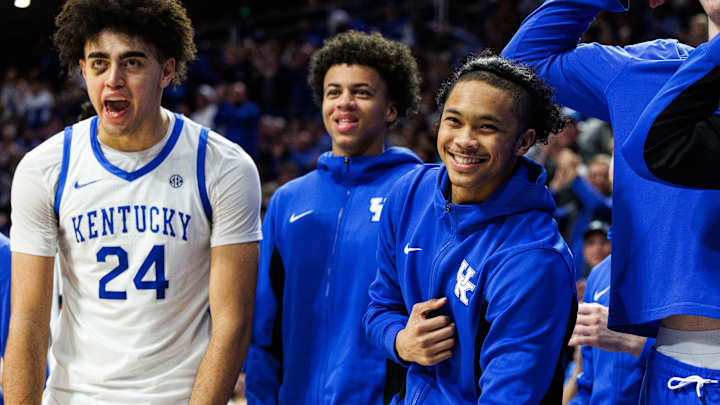
At some point in every turbulent season, a coach reaches a moment where patience collides with necessity. For Mark Pope and Kentucky basketball, that moment may have arrived quietly—but unmistakably. As injuries continue to hollow out the Wildcats’ rotation, the luxury of long-term planning is being replaced by short-term survival. That reality brings one name into sharp focus: Braydon Hawthorne. Once viewed strictly as a developmental piece and future investment, the true freshman may now represent something far more urgent. And with Kentucky’s margin for error shrinking by the game, the timing of whether to burn Hawthorne’s redshirt could end up defining not just this stretch of the season—but the direction of Pope’s first year in Lexington.
Kentucky’s Roster Is No Longer Built for Waiting
Kentucky’s injury situation has crossed the line from “unfortunate” to “unsustainable.”
The Wildcats are already without Jaland Lowe and Jayden Quaintance, two players expected to play meaningful roles. Now, Kam Williams—a 6’8 wing whose length and versatility were central to Kentucky’s lineup balance—has joined the list after breaking his foot against Texas, likely ending his season.
That’s three rotation-caliber players gone.
For a team already juggling chemistry and continuity, the losses have forced Mark Pope into survival mode. Rotations are tight. Minutes are climbing. Lineups are becoming increasingly guard-heavy. And while Kentucky has admirably continued to win games, the margin for fatigue, foul trouble, or another injury is razor thin.
This is where Braydon Hawthorne enters the conversation—not as a luxury, but as a potential necessity.
Who Is Braydon Hawthorne — and Why This Matters Now
When Kentucky recruited Braydon Hawthorne, there was no illusion that he would be an instant star. He arrived as a high-upside, long-term project, a player with intriguing physical tools and raw ability but one who would need time, strength, and reps to fully develop.
At 6’8 with a long wingspan, shooting touch, and positional versatility, Hawthorne fits the modern wing archetype Kentucky covets. But from the outset, the plan was patience. Redshirt the freshman. Let him adjust. Preserve a year of eligibility.
Mark Pope has been clear and consistent about that plan.
But plans change.
And Kentucky’s season has changed dramatically since October.
Reason No. 1: Kentucky Needs to Find Out What It Actually Has in Hawthorne
The first—and perhaps most important—reason to burn Hawthorne’s redshirt is simple: Kentucky needs answers.
Hawthorne arrived with significant hype from Big Blue Nation. Fans saw the frame, the shooting potential, the upside. But right now, everything about him at the college level is theoretical.
At some point, theory must give way to reality.
If Mark Pope truly envisions Hawthorne as part of Kentucky’s future, then seeing him in live SEC action is invaluable. Practice evaluations can only reveal so much. Game speed, physicality, decision-making under pressure—those traits can’t be simulated.
Yes, throwing a true freshman into SEC play is a risk. But Kentucky isn’t asking Hawthorne to carry the offense. They’re asking him to survive, contribute, and grow.
And the truth is, there is no perfect time to debut a freshman. The longer Kentucky waits, the fewer opportunities remain to evaluate him in meaningful minutes.
Burning the redshirt now gives Kentucky clarity:
Can Hawthorne handle the pace?
Can he defend at this level?
Can he stretch the floor?
Can he hold his own physically?
If the answers are yes—even in flashes—it changes how Kentucky approaches the rest of the season and the offseason.
If the answers are no, Kentucky still gains certainty.
Right now, uncertainty is the enemy.
Reason No. 2: Kentucky Desperately Needs Length on the Wing
The loss of Kam Williams cannot be overstated.
Williams wasn’t just another body—he was Kentucky’s primary source of length on the wing. At 6’8, he provided something Kentucky’s guard-heavy lineups simply cannot replicate: size without sacrificing spacing.
Without Williams, the Wildcats are likely to lean heavily on Collin Chandler, Otega Oweh, and Denzel Aberdeen. While all three are capable, athletic, and talented, they share one limitation: they are guards.
They’re strong. They’re quick. But they’re not long, rangy wings.
Hawthorne is.
Like Williams, Hawthorne stands 6’8 with a long wingspan and the ability to stretch the floor. Even if his offensive game is still developing, his presence alone changes spacing, defensive matchups, and rebounding angles.
Kentucky doesn’t just need bodies—it needs balance.
Right now, opposing teams can game-plan knowing Kentucky lacks true wing size. That makes defensive schemes easier to execute and forces Kentucky into mismatches.
Hawthorne won’t solve everything, but he gives Pope an option Kentucky currently doesn’t have.
And in the SEC, options matter.
Reason No. 3: The Value of Redshirts Has Changed Forever
This may be the most uncomfortable reason—but it’s also the most realistic.
The value of redshirts in college basketball is not what it used to be.
In today’s landscape of NIL, the transfer portal, and roster fluidity, long-term planning has become fragile. Players move. Situations change. Promises made today don’t always hold tomorrow.
Hawthorne has publicly expressed a desire to stay at Kentucky until he’s drafted. That’s admirable—and encouraging. But college basketball history has taught us one thing: intentions are not guarantees.
Programs can no longer operate under the assumption that a player will be around for four or five years. Development timelines are shorter. Expectations are immediate. Opportunities elsewhere are always available.
If Kentucky saves Hawthorne’s redshirt but never truly integrates him, they risk losing both time and information.
Burning the redshirt now:
Accelerates development
Clarifies Hawthorne’s trajectory
Integrates him into the program’s competitive culture
Maximizes the value of his presence right now, when Kentucky actually needs him
Redshirts are only valuable if the future is certain.
In modern college basketball, it rarely is.
The Risk — and Why It Might Be Worth Taking
There is, of course, risk in burning Hawthorne’s redshirt.
He may struggle.
He may look overwhelmed.
He may not be ready.
But Kentucky is already playing with risk.
Extended minutes for guards increase injury risk.
Thin rotations increase fatigue.
One more injury could force emergency solutions anyway.
At least with Hawthorne, Kentucky controls the variable.
And even limited minutes—5 to 10 per game—could help stabilize lineups and preserve legs.
This doesn’t need to be a permanent shift. It needs to be a measured one.
Why the Ole Miss Game Matters So Much
Timing is everything.
Kentucky hosts Ole Miss in a morning tip—an environment where energy, pace, and physicality can swing early. It’s also a game Kentucky is expected to win, making it one of the safest windows to introduce Hawthorne.
The stakes are real, but manageable.
Waiting longer risks introducing Hawthorne in even tougher circumstances—road games, higher-pressure matchups, or must-win scenarios.
If Mark Pope is going to make this move, now makes sense.
The Bigger Picture for Mark Pope
This decision isn’t just about Braydon Hawthorne.
It’s about Mark Pope’s approach to adversity.
Does he stick rigidly to preseason plans, or does he adapt aggressively to evolving realities?
So far, Pope has shown flexibility, toughness, and creativity. Burning Hawthorne’s redshirt would be another example of meeting the moment rather than avoiding it.
Kentucky doesn’t need perfection.
It needs solutions.
Final Thoughts: A Decision That Feels Inevitable
At some point, the conversation shifts from “should” to “when.”
Kentucky is thin.
The season is long.
The SEC is unforgiving.
Braydon Hawthorne may not be the answer to every problem—but right now, he might be an answer, and that’s enough.
Mark Pope has been patient.
He’s been cautious.
He’s been thoughtful.
But the timing is starting to demand something else.
And if Kentucky is serious about navigating this injury-riddled stretch while protecting its long-term future, burning Braydon Hawthorne’s redshirt might not just make sense—it might be unavoidable.




