


There are star performances that make you sit up in your chair.
Then there are performances that make you wonder what kind of player thinks this still isn’t enough.
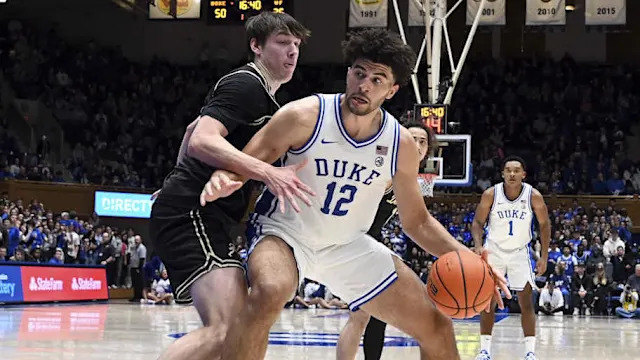
Cameron Boozer scored 32 points, grabbed nine rebounds, and handed out four assists on Saturday afternoon inside Cameron Indoor Stadium — a dominant showing in Duke’s comfortable win over Wake Forest. The crowd roared. The box score sparkled. The highlights were inevitable.
And yet, according to Jon Scheyer, Boozer walked off the floor irritated.
Not at the defense.
Not at the referees.
At himself.
That single detail — the idea that a projected one-and-done lottery pick could drop 30 in his own building and still be unhappy — might explain everything about Cameron Boozer, about this Duke team, and about why the Blue Devils are quietly becoming one of the most dangerous programs in college basketball.
The Box Score Tells One Story — Cameron Boozer Tells Another
At first glance, Cameron Boozer looks like the next inevitable Duke superstar.
He’s 6-foot-9, 250 pounds, physically mature beyond his years, and capable of scoring from anywhere on the floor. Post-ups, face-up jumpers, trail threes, bully-ball finishes — it’s all there. Through the first half of the season, Boozer leads the nation in scoring at 23.7 points per game, while also ranking among the top rebounders in college basketball.
Those numbers alone put him squarely in the ACC Player of the Year conversation and firmly on the National Player of the Year radar.
But if you ask Jon Scheyer, the numbers are almost beside the point.
“He’s never satisfied,” Scheyer said, reflecting on Boozer’s latest performance. “He’ll find something from the game where he’s pissed he didn’t do as well, even though he had 32 and nine and four assists.”
That mentality — the refusal to be impressed with himself — is rare. Especially rare for an 18-year-old. And even rarer for a player who knows the NBA is watching every move he makes.
Never Satisfied Isn’t a Quote — It’s a Blueprint
What Scheyer revealed wasn’t frustration. It was identity.
Cameron Boozer doesn’t chase dominance for validation. He chases it because he believes there is always another level waiting just beyond reach. That belief shows up in film sessions, in practice, and — most importantly — in how he plays with his teammates.
Boozer is not a stat-chaser. He’s a momentum player. When defenses collapse on him, he kicks the ball out without hesitation. When a teammate has the hot hand, Boozer becomes the screener, the spacer, the decoy. When Duke needs a bucket, he demands the ball. When Duke needs discipline, he provides it.
“He’s wired where he’s all about his teammates,” Scheyer said. “He’s not about numbers; he’s about winning.”
That wiring matters. Because when your best player is wired that way, everything else follows.
Leadership Without the Speech
Some stars lead by volume.
Cameron Boozer leads by example.
Teammates don’t talk about his scoring first. They talk about how easy he is to play with. How grounded he is. How relentless his work ethic feels behind closed doors.
Freshman forward Nikolas Khamenia didn’t hesitate when asked about Boozer.
“He’s one of the coolest dudes — super down to earth,” Khamenia said. “Even if he scores 30 and has 12 rebounds, he’s still gonna find something he could have done better.”
Sophomore wing Isaiah Evans echoed the sentiment.
“It’s easy to play with Cam,” Evans said. “It’s easy to be a friend to him off the court. He’s a real humble guy.”
That kind of leadership doesn’t come from speeches or social media clips. It comes from consistency. From showing teammates that excellence isn’t an act — it’s a habit.
Raised for This Moment
Boozer doesn’t pretend his mindset came out of nowhere.
Asked about his humility after the Wake Forest win, Boozer immediately pointed elsewhere.
“I think it’s just how I was raised,” he said.
That answer carries weight.
Cameron Boozer grew up around basketball royalty. His father, Carlos Boozer, won a national championship at Duke in 2001 and carved out a long, successful NBA career. His twin brother, Cayden Boozer, shares the Duke locker room as a freshman point guard.
With that background, entitlement would have been easy.
Instead, Boozer credits the people around him — and then immediately redirects praise to his teammates.
He talked about Dame Sarr.
He talked about Maliq Brown.
He talked about defenders, shooters, playmakers.
In a locker room filled with talent, Boozer chose gratitude.
Why This Matters More Than Any Highlight
College basketball is littered with talented freshmen who dominate early, fade late, and disappear when the pressure spikes.
Cameron Boozer does not profile as that player.
The “never satisfied” mindset doesn’t just help in November and December. It matters in February road games. In March chaos. In moments when shots stop falling and leadership becomes currency.
Duke doesn’t just have a star.
They have a standard-bearer.
When Boozer demands more of himself after a 32-point night, it quietly raises the bar for everyone else. Practices sharpen. Defensive rotations tighten. Accountability becomes normal.
That’s how championship cultures are built — not by talent alone, but by temperament.
Scheyer’s Vision, Boozer’s Execution
Jon Scheyer inherited a program defined by greatness. Sustaining it requires more than recruiting rankings.
Scheyer has made it clear he wants Duke teams built on connectivity, toughness, and unselfishness. Cameron Boozer isn’t just fitting into that vision — he’s amplifying it.
When Scheyer talks about Boozer’s dissatisfaction, he isn’t concerned. He’s encouraged.
Because coaches don’t fear players who want more.
They fear players who think they’ve arrived.
Boozer hasn’t arrived — and that might be the scariest part for the ACC.
The Quiet Reality Facing the Conference
Duke sits at 18-1, unbeaten in ACC play, and rolling through opponents with confidence and balance. Cameron Boozer is the centerpiece, but he is not the ceiling.
If Boozer continues to blend elite production with elite humility, Duke’s margin for growth remains massive. There are cleaner possessions to be had. Defensive possessions to be sharpened. Late-game situations still to be tested.
And if Boozer is still finding things to fix after 32-point performances, imagine where this team could be in March.
Explains Everything
“He’s never satisfied.”
Jon Scheyer didn’t just describe Cameron Boozer.
He explained Duke basketball’s present — and maybe its future.
In a sport obsessed with numbers, Boozer is obsessed with impact. In a game driven by ego, he’s driven by purpose. And in a program built on legends, he’s quietly carving out his own path — not by demanding attention, but by earning it.
The points will keep coming.
The awards will follow.
But what makes Cameron Boozer special isn’t what he’s done.
It’s that, in his mind, he hasn’t done enough yet.
And that should make the rest of college basketball very, very nervous.




