


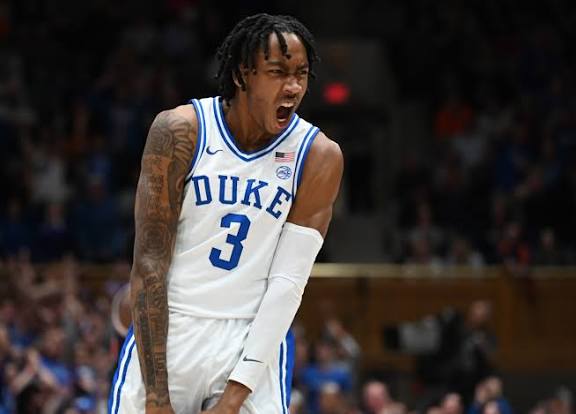
Isaiah Evans took a mid-range jumper — and suddenly, Duke’s offense looked different. Not smoother. Not prettier. Just different. In a stretch where nearly every Blue Devil basket had come from the paint, the three-point line, or the free-throw stripe, Evans calmly rose from 15 feet and knocked one down as if to say, I can do this too. It didn’t stop the game. It didn’t spark a run. But it exposed a truth Duke can no longer sidestep: Isaiah Evans is being used as a shooter when his ceiling suggests he should be creating. And the longer Duke waits to unlock that part of his game, the more they limit themselves offensively.
The Shot That Didn’t Look Important — But Was
On paper, it was just another made field goal.
In reality, it was Duke’s first made jumper in two games that wasn’t a three, layup, dunk, or free throw — a staggering stat that underscores how one-dimensional the offense has been in certain stretches. When Evans pulled up from mid-range and buried the shot, it wasn’t flashy. It was functional. And that’s exactly why it mattered.
Modern basketball has largely eliminated the mid-range shot unless a player is allowed to take it. Evans hasn’t been allowed — not by ability, but by role.
For most of the season, Isaiah Evans has been parked beyond the arc, spacing the floor, waiting for kick-outs, and serving as a release valve rather than a creator. The problem? That’s not who he is.
Isaiah Evans Is Not Just a Shooter — Never Has Been
Long before Evans arrived at Duke, his appeal was never limited to shooting. Yes, he can shoot. Yes, he stretches the floor. But his high school tape, AAU performances, and recruiting profile all told the same story: a wing who can put the ball on the floor, rise over defenders, and score from all three levels.
Yet at Duke, his responsibilities have been simplified — perhaps too simplified.
Evans has largely been asked to:
Space to the corner
Run the wing
Take open threes
Defend his assignment
Keep the offense moving
Those are important jobs. But they’re also limiting for a player whose game thrives on rhythm, touch, and confidence.
When players like Evans go long stretches without creating their own offense, they don’t just become predictable — they become hesitant.
Duke’s Offensive Problem Isn’t Just Shot-Making
Let’s be clear: Duke’s offense hasn’t been bad. But it has been narrow.
Too often, Duke scores in one of three ways:
At the rim
From three
At the free-throw line
When those are flowing, Duke looks dominant. When they’re not, the offense can stall — badly. There’s little middle ground. Little improvisation. Little self-created scoring outside of the guards.
That’s where Isaiah Evans should come in.
The mid-range jumper he hit wasn’t about efficiency charts or analytics. It was about pressure relief. It was about showing defenses that Duke can punish them when they take away the rim and the arc.
Right now, defenses are daring Duke’s wings to do anything else.
Social Media Noticed — And They’re Not Wrong
The reaction online said everything.
“Need so much more of Isaiah Evans creating his own shot and attempting more than just threes.”
That sentiment wasn’t coming from casual fans. It came from people watching closely — people recognizing a skill set that’s being underutilized.
Meanwhile, SLAM highlighted Evans’ confidence, energy, and trust in the process, posting him as the face of SLAMU 017. That disconnect is telling.
Outside the program, Evans is viewed as a dynamic, expressive scorer.
Inside the system, he’s being treated like a specialist.
Those two things don’t align.
Trusting the Work — But Waiting for the Green Light
Isaiah Evans has done everything right.
He trusted Duke.
He trusted the work.
He stayed patient.
He didn’t force shots.
He didn’t complain publicly.
He embraced his role.
But patience shouldn’t become permanence.
At some point, development requires opportunity — not just practice reps, but in-game freedom. The mid-range jumper Evans hit looked like a player testing boundaries, not defying them.
It looked like a reminder.
Why Self-Creation Matters — Especially in March
When games tighten, spacing disappears.
Defenses switch more aggressively.
Closeouts get faster.
Passing lanes shrink.
Refs swallow whistles.
In those moments, teams don’t need perfect offense — they need players who can manufacture a bucket.
That’s where Duke could struggle if nothing changes.
Isaiah Evans has the length, elevation, and touch to rise over defenders late in the shot clock. He can create separation with one or two dribbles. He can score without needing a screen or a perfectly timed pass.
But only if he’s allowed to.
The Risk of Over-Coaching Talent
There’s a fine line between structure and suppression.
Duke’s system emphasizes ball movement, spacing, and efficiency — all good things. But young players sometimes need freedom to fail in order to evolve.
Evans’ mid-range jumper wasn’t reckless.
It wasn’t forced.
It wasn’t out of rhythm.
It was natural.
Those are the shots players take when they’re comfortable — not when they’re overthinking.
Why This Matters More Than One Player
This isn’t just about Isaiah Evans.
It’s about Duke’s offensive ceiling.
Teams that win championships usually have:
A primary creator
A secondary creator
A wing who can get one when nothing else works
Right now, Duke has the first two inconsistently — and is voluntarily ignoring the third.
That’s a problem waiting to surface.
Cameron Indoor Feeds Off Confidence — Not Caution
When Evans hit that jumper, Cameron reacted differently.
Not louder — but sharper.
There was a recognition in the building: he can do that.
Cameron Indoor Stadium thrives on confidence plays. The crowd responds when players assert themselves, when they attack, when they show personality.
Evans has that energy. SLAM sees it. Fans see it. Teammates feel it.
The system just hasn’t fully embraced it yet.
What Duke Doesn’t Gain by Limiting Him
By restricting Evans to threes, Duke:
Becomes more predictable
Allows defenses to overplay the perimeter
Loses a shot-creation outlet
Slows Evans’ development
Shrinks its own margin for error
There is no strategic advantage to keeping a scorer from scoring.
What Duke Gains If They Don’t
If Duke gives Evans more freedom:
Defenses must stay honest
Driving lanes open for others
Late-clock situations improve
Evans’ confidence skyrockets
The offense gains balance
That one mid-range jumper hinted at all of that.
This Isn’t a Demand — It’s a Question
No one is saying Isaiah Evans should hijack the offense.
No one is saying Duke should abandon analytics.
No one is calling for reckless isolation basketball.
This is simpler than that.
The question Duke can’t ignore is this:
Why limit a player who clearly has more to offer?
Final Thought: Small Shot, Big Implications
Isaiah Evans’ mid-range jumper didn’t change the game.
But it challenged an assumption.
It challenged the idea that his value begins and ends at the three-point line. It challenged the structure Duke has placed around him. And it challenged the coaching staff to decide whether development or control matters more right now.
Sometimes the most important moments aren’t the loudest.
Sometimes, it’s just one shot — taken quietly, confidently, and with purpose — that forces a program to look inward.
Isaiah Evans took that shot.




