


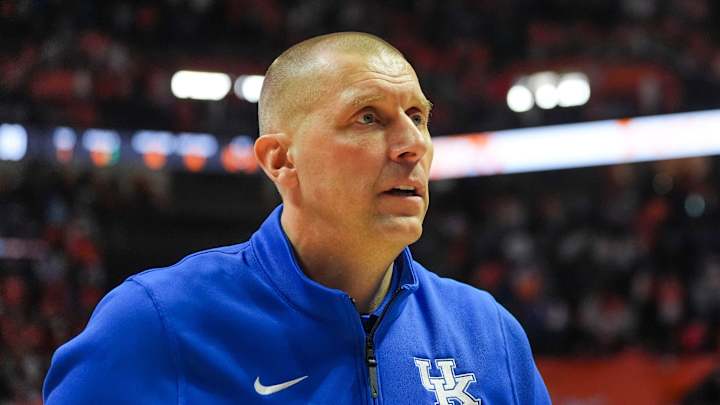
There’s a moment early in every basketball game when you can usually tell what kind of night it’s going to be. It might be a loose ball that no one dives for. A defensive rotation that’s a step slow. A possession where the offense settles instead of attacks. Those moments don’t show up in the box score, but they tell a story long before the score does. For Kentucky basketball this season, those moments have become uncomfortably familiar — and after the blowout loss to Vanderbilt, Mark Pope finally put words to what fans have been seeing all along. His team, he admitted, has struggled to truly engage early in games. And once you hear him say it out loud, it becomes impossible to unsee how much it has shaped Kentucky’s season.
A Pattern That Finally Has a Name
Kentucky’s loss to Vanderbilt wasn’t just another tally in the loss column. It was a magnifying glass.
The Wildcats once again found themselves playing from behind, but this time there was no dramatic rally, no surge of energy to flip momentum. There was only a slow unraveling. Kentucky scored just 10 points in the first 12 minutes, then watched as Vanderbilt turned a manageable deficit into a 22-point hole in a matter of three minutes. By the time Kentucky tried to respond, the game had already tilted decisively.
This wasn’t new. It was familiar.
And after the game, Pope didn’t hide from it.
On the UK Sports Network, Pope acknowledged what has quietly lingered beneath Kentucky’s ups and downs all season: his team has struggled to engage physically and mentally from the opening tip. That lack of early engagement, he admitted, has been a “battle all year long.”
“We Didn’t Do That at All”
Pope’s comments were unusually revealing — not because they were emotional, but because they were blunt.
“It’s been a space where we’ve been fighting a difficult battle all year long to get our guys to kind of embrace this idea of like being incredibly physical and forceful to earn possessions for teammates. And we didn’t do that at all.”
That statement cuts to the heart of Kentucky’s problem.
This isn’t about talent. This isn’t about schemes. This is about mindset — about whether Kentucky imposes itself on a game or waits for the game to impose itself on them.
Against Vanderbilt, the Wildcats waited.
The Cost of Settling Early
One of the clearest symptoms of Kentucky’s early disengagement is shot selection.
When the Wildcats are locked in, their offense flows. They cut hard. They attack gaps. They force defenders to react. When they’re not engaged, the offense stalls — and the threes start flying.
Against Vanderbilt, Kentucky repeatedly settled for perimeter shots early in the shot clock. There was little rim pressure. Few hard cuts. Minimal physicality in the paint. It was an offense playing on the surface rather than attacking underneath it.
Pope pointed out that Vanderbilt’s physicality — their switching, their strength around the rim, their ability to absorb contact — disrupted Kentucky. Instead of responding with force, Kentucky drifted further outside.
That’s not a one-game issue. It’s been a recurring theme.
Physicality as a Season-Long Struggle
Perhaps the most telling part of Pope’s admission was that this has been an issue “all year long.”
That statement reframes the entire season.
Kentucky’s five-game winning streak entering the Vanderbilt game masked the underlying issue, but it didn’t erase it. Even in wins, Kentucky has often needed late-game urgency to overcome early deficits. That’s not sustainable — especially on the road or against teams that thrive on momentum.
Pope acknowledged that his team has struggled to respond to physical play consistently. Vanderbilt didn’t do anything unusual; they simply leaned into Kentucky, switched aggressively, clogged driving lanes, and played with force.
Kentucky, meanwhile, struggled to match that tone.
Why Early Engagement Matters More Than Ever
In modern college basketball — especially in the SEC — early engagement isn’t optional. It’s survival.
Games are shorter in terms of possessions. Momentum swings faster. Officials allow more physical play. If a team spends the first 10 minutes trying to “feel it out,” it risks falling into a hole that even elite talent can’t escape.
Kentucky’s numbers tell the story. The Wildcats have repeatedly trailed early in road and neutral-site games this season. In fact, they now rank among the programs with the most losses by 15 points or more over the past 50 years — a stunning statistic for a blue-blood program.
Those losses don’t all look the same, but they share a common thread: slow starts, physical discomfort, and reactive basketball.
Engagement Is More Than Effort
When Pope talks about engagement, he isn’t just talking about hustle.
He’s talking about:
Defensive communication
Physical screens
Finishing through contact
Fighting for position
Making the first aggressive move instead of the second
Against Vanderbilt, Kentucky didn’t respond to contact. They didn’t force the issue offensively. And defensively, they were a step late on rotations, allowing Vanderbilt’s offense to build rhythm and confidence.
Once that happens, games snowball.
The Psychological Weight of Playing Catch-Up
There’s also a mental toll to constantly starting games on the back foot.
When a team expects to fall behind — even subconsciously — urgency becomes forced instead of natural. Players press. Shots come quicker. Frustration builds.
That was evident in Nashville.
Kentucky’s body language sagged as the deficit grew. Missed shots led to visible frustration. Defensive breakdowns led to finger-pointing. The confidence that fueled the five-game winning streak never surfaced.
Early engagement isn’t just about preventing deficits. It’s about preserving belief.
Leadership Under Pressure
Pope didn’t single out individuals, but his comments inevitably shine a light on leadership.
Teams that struggle to engage early often lack a consistent emotional tone-setter. Someone who brings force when the game is still neutral. Someone who demands physicality before it’s required.
Kentucky has players capable of doing that but consistency has been elusive.
Leadership isn’t just about scoring or stats. It’s about response. It’s about who pulls teammates together after the first missed rotation, not after the deficit hits double digits.
That’s where Kentucky has faltered.
Why This Issue Keeps Showing Up
The troubling part of Pope’s admission is not that he sees the problem it’s that the problem persists.
If this has been a battle all season, then it’s a deeply ingrained habit. Habits don’t change overnight. They require accountability, repetition, and sometimes uncomfortable decisions.
Pope is still early in shaping this group’s identity. But as SEC play intensifies, the margin for patience shrinks.
Kentucky cannot afford to spend the first quarter of every game searching for intensity.
Can It Be Fixed?
The encouraging part? This problem is fixable.
Engagement is not about learning new plays or adding new talent. It’s about mindset and emphasis.
Fixing it starts with:
Defensive pride from the opening possession
Offensive aggression that prioritizes the paint
Clear expectations for physical response
Immediate accountability when effort dips
Kentucky has shown it can play with force — just not consistently.
What the Vanderbilt Loss Revealed
The Vanderbilt game didn’t expose a lack of ability.
It exposed a lack of readiness.
Vanderbilt came out knowing who they were. Kentucky came out trying to find itself. By the time the Wildcats realized what kind of night it was going to be, it was too late.
Pope’s honesty after the game suggests he understands that reality.
The Bigger Picture
Kentucky’s season is far from over. One loss, even an ugly one, does not define a year.
But patterns do.
And when a head coach openly admits that early engagement has been a season-long struggle, it reframes every slow start, every early deficit, every frantic comeback attempt.
It’s not bad luck. It’s identity.
Final Thought
Mark Pope didn’t sugarcoat it. His team has struggled to engage early in games — and it shows on the court.
It shows in the slow starts.
It shows in the early deficits.
It shows in the body language when adversity hits.
The question now isn’t whether Kentucky has the talent to compete. It’s whether they can bring the right mindset from the opening tip — consistently.
Because in this league, waiting to engage is the fastest way to fall behind.
And Kentucky has seen enough of that already.




