


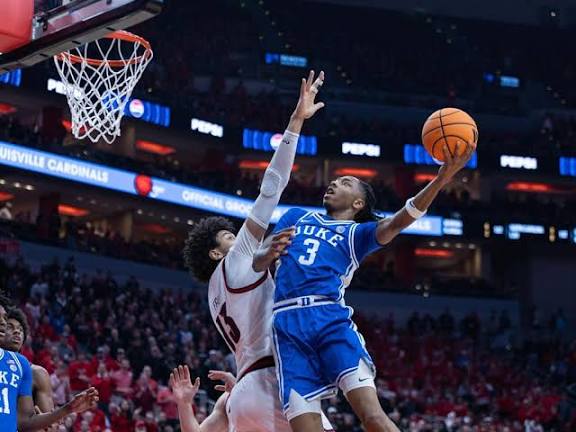
Duke basketball looks to pick up its second-straight win at Virginia Tech’s Cassell Coliseum on Saturday, Jan. 31.
Cameron Boozer. AJ Dybantsa. Darryn Peterson. Kingston Flemings. Caleb Wilson. The list goes on.
Freshmen excellence has defined this college basketball season. And while each of those players, including Duke’s own Boozer, have foreshadowed excellent NBA futures, what can get lost in the narrative around college basketball is the beauty of growth and the unique path that each player takes in their career.
Not every 18-year-old (or younger) is going to have a seamless adjustment from being the go-to guy on their high school or prep team to the arduous intensity of college basketball. Nor are they supposed to; that’s what coaches are for. Not to mention the added mental pressure from the outcry of one bad game.
Unlike some of the teams bolstered by young talent, nobody at Duke was a routine starter on a college team last year. Head coach Jon Scheyer’s group does not have a transfer that plays significant minutes (one hope was Cedric Coward, whose burgeoning talent is instead producing flowers for the Memphis Grizzlies). What that means is the path for this team is different than most; it’s not immediately dominant but requires fan patience.
The team has shown some glaring weaknesses, but with all that said, because of Scheyer’s elite coaching and player adjustments, the Blue Devils have amassed a 19-1 record featuring one of the toughest non-conference schedules in the country. Freshmen Nikolas Khamenia and Dame Sarr, as well as sophomores Isaiah Evans and Patrick Ngongba II, are following a parallel individual growth path, carving out roles and expanding their repertoires to maximize their impact.
In Duke’s 83-52 statement against Louisville Jan. 26, the Blue Devils played arguably their most complete game of the season, with only 19 points from Boozer. Khamenia’s career-high 14 points came largely in the second half, and he also played an important role in guarding Louisville’s elite backcourt in the nearly eight-minute first-half scoring drought from the Cardinals.
His first three came on a play epitomical of Duke’s paint domination. Maliq Brown grabbed an offensive rebound after a Foster miss. Cayden Boozer couldn’t make a layup, but Foster came flying in to swipe a rebound from Louisville’s 6-foot-11 forward Sananda Fru. Cayden Boozer got a paint touch and swung a cross-court pass to Khamenia. He buried the left-corner three. Double fist-pumps from Scheyer.
“I show up with the same mentality to help my team, whatever it may be, whether it’s screening, rebounding, guarding. Scoring will come,” Khamenia said.
The Los Angeles native had a breakout performance against Michigan State, then saw his minutes slow near the beginning of ACC play as he went through a drop in production.
“Nik is on the journey not even like most freshmen. He’s still in rare air in terms of making an impact on one of the best teams in the country,” Scheyer said. “But you’re going to go through your moments of ups and downs. And I think he’s figuring out how to be really successful in college and how to adjust to certain areas, but also how to have that belief in yourself still.”
That belief is paramount, because it can be easy to get dejected as a freshman at a place like Duke, where the likes of Boozer, Cooper Flagg, Kon Knueppel and other unicorns of college basketball abound. Freshmen are supposed to progress, and their seasons aren’t always pointed upward.
Duke’s other wing, Dame Sarr, has carved out his niche as a defensive stopper. In that same Michigan State game, his length at the top of the 3-2 zone helped hold stellar guard Jeremy Fears Jr. without a field goal, and he’s also taken on the assignment of Ryan Conwell and Ebuka Okorie in ACC play. His point scoring has slowed but not at the expense of his defensive intensity.
“I feel like everybody’s path is kind of different. So me, I just stick to my path, stick to my progress,” Sarr said. “I don’t look out too much … and I just worry about what I can do to be a better player.”
The development doesn’t just stop with year one; it goes into another season for most college basketball players. For Evans, even though his 3-point numbers are significantly down from his freshman year (albeit with much more volume), his growth on the defensive end and clutch shotmaking from all areas of the floor are evident. Against the Cardinals, he had the tough assignment of All-ACC guard Isaac McKneely, who notoriously runs off screens and creates a conditioning challenge for any defender. But he only made one three when Evans guarded him and took only six shots the whole game. And Foster, who didn’t have the sophomore year he or the Blue Devil faithful had hoped, is now playing the best basketball of his career as a reliable 3-point threat and floor general.
“We take pride in the different journeys that we want to be a part of, and that journey can be a one-year, two-year, three-year or even a four-year journey. We’ve doubled down and spent a lot of time and energy thinking about player development and how to approach that on the college level, which is different,” Scheyer said after the Louisville game.
As a result of Scheyer’s coaching, a young Duke team overachieved in the non-conference, emerging unscathed from the Arkansas-Florida-Michigan State stretch of three top-25 opponents. The Blue Devils’ lone loss to Texas Tech was an embarrassing collapse against a depleted roster in the waning minutes of the game. But that’s college basketball; games like that happen. It’s a coach’s job to learn from it.
Duke’s effort on the defensive end was certainly in question as December turned to January. With turnovers galore against Lipscomb and too-close-for-comfort wins against Georgia Tech and Florida State, the Blue Devils had to quickly negate that lull in the schedule. This team has struggled to shoot the ball all year; that hasn’t improved in this recent hot stretch. Duke shot 31.2% between the Cal and Louisville games from deep, below its 34.4% season average. There’s little the coaching staff can do on that front. But what can help an inconsistent offense? More chances and good defense.
Scheyer’s defensive adjustments — the Blue Devils have started switching less on screens — and emphasis on getting back in transition and fighting on the offensive glass has more than made up for the lack of shooting. Holding Louisville to 52 points and both California teams to under 60 gives Duke a much wider margin of error on offense.
“I love switching one through five to stand teams up. I don’t think we necessarily did that as well as we normally have … I think our guys have actually developed a better toughness, fighting through some screens,” Scheyer said. “I think the exciting part as a coach, you’re finding each team, what works for them … I don’t think there’s one way you have to play defense. I think there’s adjustments you have to make as a coach, you have to make sure your guys feel good.”
This team is much different from last year’s in both offensive output and defensive efficiency. Scheyer directly asked the team what they feel most comfortable with on defense and has schematically adjusted. But he hasn’t taken any accommodations for effort. Duke often ends up with loose balls and gains extra possessions through deflections (enter Maliq Brown) or rebounds.
A year-to-year team difference, rough patches, late bloomers. Those are all natural forces in the college basketball cosmic order, especially early in the season. Duke won in its non-conference slate largely due to prime late-game execution and deadly defensive stretches. A lot of the “what if” questions are being answered for Duke, and this squad with only one rotation senior is starting to play to its strengths and has its rotation players flourishing.




